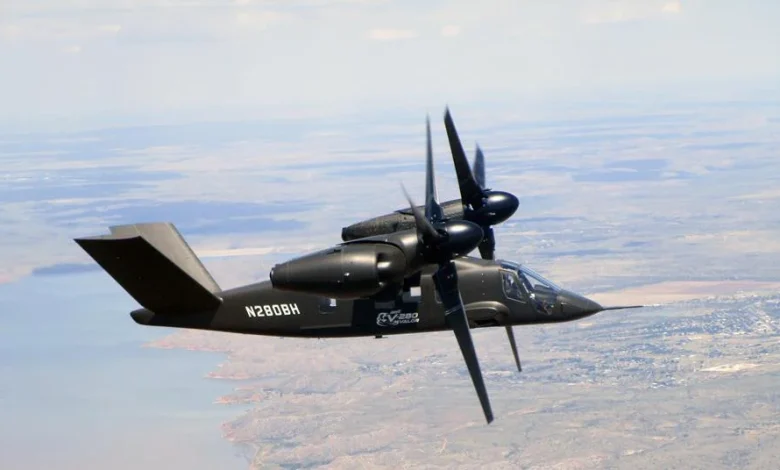
Engine maker Rolls-Royce has begun testing the new AE 1107F turboshaft that will power the US Army’s developmental Bell MV-75 tiltrotor.
Rolls-Royce says the new powerplant, which is derived from the long-serving AE 1107 family of rotorcraft engines, will feature on the prototype MV-75s currently being matured by Bell ahead of a full production decision.
“We continue working closely with the US Army and our industry partners to deliver an ultra-modern propulsion solution with proven, low-risk AE 1107F engines,” says Candince Bineyard, director of US business development for Rolls-Royce Defense.
Testing on the AE 1107F is taking place at the Rolls-Royce campus in Indianapolis, the company’s largest site in the USA.
The AE 1107F is 80% common with the 7,000shp (5,220kW) Rolls-Royce AE 1107C turboshaft, two of which power each Bell-Boeing V-22 Osprey.
More than 400 examples of that first-generation tiltrotor are in active service across the US Marine Corps, Navy and Air Force, along with a small Japanese fleet.
Bineyard describes the AE 1107 family as a “proven” and “low-risk” solution for tiltrotor propulsion, with over 1 million flight hours accumulated across the more than 1,000 AE 1107C engines delivered for the Osprey programme.
One major change between the MV-75 and V-22 is the elimination of the fully rotating engine nacelles featured on the Osprey for transitioning between vertical and horizontal flight.
On the newer tiltrotor design, the wing-mounted Rolls-Royce engines will remain static. Only the rotors and gearboxes will transition on the new tiltrotor – simplifying the design and improving reliability, according to Bell.
Material shortcomings with the highly complex rotating nacelles featured on the V-22 were recently cited in a US Navy safety review as a major contributor to serious safety incidents involving the Osprey in recent years.
A maiden sortie and delivery of the first example – one of eight MV-75 prototypes Bell is under contract to supply – are expected in 2027.
That delivery will be preceded by a critical design review in 2026, which will indicate whether the army’s current accelerated fielding plan for the MV-75 remains viable.
The US Army aims to field its first-ever tiltrotor to a frontline unit by 2030 at the latest.
The storied 101st Airborne Division, which now focuses on helicopter air assault operations, has been identified as the launch customer for the MV-75. An initial goal of equipping two assault/medium-lift aviation battalions with the tiltrotor has been established, representing around 48 aircraft.
Special mission pilots from the 160th Special Operations Aviation Regiment will also receive the MV-75, albeit several years later.
Bell plans to complete final assembly of the MV-75 in Amarillo, Texas – the same location where it currently produces Ospreys.
Existing US orders will keep the Osprey line running through the end of 2027, as production on the MV-75 is set to begin ramping up.