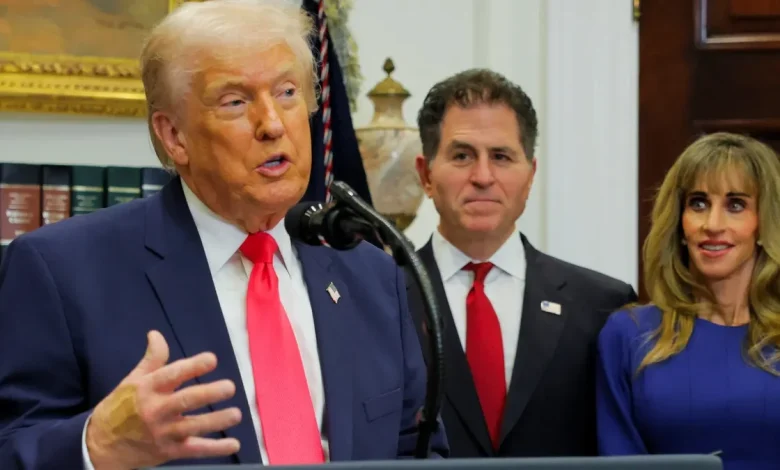
Scott Bessent unveils official Trump accounts website
The Treasury Department unveiled the Trump accounts website, with the IRS noting that parents will have to file the new Form 4547.
- Parents cannot depend on an automatic enrollment system to create a new Trump Account for their children.
- To qualify for the $1,000 pilot program contribution for a Trump Account, a child must be a U.S. citizen, have a valid Social Security number and be born in 2025, 2026, 2027 or 2028.
- If you live in the right zip code — and many people do for this program — families with newborns and young children could see $250 from tech billionaire Michael Dell and his wife Susan.
Was your baby born in 2025? Or are you expecting a little one with a due date in 2026? An extra $1,000 in savings could be on the way for your baby if you make the right moves.
The trick? Money for the much-talked-about new Trump Account won’t just suddenly appear. You’re going to need to fill out and file a new, extra tax form to get the cash.
Unlike many 401(k) plans, you cannot currently depend on an automatic enrollment system to create a new Trump Account for your child. And so, there is plenty of risk that some families who need the money the most could miss out on a powerful opportunity to build savings, and even some hope, for their children’s financial future.
To qualify for the $1,000 pilot program contribution for a Trump Account, a child must be a U.S. citizen, have a valid Social Security number and be born in 2025, 2026, 2027 or 2028.
More information is to be available Dec. 17, according to TrumpAccounts.gov. The Internal Revenue Service issued some guidance online on Dec. 2.
Let’s face it, everyone — and perhaps especially parents of newborns and toddlers — can get bogged down in everyday life. Changing diapers. Potty training. Rushing to work. Making sure to read to little ones even when you’re tired. Calming upset kids in the middle of the night. Starting all over again the next day.
No one gets warm and fuzzy feelings when tasked with figuring out another tax form, even if there’s a great deal of benefit in filling one out. But you’ve got to do it.
What’s the new tax form needed for a Trump Account?
It will be essential for parents and legal guardians to use IRS Form 4547 to elect to establish an initial Trump Account for the exclusive benefit of a child who is eligible. Contributions to Trump Accounts cannot be made before July 4, 2026.
William Elliott III, a professor of social work at the University of Michigan, said he’s concerned that many people, including lower-income families, will lose out because people in general don’t buy into programs with extra paperwork.
Based on research, he speculates that the sign-up rate could be in the 40% to 50% range of eligible participants if a great deal of effort is placed into promoting the program. The participation rate could be less, he said, if little is done to get the word out about the new Trump Accounts.
Ultimately, he favors an automatic enrollment system using Social Security numbers.
“If they don’t do automatic enrollment, you’d never get full participation or anything close to it,” Elliott said.
Elliott’s theory rings true with the growth we’ve seen with 401(k) plans over the years, as many companies now sign up new hires automatically and make them save. Employees may have to opt-out, instead of necessarily opting in.
How child savings accounts give families a lift
Elliott has been working some 20 years conducting research on child development accounts, also known as child savings accounts. He’s also a leading researcher on college savings accounts, college debt and wealth inequality.
And he supports the creation of the federal child development accounts.
In May 2024, Elliott testified before the Senate Finance Committee in Washington about the benefit of creating federal children’s savings accounts that can offer families more room to build wealth for the next generation.
Elliott told me in a phone interview that child development accounts, which are offered in several states and communities already, have proven to raise expectations among families that a child will go to college.
San Francisco’s Kindergarten to College Program, launched in 2011, was the “first universal, automatic Child Savings Account program in the country,” according to the program’s website.
The program, known as K2C, automatically opens a savings account seeded with $50 in public money for every child entering kindergarten in San Francisco’s public schools, “putting students on a path to college from their first day of school,” according to the website.
Some states that offer child development accounts include Maine, which offers a $500 seed grant for newborns. That program moved from an opt-in enrollment structure to automatic enrollment in 2014.
It’s not just the dollars deposited; it’s what that money represents. It’s a vote of confidence, if you will, that better things are ahead for a child.
Elliott calls it “forming tangible hopes.”
Such accounts can change a family’s expectations about whether college is attainable for a child, according to Elliott. He personally experienced bouts of being homeless as a child in Beaver Falls, Pennsylvania, a troubled steel mill town in the late 1970s.
The seed money in these accounts, he said, drives children to do better in school. And financial literacy is no longer an abstract concept when one can reference savings accounts.
“They don’t just give up,” he said.
Some studies indicate that these savings accounts can ease stress on families and potentially mitigate symptoms of maternal depression.
Others will be able to ‘stack wealth’ into these accounts
Ideally, others will pony up some cash for Trump Accounts.
“A thousand dollars in and of itself from the federal government is nice,” Elliott said. “It will be helpful but not enough.”
What can make these child development accounts even more attractive, he said, is when you can get companies, foundations, churches and communities to donate to Trump Accounts.
“You have the opportunity to really stack wealth in these accounts,” Elliott said.
Where families can get an extra $250 for children
If you live in the right ZIP code — and many people do according to the guidelines for this program — families with newborns and young children could see $250 from tech billionaire Michael Dell and his wife, Susan.
On Dec. 2, the White House announced that the Dells will make a $6.25 billion charitable commitment to add money to Trump Accounts. The first 25 million American children age 10 and under living in ZIP codes with median incomes below $150,000 will receive an additional $250 into their Trump Accounts.
The gift from the Dells will cover the large majority of ZIP codes in Michigan and across the United States. ZIP codes in more affluent communities are excluded.
An analysis done by Poverty Solutions at the University of Michigan indicated that there are only 12 ZIP codes in Michigan with a median income above $150,000 — most in Oakland County. None are in Detroit.
A spokesperson from the Dells said more specific information involving the ZIP code analysis for the program is expected to be available in the first quarter of 2026.
The gift from the Dells will prioritize children born in the years 2016 through 2024, which includes those children turning 10 in 2026, according to the spokesperson from the Dells.
Children who are 10 years old now and will turn 11 in 2026 could be put in a group for any remaining funds in the future. They would not be included in the initial priority group, according to the spokesperson.
A rare bipartisan approach to reach CEOs
While the child savings accounts are marketed as Trump Accounts, the concept has support from Democrats, too, even in a highly politicized universe.
In a rare bipartisan move, U.S. Sens. Cory Booker, D-New Jersey, and Ted Cruz, R-Texas, sent a letter in early December to the CEOs of Fortune 1000 companies urging them to support child investment accounts created by the One Big Beautiful Bill Act of 2025.
“We believe these accounts — much like 401(k)s — represent a transformative tool for building long-term financial security, expanding economic prosperity, and fundamentally restoring confidence in American capitalism,” according to the letter.
Back in 2018, Booker proposed American Opportunity Accounts, known as “Baby Bonds.”
What you’ll need to do in 2026 to get a Trump Account
We’ll learn more about the process in the weeks ahead. But it will be important that parents take time to file the proper paperwork at tax time or, according to the IRS, through an online tool or portal expected to be available in mid-2026.
Parents should plan to set up these tax-deferred savings accounts for eligible children as soon as possible next year, according to Mark Luscombe, principal analyst for Wolters Kluwer Tax & Accounting in Riverwoods, Illinois.
You can file use IRS Form 4547 when you file your 2025 tax return next year to enroll in the pilot program, according to the Internal Revenue Service’s latest guidelines. The final version of the form isn’t yet available but a draft was released in early December.
Much of the discussion is around newborns but a Trump Account can be set up for older children.
Tom O’Saben, enrolled agent and director of tax content and government relations for the National Association of Tax Professionals, explained that you can open a Trump account for children under 18 at the end of the year the election is made.
If the election is made in 2026, he said, the child must have been born after Dec. 31, 2008.
The promise of a $1,000 deposit from the federal government only applies to children born Jan. 1, 2025, through Dec. 31, 2028, after an account is opened.
But opening an account would benefit a toddler or young child who qualifies to receive the $250 from the Dells or other money that becomes available along the way.
“After the election is made, beginning in May 2026, Treasury or its agent will send information to the individual who made the election to activate the account through an authentication process and complete the opening of the initial Trump account,” according to details posted online by the White House.
Luscombe noted that it is likely that current IRA trustees, like banks and investment companies, will offer these accounts down the line.
Yet, the U.S. Treasury plays a significant role, Luscombe said, by approving the initial set-up of the account and making the one-time $1,000 contribution.
You do not get to pick and choose from a long range of options for how you’d like that money invested — no bets on bitcoin or gold; no stuffing the money into savings bonds or certificates of deposit.
By law, Trump Accounts may only be invested in broad U.S. equity index funds that track the overall U.S. stock market, such as the S&P 500 index. These funds must charge no more than 0.10% in annual fees, according to a White House explainer online.
At a later date, the White House noted, parents or guardians will be able to transfer the full balance of a Trump Account to their preferred brokerage firm through a trustee-to-trustee rollover.
Others will be able to contribute to these accounts, including parents or guardians, grandparents, family members, friends and employers.
Qualifying charitable organizations and government entities may make contributions for all children in a “qualified class,” such as all children born in a year or all children in a state.
The annual contribution limit is $5,000 total per child, with cost-of-living increases after 2027. Qualifying charitable organizations and government entities may make additional contributions that do not count toward the $5,000 limit.
The one-time contribution of $1,000 from the U.S. Treasury does not count against the annual $5,000 contribution limit set for parents, guardians and other contributors.
H. Luke Shaefer, director of Poverty Solutions at the University of Michigan, admires the principles behind the policy.
“It certainly is a benefit for families to get that money,” he said.
But parents who are savers need to review if they could be better off contributing their money to tax-advantaged 529 plans for higher education or other investment vehicles, instead of Trump Accounts, once they receive the initial $1,000 or money from other programs, said Shaefer, who is also a professor of public policy at the Gerald R. Ford School of Public Policy.
Shaefer also expressed concerns about the financial struggles that many low-income families face when it comes to necessities, like food.
“I’m much more worried about the changes to the SNAP program and what they might be for future benefits,” he said. And, he said, those concerns far outweigh any benefit of the effort to establish Trump Accounts for many families.
The $1,000 in seed money generally cannot be withdrawn from Trump Accounts, according to the IRS, before Jan. 1 of the calendar year in which the child turns 18 years old.
The money won’t cover everyday bills, but that doesn’t mean that the opportunity to build wealth over the long term should be ignored.
No doubt, we’ll learn more about how these accounts can work — and perhaps some potential glitches — along the way. Right now, though, parents should put IRS Form 4547 or a new, upcoming online tool for signing up for Trump Accounts on their to-do lists for 2026.
Contact personal finance columnist Susan Tompor: stompor@freepress.com. Follow her on X @tompor.