Watching Marty Supreme reminded me of a time I was invited to watch a trio of shorts written, filmed, and edited by a group of teenagers in a summer film workshop. The first short quickly set up its protagonist as a loser, shunned by his peers, until he proved them wrong, and ended the story surrounded by a group of girls (played by all the girls at film camp) looking at him adoringly. In each subsequent film, the exact thing happened. Only the guy playing the protagonist changed.
Asked how all the teams independently came up with the same exact plot, a girl from the camp replied cheerfully—”We just did what the boys wanted.”
This, in a nutshell, is Marty Supreme—directed by Josh Safdie, written by Safdie and Ronald Bronstein, starring Timothée Chalamet. It has the largest budget of any film in the history of its production studio, A24. It is a colossal team effort. (Those sets! Those costumes!) And it also absolutely vibrates with “this is what the boys want.”
Marty Supreme is, very self-consciously, A LOT. Your enjoyment of that A LOT will be directly predicated on your capacity to ride the rollercoaster of yet another film about one dude’s quest for the trappings of success—prizes, hotel room upgrades, and the complete absence of a nine-to-five job or any responsibility to any other person, ever.
It also often feels like a more Hollywood iteration of the Safdie brothers’ magnum opus Uncut Gems (2018), which they spent a decade making together before the two of them publicly parted professional ways in early 2024. Uncut Gems was a movie about a gambler who couldn’t stop gambling; Marty Supreme is about a scammer who can’t stop scamming.
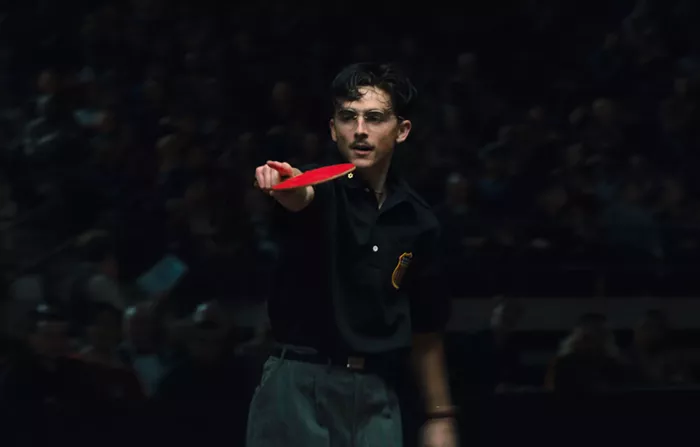
Our protagonist, Marty Mauser (Chalamet), is a dirtbag shoe salesman in early 1950s New York City who happens to be very good at ping-pong. The problem: He’s short on funds to make it to the world ping-pong championships overseas. Marty considers ping-pong to be a dignified sport, so he can’t lower himself to throw matches for cash, nor will he participate in goofy stunts like facing off against marine mammals.
The only dignified alternative? Crime.
The problem presented to the moviegoer: It’s frequently a challenge to tell what the crime even is.
“Josh needs more,” said sound editor Skip Lievsay, at a post-screening Q&A we attended. “More people. More animals. Dogs barking.” Attempts made at denying Safdie’s urge to smush as much audio chaos as possible into a scene, Lievsay continued, and “Safdie will say: ‘Can we just throw it in the back?’ Like the back is a nebulous place where you can put more sound.”
“Josh and I are both maximalists and proud of it,” added Daniel Lopatin (best known as electronic musician Oneohtrix Point Never) who composed the score for this and many of the Safdies’ previous films. In Uncut Gems, Lopatin curated a library of New Age tones that had been designed for meditation—specifically, to explode chakras. In Marty Supreme, Lopatin has made some cerebral compositions with sampled bouncy noises (in honor of it being a ping-pong movie).
Watching Chalamet flail around and chatter a mile a minute, I found myself missing nothing so much as the gem in Uncut Gems, and the clear goal of everyone who desired it. Those who have seen the film will recall that Lopatin scored an appearance of the central gem with the BWOM WOM WOM of a Sonic Steel Bass, an experimental instrument created by Constance Demby.
Safdie’s maximalist vision extends to a maximal cast. “It was a beast,” said casting agent Jennifer Venditti, who was also at the Q&A. Venditti is considered legendary for her ability to find people who have an almost hyperreal ordinariness about them. For this film, she cast so many iconic-looking early ’50s Lower East Side types that Marty Supreme looks like we’ve entered a Weegee/Ascher Fellig photograph. One detraction: In Weegee’s photos, every person is the star of their own life. In Marty Supreme, all those extras and bit players are shot like a backdrop for Chalamet. Even Mauser’s buddy in pool hustling, Wally (Tyler Okonma, better known as Tyler, the Creator), is a sidekick with no character arc of his own. As Venditti put it: “This movie was made for Timmy.”
Safdie got in on the ground floor of the Chalamet elevator, beginning talks with the actor about a future project before Chalamet’s big breakout film Call Me by Your Name (2017) even hit theaters. The script was written for Chalamet specifically. It ends up pretty far from the book that Marty Supreme is loosely based on, The Money Player: The Confessions of America’s Greatest Table Tennis Champion and Hustler, by ping-pong champion Marty Reisman.
Reisman, a nervous kid tormented with compulsive thoughts ever since he saw a person die on the street, found a weird solace in ping-pong—with the help of the universe of weirdos who temporarily hopped across barriers of class, race, and gender to play at the Broadway Table Tennis Courts.
Left to right: Tyler Okonma as Wally and Timothée Chalamet as Marty. Courtesy a24
The courts were run by a Black man from Barbados named Herwald Lawrence, described by one player as “a gorgeous hunk of man.” Lawrence would address any newcomer with a casual: “Care for a game, old top?” Then he’d play a quick one to assess their skills, and pair them off with someone who he felt would help them level up. Once Reisman found the place, he improved rapidly, in part because he almost couldn’t bear to do anything else.
Reisman writes that he regrets this and wishes he had stayed in school and tried to acquire other skills than ping-pong. Unlike film Marty, Reisman appears to have never encountered a ping-pong gig that he considered beneath him. He also, like many on the international ping pong circuit, did a brisk business as a smuggler.
One enduring similarity between the two: Like the film Marty, Reisman never stopped scamming. In 1977, a writer for Sports Illustrated describes being gently fleeced by Reisman as realizing “that for a few heady moments he had costarred in a hit sideshow that has been running off-Broadway for nearly 20 years.”
Marty Supreme loses a lot by so totally focused on its central character. The anecdotes and wacky scrapes of any one person will never be as interesting as that person in context. No man is an island, every man is a sideshow.
Marty Supreme opens in wide release on Wed Dec 25, 165 minutes, rated R.