GAMBLING
Annual lottery profits continue to hover above $1b
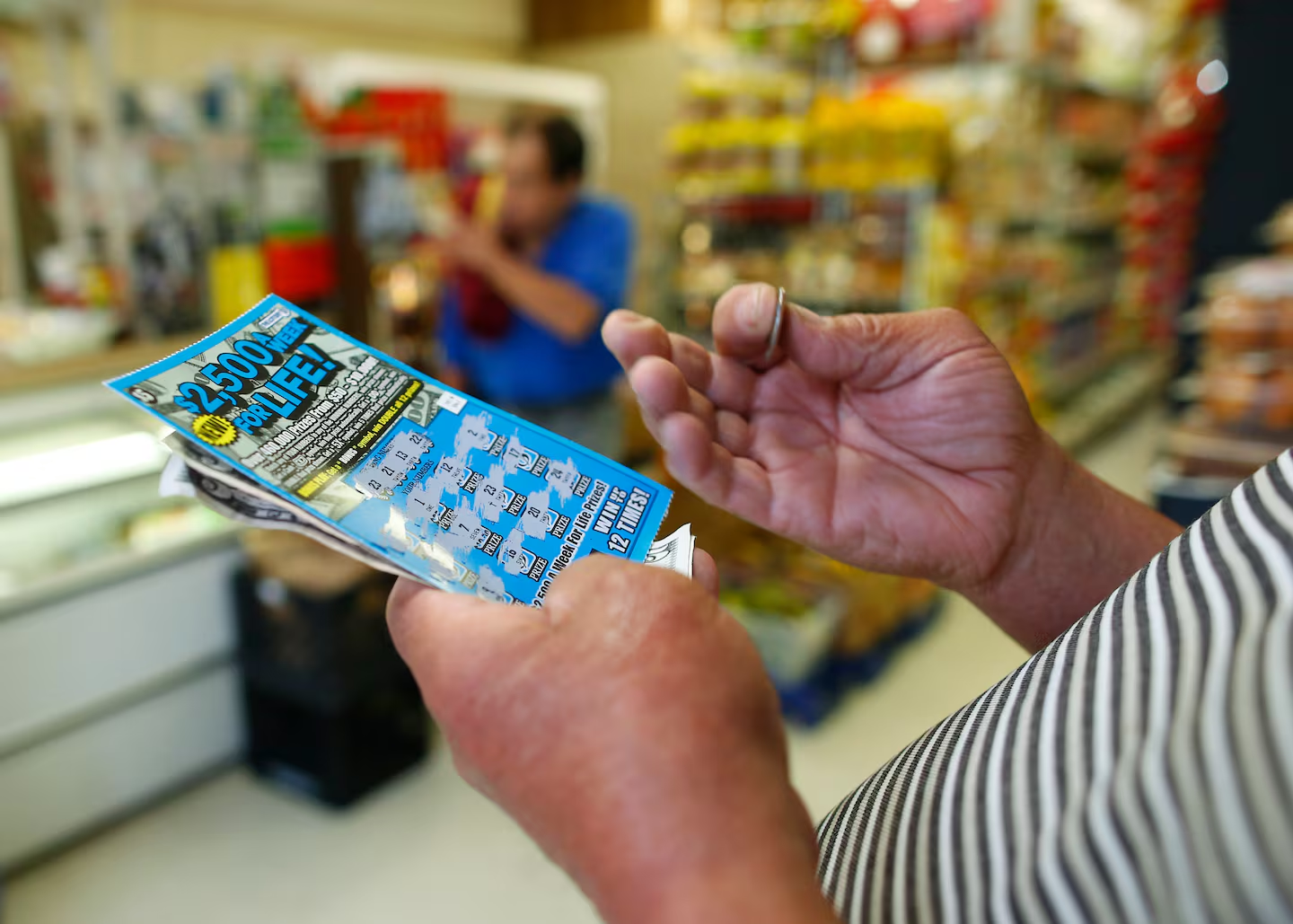
The Massachusetts Lottery is poised to generate more than $1 billion in net profits for the sixth consecutive fiscal year, and the launch of iLottery next summer will modestly add to an annual haul that is beginning to stagnate. In fiscal year 2025, the lottery brought in $5.96 billion in revenues, translating into $1.067 billion in net profits deployed to cities and towns, Treasurer Deb Goldberg told the state’s top budget writers Tuesday. Fiscal 2025 marked five straight years of net profits in excess of $1 billion. The lottery paid out more than $4.4 billion in prizes, including a “record-setting prize percentage payout” of 74 percent, Goldberg said. Goldberg expressed optimism that the lottery remains on track to turn a net profit of $1.050 billion for fiscal 2026, even as she pointed to “economic headwinds and continuing impacts from the competitive marketplace.” “Lotteries across the country are facing increasing unpredictability of multistate game sales driven by large jackpots,” Goldberg said at the fiscal 2027 revenue forecast hearing, according to remarks shared by her office. “In Fiscal Year 2025, sales of jackpot-driven games Powerball and Mega Millions experienced a combined $159 million decrease.” Goldberg added that fiscal 2026 is “off to a more promising start,” as she noted two Powerball jackpot runs that reached the $1 billion mark. Goldberg said the lottery is projected to have a net profit of $1.025 billion in fiscal 2027, which will mark the first year of revenue stemming from the start of iLottery. The funding stream will support child care initiatives. Online offerings are slated to go live in the summer of 2026, with iLottery estimated to bring in $70 million in net profit in the first year of operation. Net profit is expected to climb to $180 million for the third year of iLottery, $230 million in the fifth year, and nearly $360 million a decade in. With casinos and then sports wagering and now an iLottery, state officials are growing more reliant on gambling and gaming revenue to support public spending. — STATE HOUSE NEWS SERVICE
Get Starting Point
C-SUITE
Kraft Heinz replaces CEO ahead of split into public firms
A bottle of Heinz tomato ketchup next to a box of Kraft Mac & Cheese.Justin Sullivan/Getty
Kraft Heinz Co. named a new chief executive, with former Kellanova CEO Steve Cahillane set to take over from Carlos Abrams-Rivera on Jan. 1. Cahillane had been chief executive of Kellanova, the snack food company that was previously part of Kellogg, since 2017. Abrams-Rivera, who has been Kraft Heinz’s CEO for about two years, will serve as an adviser to the company until March 6, Kraft Heinz said in a statement. The move follows a difficult period for Kraft Heinz, which said in September that it would split into two separate entities. The company’s stock has dropped about 6 percent since then, bringing the year-to-date decline to about 20 percent. The shares rose 0.9 percent at 11:32 a.m. on Tuesday in New York trading. After the separation into two public firms, Cahillane will lead the company with brands such as Heinz ketchup, other condiments, and boxed meals that comprise its fastest-growing products with about $15 billion in annual sales. The split is expected to be completed in the second half of 2026, according to Kraft Heinz. Cahillane’s arrival fanned speculation about a potential deal for the company he will lead, largely because he oversaw the split of Kellogg. The business he subsequently led, Kellanova, was sold to Mars Inc. — BLOOMBERG NEWS
MEDIA
Lenard McKelvey, known professionally as Charlamagne tha God, in the iHeartRadio studio where he hosts “The Breakfast Club,” in New York in 2017.ANDREW WHITE/NYT
The number of video podcasts set to flood Netflix next year is growing. On Tuesday, the streaming giant announced a partnership with iHeartMedia, furthering its long-awaited push into podcasting — and yanking a few more shows off YouTube, its rival in the modern entertainment wars. Under the deal, at least 15 podcasts produced by iHeartMedia will publish their video episodes exclusively on Netflix beginning in early 2026, the companies said. They include “The Breakfast Club,” a popular syndicated weekday radio program co-hosted by Charlamagne tha God; “My Favorite Murder,” a long-running true crime podcast; and shows from comedians Chelsea Handler and Bobby Bones. The announcement follows a deal for 16 podcasts produced by Spotify Studios and the Ringer, the digital media company founded by Bill Simmons, to air their video episodes on Netflix, also in 2026. Audio versions of the iHeartMedia podcasts will still be available on other platforms. In a statement with Netflix, the radio conglomerate emphasized that audio was still important to its business, even as video podcasting has been on the rise. — NEW YORK TIMES
Retail sales unchanged in Oct. hurt in part by decline in auto sales
Customers shopped for Halloween candy at a Target store in Novato, Calif., on Oct. 30.Justin Sullivan/Getty
Sales at US retailers and restaurants were unchanged in October from September as consumers moderated their spending amid worries about higher prices and other economic uncertainties after splurging over the summer. But a big factor dragging down the figure was a 1.6 percent drop in sales at motor vehicles and auto parts dealerships, hurt by the expiration of federal government subsidies that sliced demand for battery-powered electric cars. Excluding that category, retail sales rose 0.4 percent, the Commerce Department said Tuesday in a report delayed more than a month because of the 43-day government shutdown. The overall flat spending in October was less than economists expected and followed a revised 0.1 percent increase in September, the agency said. Retail sales jumped 0.6 percent in July and August and 1 percent in June. The federal government is gradually catching up on economic reports that were postponed by the shutdown. — ASSOCIATED PRESS
Last US cents sold at auction for sum of $16.76m
Blank coins wait to be the last pennies pressed at the US Mint, in Philadelphia, on Nov. 12.Matt Slocum/Associated Press
To those who argue that the US penny had no value: Some coin collectors beg to differ. In fact, they doled out millions for the final pennies circulated in the United States before the government ended the cent’s production back in November. The US Mint sold 232 three-cent sets for a whopping sum of $16.76 million at an auction last Thursday hosted by Stack’s Bowers Galleries. The 232nd set — containing the last three pennies ever made — sold for $800,000. That bidder also got the three dies that struck those Lincoln cents. John Kraljevich, director of numismatic Americana at Stack’s Bowers, said it was the kind of auction where you don’t know the items’ market value until people make their bids. “I’ve been going to coin auctions for 40 years, and I can tell you, I’ve never seen anything like this, because there’s never been anything like this,” Kraljevich said. — ASSOCIATED PRESS
HOLIDAYS
Americans like artificial Christmas trees even though prices are up
Melissa Webb assembled an artificial Christmas tree at Lee Display’s warehouse in Fairfield, Calif., on Dec. 9.Terry Chea/Associated Press
On a recent December day, Mark Latino and a handful of his workers spun sheets of vinyl into tinsel for Christmas tree branches. Latino is the chief executive of Lee Display, a Fairfield, Calif.-based company that his great-grandfather founded in 1902. Then, it specialized in handmade velvet and silk flowers for hats. Now, it’s one of the only companies in the United States that still makes artificial Christmas trees, producing around 10,000 each year. Tariffs shone a twinkling light this year on fake Christmas trees — and the extent to which America depends on other countries for its plastic fir trees. Prices for fake trees rose 10 percent to 15 percent this year due to the new import taxes, according to the American Christmas Tree Association, a trade group. Tree sellers cut their orders and paid higher tariffs for the stock they brought in. Despite those issues, tree companies say they aren’t likely to shift large-scale production back to the United States after decades in Asia. Fake trees are labor-intensive and require holiday lights and other components the United States doesn’t make, said Chris Butler, chief executive of the National Tree Co., which sells more than 1 million artificial trees each year. Americans are also very price-sensitive when it comes to holiday décor, Butler said. About 80 percent of the US residents who put up a Christmas tree this year planned to use a fake one, according to the American Christmas Tree Association. That percentage has been unchanged for at least 15 years. — ASSOCIATED PRESS