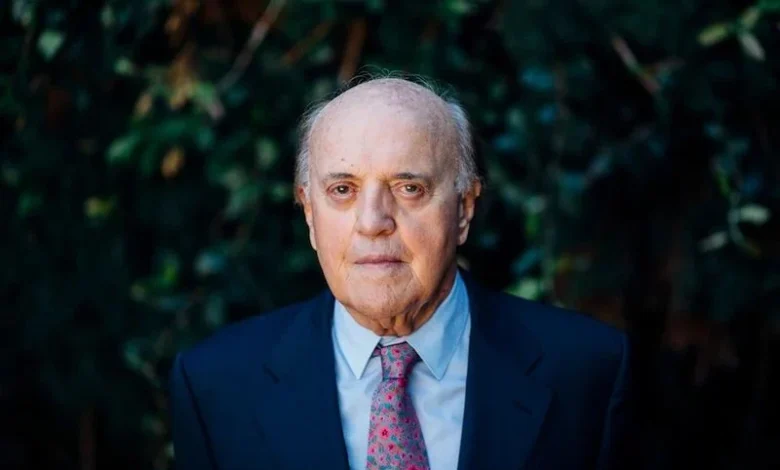
Peter Arnett, the Pulitzer Prize-winning reporter who spent decades dodging bullets and bombs to bring the world eyewitness accounts of war, from the rice paddies of Vietnam to the deserts of Iraq, has died. He was 91.
Arnett, who won the 1966 Pulitzer Prize for international reporting for his Vietnam War coverage for The Associated Press, died on Wednesday in Newport Beach, surrounded by friends and family, his son Andrew Arnett said. He had been suffering from prostate cancer.
“Peter Arnett was one of the greatest war correspondents of his generation – intrepid, fearless, and a beautiful writer and storyteller. His reporting in print and on camera will remain a legacy for aspiring journalists and historians for generations to come,” said Edith Lederer, a fellow AP war correspondent in Vietnam in 1972–73 and now AP’s chief correspondent at the United Nations.
As a wire-service correspondent, Arnett was known mainly to fellow journalists during his reporting stint in Vietnam from 1962 until the war’s end in 1975. He became a household name in 1991, however, after broadcasting live updates for CNN from Iraq during the first Gulf War.
While almost all Western reporters had fled Baghdad in the days before the US-led attack, Arnett stayed behind. As missiles rained down on the city, he delivered live accounts by cellphone from his hotel room. “There was an explosion right near me, you may have heard,” he said in a calm, New Zealand-accented voice moments after a missile strike boomed across the airwaves, air-raid sirens wailing in the background. “I think that took out the telecommunications centre. They are hitting the centre of the city.”
It was not the first time Arnett had come perilously close to danger. In January 1966, he joined a battalion of US soldiers pursuing North Vietnamese snipers and was standing next to the battalion commander when bullets tore through a map the officer was holding and into his chest, just inches from Arnett’s face. The commander collapsed at Arnett’s feet.
Arnett later wrote the fallen soldier’s obituary, vividly recounting how Lt Colonel George Eyster died “like a rifleman” on a dusty jungle path.
Arnett had arrived in Vietnam just a year after joining the AP as its Indonesia correspondent – a posting cut short after he reported that Indonesia’s economy was in shambles, prompting authorities to expel him. It was the first of several controversies in a career that would nonetheless become historic.
At the AP’s Saigon bureau, Arnett worked alongside celebrated journalists such as bureau chief Malcolm Browne and photo editor Horst Faas. He credited Browne with teaching him survival lessons that kept him alive in war zones for decades, including avoiding medics and radio operators and never turning to look after hearing incoming gunfire.
Arnett remained in Vietnam until Saigon fell in 1975. As the war drew to a close, AP headquarters ordered him to destroy bureau papers. Instead, he secretly shipped them to New York, believing they would one day be historically valuable. They are now preserved in the AP archives.
After leaving the AP in 1981, Arnett joined the newly formed CNN. In the years that followed, he conducted exclusive – and controversial – interviews with Saddam Hussein and Osama bin Laden. His 1995 memoir, Live From the Battlefield: From Vietnam to Baghdad, 35 Years in the World’s War Zones, chronicled his career.
Arnett resigned from CNN in 1999 after the network retracted an investigative report he narrated but did not prepare. In 2003, while covering the second Gulf War for NBC and National Geographic, he was fired for giving an interview to Iraqi state television in which he criticised US war strategy.
Despite predictions that his television career was over, Arnett was hired within a week by broadcasters in Taiwan, the United Arab Emirates and Belgium. In 2007, he began teaching journalism at Shantou University in China. After retiring in 2014, he and his wife, Nina Nguyen, settled in Southern California.
Born on November 13, 1934, in Riverton, New Zealand, Arnett discovered journalism at the Southland Times shortly after high school. After stints in Thailand and Laos, he joined the AP, beginning a lifetime of war reporting.
Arnett is survived by his wife and their children, Elsa and Andrew. “He was like a brother,” said retired AP photographer Nick Ut, a longtime friend. “His death will leave a big hole in my life.”