While technically the Next Gen ATP Finals belong to the 2025 season, many consider this the unofficial start of the 2026 season as most of these players already had their offseason and will largely just continue competing after the conclusion of this event.
It’s an event where the best young players are competing against each other, and the Day 1 day session. The evening session will also feature two matches, but for now, we’re going to dive into what happened in the day session, where we witnessed a minor upset that set the tone for what promises to be an exciting tournament.
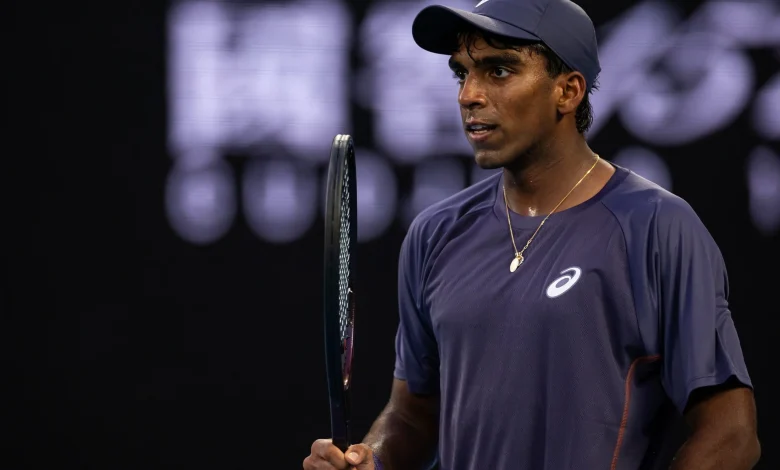
Nishesh Basavareddy defeats Dino Prizmic 4-2 4-3(7) 3-4(3) 4-2
As you can see, it’s a bit of a different format for the Next Gen Finals, but most tennis fans by now are quite familiar with it. Nishesh Basavareddy was largely considered the underdog in this one, but he pulled through with a composed performance that showcased his growing maturity on tour.
The reason why is rather simple: he’s the more experienced player when it comes to the ATP Tour, and he was able to use that, along with his previous experience with this event, having competed at it last year, to claim victory in this match.
It was a fascinating clash of styles. Prizmic dominated with his serve, unleashing 14 aces that demonstrated his thunderous first delivery. The Croatian was swinging freely, hunting winners on nearly every shot with a fearless aggression that makes highlight reels. Yet when rallies developed beyond those booming serves, it was Basavareddy who consistently came out on top with his steady, calculated approach.
Prizmic played to win, literally, going for winners in almost every rally. The shot-making was spectacular at times, but the execution wasn’t quite there. He finished with 40 winners that look impressive on paper compared to Basavareddy’s 19, but the story beneath those numbers tells a different tale.
What ultimately cost Prizmic the match was the 45 unforced errors compared to only 25 from Basavareddy. The turning point came in the second set tiebreak, which in many ways steered the match decisively into Basavareddy’s favor. The American seized that momentum and never looked back.
The open play statistics paint an even grimmer picture for Prizmic: if we remove the 14 aces from his winner total, he only had 26 winners from open play. With 45 unforced errors accompanying those 26 winners, it simply wasn’t good enough to secure the match against a player who won’t beat himself.
Basavareddy was content to let his opponent take risks while he absorbed pressure and waited for his moments. That patience and refusal to deviate from his game plan is what separates players who survive at this level from those who merely show flashes.
Overall, it was a compelling clash of styles with the hyper-aggressive approach of Prizmic working against him today. Sometimes in tennis, the player who hits fewer winners walks away with the victory. Today was one of those days.
Alexander Blockx defeats Justin Engel 3-4(7) 4-2 4-2 4-2
Somewhat expectedly, the more experienced and older Blockx was able to overcome late addition Justin Engel, who replaced Jakub Mensik less than a week ago. Still, Engel showed good promise for somebody who arrived on a relatively short turnaround, winning the opening set in a tight tiebreak that suggested this might be a longer battle than anticipated.
Engel has been that type of player throughout his young career. When he truly plays his best tennis, he can hang with some of the best players in the world—we saw glimpses of that in the first set. But once Blockx really figured out how Engel plays and began to exploit the patterns in his game, it wasn’t nearly as easy for the German anymore.
When it comes to Blockx, he showed exactly why he might be a dark horse candidate to make the final. He sits at 116th in the world and is right there on the cusp of making that big leap into the Top 100. He’s a cerebral player with a really precise serve, which he demonstrated beautifully here by hitting 17 aces without a single double fault.
That serving clinic allowed him to drop only eight points behind his first serve in the entire match. There was simply nothing Engel could do to counter him or create any kind of pressure when Blockx was serving. The Belgian was in complete control whenever he stepped up to the line.
Blockx also played his measured approach to perfection, finishing with 30 winners (17 from serve) and 21 unforced errors, a solid overall mark that reflects his tactical discipline. He was greatly helped by Engel, who at times tried to do too much, resulting in 29 unforced errors against only 14 winners.
Engel also didn’t get as much from his serve as he needed, managing only four aces. That deficit proved critical as he couldn’t create any pressure on Blockx’s serve and had to resort to being hyper-aggressive just to try and put any kind of pressure on him. It didn’t work outside the opening set because after that tiebreak loss, Blockx was able to figure out how to attack his opponent and patiently use his chances when they arrived.
Embed from Getty Images
The execution was clinical. How well Blockx performed tactically is best illustrated by one stark statistic: he converted all three break points he had in this match. Not some but all of them. That’s the mark of a player who understands the big moments and doesn’t let them slip away.
A deserved victory for the better and more experienced player, and one that announces Blockx as a genuine threat in this tournament. If he continues serving like this and executing with such precision in the crucial moments, we might be talking about him as more than just a dark horse candidate.
Main Photo Credit: Mike Frey-Imagn Images