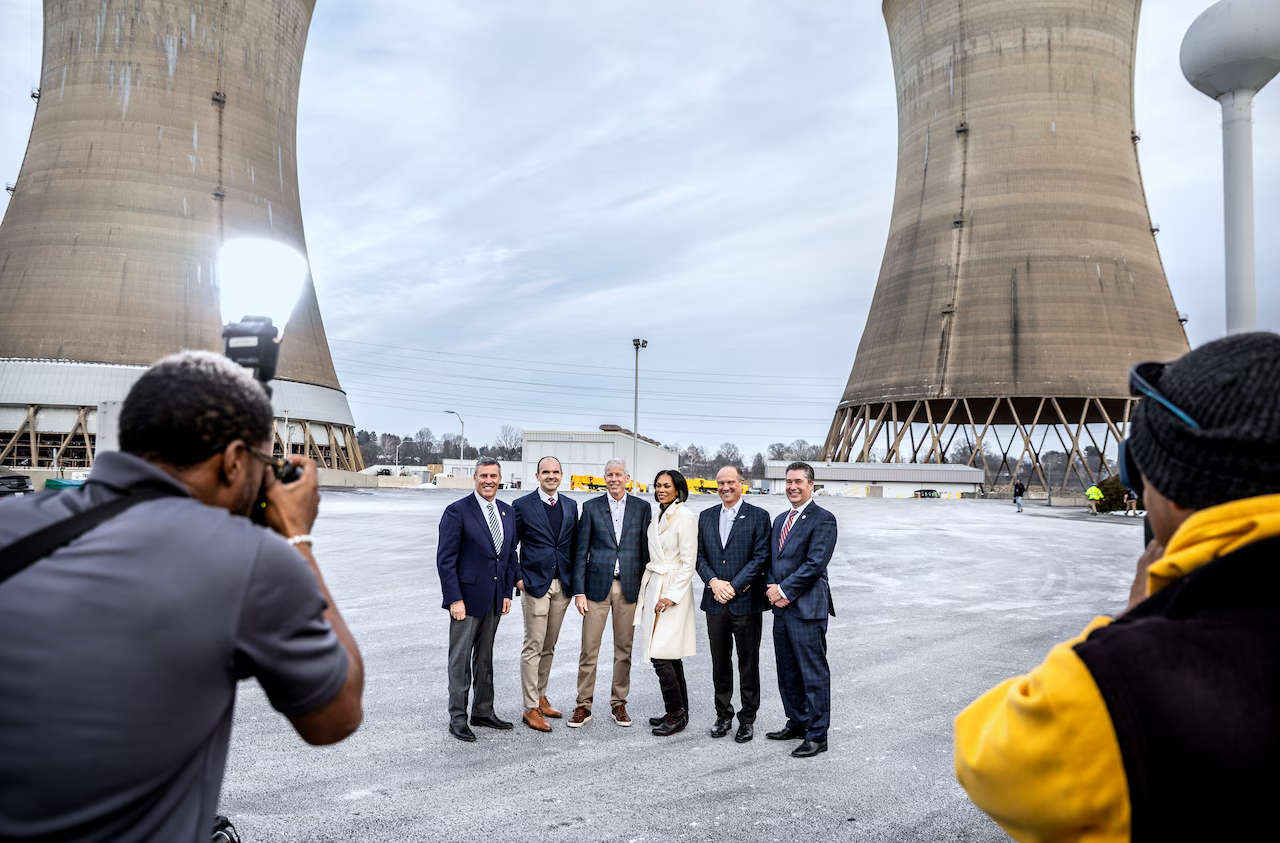
THREE MILE ISLAND — The Trump administration officially threw itself into the restart of the nuclear power station at Three Mile Island last month with a commitment of $1 billion in low-interest federal financing.
On Wednesday, it underlined that support with a site visit from U.S. Energy Secretary Chris Wright.
“I’m very proud of this plant starting again,” Wright said, after completing a semi-private tour of the now-renamed Crane Clean Energy Center.
“I’m very proud that we’re going to change direction [from the Biden administration’s energy policies]. We’re going to reduce the risks of blackouts, we’re going to drive down electricity prices, and we’re going to make an investment climate, an energy climate, so players like Microsoft and all the other large American technology companies can build all the data centers that they want and have reliable electricity to power them.”
In fact, the Biden administration was demonstrably supportive of the so-far limited interest in restarting recently shuttered nuclear plants.
But Donald Trump was returned to the White House in the 2024 election.
And that makes the plant at Three Mile Island a “poster child,” as Wright put it, of the Trump administration’s agenda.
Wright’s office announced Nov. 18 that it has closed on a $1 billion loan to help with Three Mile Island Unit One’s restart.
The funding is said to be the first loan closed through the Energy Dominance Financing Program, as it was rebranded in this summer’s “One Big Beautiful Bill.
It might also be the single-biggest chunk of funding for what Constellation Energy Generation initially priced out as a $1.6 billion restart project, and Wednesday’s affair was part celebration of this new federal-private partnership.
Constellation President and CEO Joseph Dominguez said Wednesday the company plans to plow the avoided interest cost right back into the restart to help the Crane plant meet an aggressive 2027 restart timeline.
He explained how that will help.
“Look, this is a people problem. This is getting skilled labor here — both contractors and our own team at Constellation — up and ready to rock and roll as fast as possible.
“Little bit of money greases the skids in terms of getting the craft that we need here, getting the training done on a more expedited basis,” Dominguez said.
“And in the case of the fuel for the reactor, what it allowed us to do is give more money to that fuel vendor so that they could move us forward in their production schedule so we could be the first entity to get the uranium needed to run this place.”
Dominguez again — in a sidebar of special importance to south central Pennsylvania because of the 1979 accident at the twin Unit Two reactor here — stressed the highest priority is safety.
“Everybody understands the significance because of what this place represents. It represents our darkest day in this business…
“Any compromise in safety ends my business. I understand that. First and foremost, it is of highest priority,” Dominguez said.
Constellation announced last year that it wants to reopen the old TMI Unit One reactor, which the company’s corporate forefathers shuttered in 2019 for economic reasons.
At that time, Exelon said its operational costs meant its power could no longer compete with cheap natural gas then flooding the energy market.
A technology-driven sea change in U.S. energy demand has changed that paradigm.
First, weather-related incidents such as the 2021 deep freeze in Texas raised concerns about the reliability of a power grid reliant mostly on fossil fuels and renewable energy sources.
That in turn caused Big Tech firms — many with prominent commitments to sustainability to meet — to question whether they could meet their needs through renewables “every hour of the day” and to show a new openness toward nuclear.
And secondly, there’s the growing demand from tech companies trying to harness artificial intelligence and stay ahead of the Information Age economy.
U.S. Energy Secretary Chris Wright speaks. A power purchase agreement with Microsoft paves the way for the launch of the Crane Clean Energy Center and the upcoming restart of Three Mile Island Unit 1 nuclear plant.
December 17, 2025.
Dan Gleiter | dgleiter@pennlive.comDan Gleiter | dgleiter@pennlive.com
In TMI Unit One’s case, Microsoft has agreed to buy the equivalent of all the wattage produced by the restarted nuclear plant for at least 20 years, guaranteeing Constellation’s plant can operate profitably over the long term.
Some commentators have recently expressed concern about an artificial intelligence-fueled bubble that may burst in a matter of years.
Addressing his side of the deal, Microsoft vice president for energy Bobby Hollis, also present Wednesday, said his firm’s commitment to the Crane plant is ironclad.
“I can’t speak for the whole sector because… there’s a lot [that] goes into it when you’re talking about data centers,” Hollis said.
“But for Microsoft, we plan to do exactly what we know we’re going to be requiring and needing. So when we contract with a company like Constellation, it’s because we know that they’ll deliver, and that we also require what they’re delivering to us.”
Pennsylvania was not early to this race, but there are indications that the Keystone State — because of strong energy resources, good water supplies and seasonal weather that can help with cooling needs — is becoming more of a player in the data center boom.
Amazon announced two major projects earlier this year.
Could Microsoft follow suit?
Hollis said the company is looking.
“There’s not anything signed yet, but we are continuing to look aggressively here. Because it definitely lines up with this great facility here.”
Constellation is aiming for a summer 2027 restart, though there are still several major hurdles to clear, including:
- Nuclear Regulatory Commission approvals of plans for reactor operations, projected environmental impacts, and security and emergency preparedness plans.
- A Susquehanna River Basin Commission review of new water usage requirements.
- Regional electrical grid monitor PJM’s confirmation that enough transmission capacity exists for the addition of 835 megawatts to the grid.
Dominguez said the latter point is probably the biggest single threat to a 2027 restart.
“We will have the staffing. We will have the licensed operators. We’ll have all the critical components here. We will be able to fuel this reactor in the second quarter of 2027, on schedule…
“PJM, the local grid operators, and the utilities, [have] got to act with the same level of urgency to do the interconnection. This should not be a gargantuan task. This plant was operating five years ago. We’re not talking about new wires.”