Gwyneth Paltrow on ‘very savvy’ Timothée Chalamet, why Josh Safdie is ‘one of the greats,’ and her return to acting in ‘Marty Supreme’

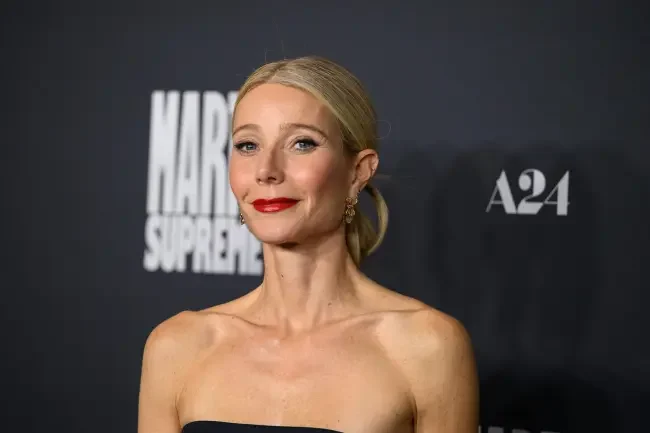
“Who knew that there could be a whole movie about ping pong?”
Indeed. And yet that’s what brought Oscar winner Gwyneth Paltrow back to acting, in a role tailored for her by director Josh Safdie. In his critically acclaimed new feature Marty Supreme, she stars opposite Timothée Chalamet as Kay Stone, a fading movie star who lets herself get seduced by Chalamet’s scheming Marty Mauser, just because he relishes yet another challenge. She rebuffs his attempts at first, but soon gets drawn in by his relentless pursuit, while she’s attempting a stage comeback of her own, financed by her wealthy husband (Kevin O’Leary).
Here, Paltrow reveals why to Gold Derby she couldn’t say no to the role, her experiences working with Chalamet and Safdie (“one of the greats”), and whether we’ll see her onscreen again anytime soon.
Gold Derby: How did this part come your way?
Gwyneth Paltrow: My managers texted me and said, “There’s a great director named Josh Safdie who’s very interested in having you playing this part in a movie. Will you have a meeting with him?” And I wrote back, “Maybe.” I’ve been sort of living under a rock focused on other things. I really had not kept up with the world of cinema and who was doing all the interesting things. So then I watched Uncut Gems, and my brother, who’s a filmmaker, was like, “You have got to meet this guy. You have to do it, whatever he’s asking you to do.” It turned out that it’s when my kids were going off to college and the nest was going to be empty. I just kind of thought, “All right, well, I’ll do it. I’ll move to New York and do it.” And I’m so glad I did. It was such a wonderful experience.
What was your reaction when you first read the role of Kay?
I was very intrigued by Kay and how broken she seemed, and very fascinated by the journey that I saw her going on in my mind’s eye. This very kind of shut down, disassociated person, being brought back to life by this young man in a certain sense, even though she knew that it wasn’t a real romance with feeling. She seemed to be getting so much out of it and making these kind of wild choices, risky choices, and thinking about the confinement of being a woman in the ‘50s and that lack of agency and what Marty seems to provide her. I just thought it was fascinating.
What were your conversations with Josh about finding your way into her?
He’s very detailed in his backstories about everything. He had fully fleshed out where she came from, how she had become a movie star, from being a showgirl, and why she turned away from it — she had lost her son in the war, and I think was going for some kind of stability. She wasn’t easy to figure out. It took a long time for me to piece together all of her motivations and all the beats of when she starts to transform. Josh was very helpful in that. He gave me lots of lots of visual references, which I found very helpful to have.
What kind of visual references? Did you do any research on your own?
He provided me with his bible of images for the movie in the world. There was this one seminal image of this woman in the Dior suit and hat from the ‘50s with this sort of vacancy. He kept referring back to this photograph and it was a bit wordless, but it made a lot of sense to me.
She is so complicated. There’s a version of her that doesn’t respond to Marty at all and lets him go. And so it’s very interesting that she lets him into her life.
I think she is at a pivotal moment in this loveless marriage. He comes in and I think she decides that she’s gonna [go for it]. It’s almost like they rub off on each other, you know? It’s like he wants her stardom. He wants her money. He wants all of the shine that comes with it. And she wants to reconnect with that very visceral part of herself that he represents, this ambition and hunger for to pursue your dream. So I think they both are looking for that in the other person.
How did it feel for you to be back on a set after so many years?
Weird. Really weird. Like a fish out of water. I was doing my costume fittings, and I was like, “Did I really say yes to doing this? What am I doing?” And then I got on set and luckily my first day of filming was a scene where I’m rehearsing a play. So that was very natural for me. My whole life has been in the theater watching my mother rehearse plays and playing backstage and then doing a million plays myself. And so the camera was far away, and I thought, “OK, I can get my bearings.” We were blocking the play in real time. And it was such a gentle way for me to be back. And I started to think, “OK, now, I know what I’m doing.”
But then you certainly had a few more challenging scenes, ahead especially with the breakdown when the reviews came out.
It was so sad because clearly, yes, it was about a bad review, but it was sort of a reckoning of sorrows, a culmination of all of these unhappy things that had happened to her and choices that she had made. And so I really wanted it to come from like the deepest place possible, not from the ego of a bad review, but from every cell in her body. I have my ways of getting there, that involves listening to music and I kind of go into this weird place, but it’s always very cathartic when you can do a scene like that.
What were some of the other more challenging scenes for you?
We did the [kissing] scene in Central Park, and it was freezing cold and paparazzi everywhere, and that makes me self-conscious, you know? So that was really challenging because I want to be able to be acting with the other person kind of in privacy in our own world. And all I kept thinking this is going to be stupid gossip in the papers. And I was right.
What was it like working with Timothée as a scene partner?
He’s a great scene partner. He’s very talented, very dedicated, takes the work very seriously. He’s very brave. He’s confident. It’s wonderful to see. He can sort of choose his own adventure now, and he’s not even 30 years old. I think he’ll make choices that always keep the big picture of where he’s going in mind. And I think he’s very savvy. And he’s a real marketer. So I think he’ll make really interesting choices.
Talk about the clothes and the costume and the makeup. How much does that help inform your performance and help you get into character?
It helps me immeasurably. I’m very visual and tactile so it helps me. I always joke that it’s like half the battle. Maybe not half, but pretty close. Especially when I’m playing somebody like her, where her sartorial expression is extremely well thought-out. This is her armor. She wants to tell the world who she is with what she’s wearing and her hair. So when you get a role like that, where the wardrobe is such a psychological expression of the person, it’s very, very helpful.
You’ve worked with some pretty incredible directors throughout your career. How does Josh compare?
He’s one of the greats. I’ve been very lucky in my career to work with the guys who are now all considered the best directors. And I think he belongs on that dais. He’s such an original and such a talent and so specific. And he’s just very inspiring and he’s always kind of throwing a wrench in things. So he’s different from other directors in that way. I was always sort of trying to track exactly what he was after, and I think he wanted things very alive.
Can you share an example of that?
He would direct you very different ways in all the different takes. When we were doing the scene in Central Park with getting busted by the policemen, he wanted it very free and wild — he’s looking for truth. I think he’s looking for the quirky truth of human beings and what really happens in moments and how people really behave. So he sort of goes all over to get it. I wouldn’t say it’s traditional filmmaking in that sense. It’s just such a different style. If I think of Wes Anderson and kind of making a tableau, and that’s just the opposite from Josh — he’s like throwing firecrackers in it all the time.
Looking back, do you have a favorite scene or moment that you’re proudest of?
I really love the scene where we’re on the phone and she has such a strange reaction to him. It’s sort of calm and she’s bored. And so she’s kind of entertaining this kid on the phone. But then he does say something that kind of really piques her interest about watching him play table tennis, which is ridiculous. I loved doing that scene.
This is a movie packed with scoundrels. Where does she rank among them in this cast of characters?
She’s a scoundrel, too. I think she is somebody who has lost her way, I think she’s somebody who, like all artists, in a sense, had this dream to achieve success in order to heal something within. I think she very much had that in her past. And I think she’s a person who is still in search of her own truth, and I think she makes some dubious choices. When they have that scene together in the dressing room when she says, basically, “I would have stolen from me too? Like, don’t try to bullsh-t a bullsh-tter.” So I think she’s aware of the truth of who she is. And she’s not faking it. But I think she’s also lost optimism and momentum.
Is she honest about her own acting ability?
I think she maybe was a great actor. I think she comes back and in a bit of haste and chooses a play that maybe isn’t totally supportive of her gifts. And it’s just a mess. And I think she’s devastated because she knows she’s good.
Should we feel bad for her at the end of the movie? Where should our sympathies lie?
I feel bad for her at the end of the movie. She has a rough time in this film, and I think she still has a lot more to bring to the world. I felt very sad for her after that last scene.
What did you learn from the experience of making this?
I learned never to say never.
Never say never to acting?
I thought, I don’t really think I have interest in this anymore. It turns out I do.
So are you ready to return to acting?
Whoa, whoa, whoa! I feel open to it. I’m not going to rush into anything.
What do you know now that you wish you’d done when you were starting out?
So many things. I don’t even know which one to pick. I wish that I had been warned about success. Everybody warns you and tries to prepare you for what happens when it’s going to go wrong, and you’re not going to make it. And what’s your backup plan? And how are you going to pay rent and, but nobody prepares you if you do make it, watch out for this and be strategic about the choices that you make. I wish that I had been a bit more prepared because I think I would have come to it with more clarity and the idea that I had some agency in my own career and the choices that I made.
Where do you keep your Oscar?
I keep it in my library. It used to be hidden behind a door, and now it’s kind of on the shelf. So I feel like I’m making progress there.