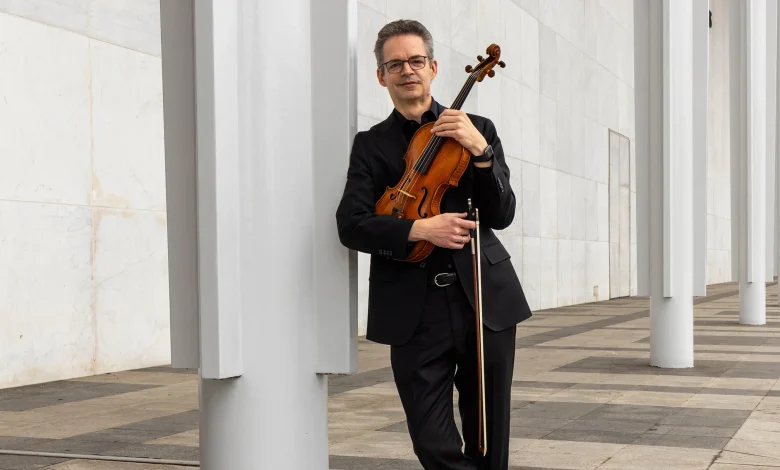
Photograph by Evy Mages.
On a blustery evening in October, Daniel Foster sat onstage at the Kennedy Center, viola in his lap. The National Symphony Orchestra was about to play “Don Juan,” an 1889 tone poem by Richard Strauss about a young libertine in search of the ideal woman. The opening is fiendishly tricky for viola. It has a fast and technical harmonic line that’s musically demanding and strange. Thirty years ago, in his audition to be the NSO’s principal violist, Foster played that excerpt. He won the job.
Foster loves playing Strauss. He loves the “liquid clarinet and the heroic French horn,” the way Strauss “pushes us into the whole range of the instrument,” asking for “the full gamut of moods and types of sound.” It’s fun, he says, to play music so demanding and sublime. Audiences love it, too. In his 30 years with the orchestra, Foster has performed “Don Juan” at various points, and always, the house was nearly full. But lately, crowds at the Kennedy Center have thinned. From the edge of the stage that night, he peered out past the grand, honeycombed chandelier, across the hall’s lush red upholstery, at deserted balconies and clusters of empty seats.
In February, just weeks after his inauguration, Donald Trump pledged to “make the Kennedy Center in Washington, D.C., GREAT AGAIN.” Citing drag shows and “anti-American propaganda,” he fired 18 Biden-appointed members of the board and made himself its chairman, vowing to rid the institution’s programming of anything woke. The fallout was intense. Performers canceled, employees resigned. Then the boycotts began. The Kennedy Center—home to the National Symphony Orchestra and Washington National Opera, host to an array of high-wattage touring acts—typically operates near capacity. By fall, attendance was down almost 40 percent.
As a citizen, Foster gets it: With Trump as the Kennedy Center’s chairman, he says, some people feel a “visceral thing” about seeing performances there. And he understands the desire to pin a failure on the administration, to send a message about partisan meddling in the arts. But it’s been disorienting to be caught in this maelstrom. As an orchestral violist, Foster spent his life in a notably apolitical job. Then suddenly, the chaos of federal politics infected his work
“Right now, I’m doubling down on what I’m there to do, which is what I love to do: I have music to prepare,” Foster said in November, amid a drumbeat of dire news stories about the Kennedy Center’s financial decline. “I try not to get overly big-picture about things, but the money that comes in from ticket sales is not just gravy.” It’s one of the NSO’s primary revenue streams. And if audiences continue to boycott the Kennedy Center, he’s concerned about collateral damage to the orchestra, in whose orbit he’s spent his whole life.
By the time Foster came into consciousness, he was already playing music. “I don’t have any recollection of choosing it,” he said; lessons were always just something he did. His first teacher was his father, William Foster, a violist who had joined the National Symphony in 1968. Back then, the orchestra played at Constitution Hall. Foster was a toddler in 1971 when the Kennedy Center opened and became the NSO’s permanent home.
Throughout his childhood, Foster was in and out of the Kennedy Center, intimately familiar with its cluttered green rooms and underground parking lot and labyrinthine hallways backstage. It felt special, the days when he was on vacation from school and came to his dad’s rehearsals. If he and his brother got restless, they’d sometimes roam the building’s vacant public spaces—the Hall of Nations, the Hall of States—“kind of mouths agape, looking around” at the scale and grandeur of it all.
He also heard great music. In 1977, the famed cellist Mstislav Rostropovich became the NSO’s music director. An exiled Soviet dissident, Rostropovich brought the orchestra global renown, expanding its size, recruiting preeminent guest artists, and plotting ambitious international tours. His 17-year tenure is legendary. The NSO’s musicians “live in a completely different world now than [before] Slava took the reins,” Foster’s dad told the Washington Post in 1992. The maestro was “able to instill some of [his] genius in the orchestra.”
In some ways, Foster’s path seems preordained. For generations, his family has teemed with musicians: his mother, his brother, various cousins, multiple grandparents. His maternal grandfather, a violinist, is best known for introducing the Suzuki method of music education to the United States. But Foster meant to do something else. He thought he’d study math or philosophy. He nursed a passion for sports. Then, in high school, he came to love the viola, with its throaty, earthbound sound. It suited him, sitting in the middle of the harmony, not carrying the melody but maneuvering beneath it, subtly changing a piece’s emotional mood.
“It’s kind of weird the way my life played out,” Foster recently reflected, “because I was bound and determined to set my own course, and I ended up doing the opposite.” He enrolled at Oberlin College, where his parents and grandparents had gone, and studied viola, just as his father had done. A year after graduating, he got a job in the NSO’s viola section, where he played alongside his dad. For a while, the Fosters shared a music stand onstage. They were colleagues for 25 years.
Daniel and dad William in Moscow in 1993. Photograph courtesy of Daniel Foster.
Foster’s first season with the orchestra was also Rostropovich’s last. And the very first concert he played with the NSO was not at the Kennedy Center but in Moscow’s Red Square, during the Russian constitutional crisis of 1993. The air was near freezing, but still, the concert was packed—100,000 people came, according to press coverage at the time. Among them was Boris Yeltsin, whose presidency was then under threat. The chill knocked instruments out of tune and some musicians wore fingerless gloves, but Foster recalls the concert being “completely epic.” When the orchestra played Tchaikovsky’s 1812 Overture, the bells of the Kremlin rang out.
During his 30-year career, Foster has had some transcendent moments: performing with Itzhak Perlman and Yo-Yo Ma, playing music he’s loved since he was a child. And just as his dad lived through that lustrous Rostropovich era, Foster feels that the NSO is currently approaching another peak. Music director Gianandrea Noseda, who came to Washington in 2017, has been “the perfect person at the perfect time to unleash all of our potential,” Foster said. Under Noseda, there’s been a different energy in the orchestra, its 96 members reaching for musicianship they couldn’t access before. It’s exciting to be part of. The musicians want the public to see. It’s a bitter irony, then, that just as the orchestra is reaching this artistic pinnacle, much of its audience has disappeared.
The opening theme of “Don Juan” is strident and ascending. As it echoed across the concert hall, Foster sat at the head of the violas, taut with focus, fingers flickering through a vertiginous cascade of notes. The piece meanders through moods: ominous timpani rolls, a sad morass of horns, tinkling bells, the deep bloom of harp. Toward the end, as Don Juan falls into despair, there’s a frenetic collapse, a blurred chromatic dive, the notes piling up into chaos, into stressful minor chords that precede the hero’s death. It’s a bleak ending, but still, the paltry audience cheered.
Musicians are trained to leave their problems backstage. Whatever afflicts them, they still have to focus and play. That’s what Foster’s been trying to do, but it’s tough with all the turbulence—the near-constant bad headlines about the Kennedy Center’s leadership, about a Senate investigation into its finances, about its sudden hosting of partisan events. There was the booing of JD Vance, then the alarming speculation about the opera’s potential relocation, then the multi-week disruption when FIFA took over the Kennedy Center to host its World Cup draw. Meanwhile, Foster has rehearsed and performed and tried not to worry, to varying degrees of success.
Lately, members of the orchestra have strategized about winning their audience back, but nobody quite knows what to do.
Looking out across the hall’s empty seats, he often thinks of the pandemic—of that dismal year when the orchestra couldn’t perform, when he’d drag himself into his music room to practice and think, What am I doing this for? Without people to listen, what’s the purpose? Now, after a concert, Foster can’t help but imagine those who didn’t attend—the orchestra’s regular audience, the subscribers who chose not to return—and wish that they’d come. “I think it would have value to them,” he said. “People want to feel stuff. It makes us feel alive.”
Lately, members of the orchestra have strategized about winning their audience back, but nobody quite knows what to do. For Foster, talking to people—friends, acquaintances, strangers from his neighborhood listserv—has brought a little relief. Even skeptics will listen when he speaks in more personal terms, when he explains what the boycotts have meant to him and his family: to his wife, who plays flute in the Washington National Opera, and his son, who’s a college violinist and might someday want to audition for the NSO.
Often, Foster finds himself puncturing misconceptions. One is that the administration is telling musicians what to play, which—aside from a new policy requiring the national anthem before each concert—he insists is not true. Another is that the orchestra and opera could simply play elsewhere until a new administration is sworn in. But the Kennedy Center, he explains, has the region’s only orchestra pit big enough for grand opera, and no other venue could accommodate the NSO’s busy concert schedule without canceling previously booked acts. Besides, the Kennedy Center provides the orchestra with significant financial support, so leaving would mean losing that money. And the NSO should play at the Kennedy Center, he believes: “We’ve been there for 54 years now. It’s our home.”
Hurting the Kennedy Center to send a political message could also mean the collapse of a 95-year-old orchestra and a 70-year-old opera.
For those who simply refuse to support an institution that’s publicly affiliated with Trump, Foster’s arguments won’t make much difference. Still, he wants them to understand that hurting the Kennedy Center to send a political message could also mean the collapse of a 95-year-old orchestra and a 70-year-old opera, a diminishment of the city’s arts programming, and ripple effects through the community—on the elementary schools for which the NSO regularly gives free concerts, for example, or the soup kitchen near the Kennedy Center where opera musicians sometimes play during meals. “It’s not appropriate for me to tell people what they should and shouldn’t do,” he said. But he does wonder, if all that were lost, whether it would have been worth it to the public in the end, whether the potential consequences of the boycott are proportionate to its aim of perhaps slightly embarrassing Trump.
In discussing the orchestra’s uncertain future, Foster recalled a time during the pandemic when he worried that audiences would never return—that they’d get used to hearing music on a stereo and forget the value of venturing out, in person, to watch. But people did come back, he said, because when musicians play for an audience, something ineffable happens. He described an outdoor performance at Wolf Trap—the first concert he played post-pandemic where nobody was required to mask, where he could see people’s expressions in the crowd. Renée Fleming was singing. And during a few measures of rest, Foster glanced out at the audience and saw them “outside of themselves,” having a collective experience of beauty. “You could see it on their faces—they were transported,” he said. “And that’s it, right there—we feed off of that. That’s what you wish for.” As he described it, he spent about a half a minute in silence, overcome.
This article appears in the January 2025 issue of Washingtonian.