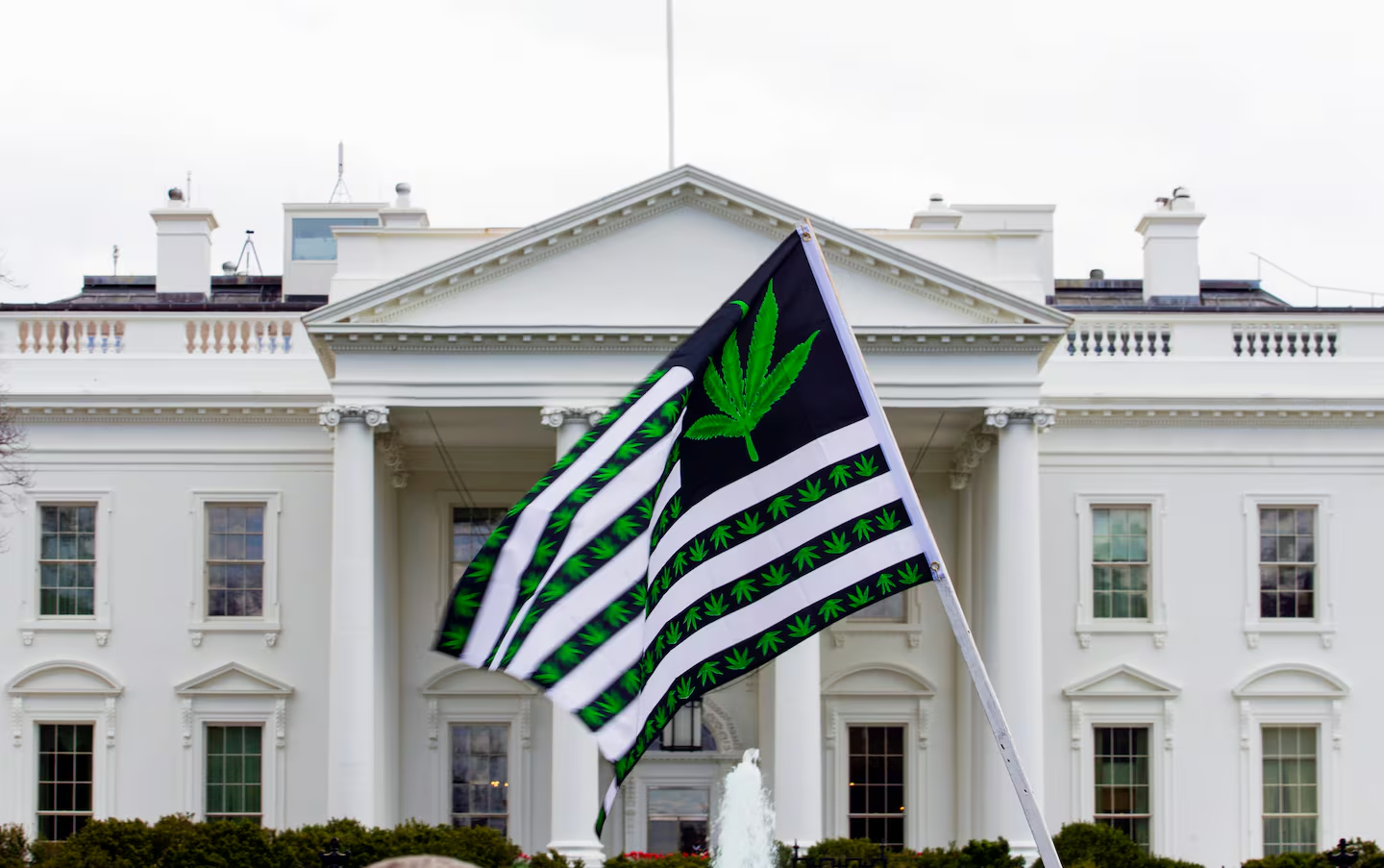
President Trump signed an executive order Thursday reclassifying marijuana as a Schedule III drug, a move that falls short of national legalization but still carries real political weight.
The change would loosen restrictions on research, ease banking and tax barriers, and formally downgrade marijuana from the federal government’s most restrictive category for the likes of heroin and cocaine.
The order will not legalize marijuana nationwide, but it’s a tacit acknowledgment that law and culture have drifted badly out of sync. States will still decide whether recreational use is permitted, and Congress would need to act to create a comprehensive federal framework. Future presidents, including Trump, will still have to decide whether to enforce the federal law in states where it is legal. But politics rarely waits for statutory perfection. On one of the most popular policy questions in the country, Trump is now positioned to claim momentum and credit on an issue that once seemed destined for Democrats.
Get Starting Point
Marijuana legalization was a Democratic issue, not just culturally, but politically. Recreational marijuana is legal in 25 states and the District of Columbia, according to state law trackers. Seventeen of those states are solidly Democratic, with three more — Arizona, Michigan, and Nevada — falling into the swing state category.
President Trump displays an executive order reclassifying marijuana as a less dangerous drug in the Oval Office of the White House on Thursday.Evan Vucci/Associated Press
Public opinion explains why Trump’s move is politically safe. Gallup polling has shown support for marijuana legalization hovering around 70 percent nationally for years. Pew Research finds nearly nine in 10 Americans believe marijuana should be legal in some form. (This in a time when Americans can hardly agree if the sky is blue.)
The polling is also clear that legalization draws majority support not just overall, but among independents and younger voters in particular, a group Democrats rely on but have struggled to energize in the last presidential election.
Trump grasped that reality without bothering with policy theory. In Florida last year, he said he would vote (as a Florida resident) for a marijuana legalization ballot measure that ultimately won 56 percent support, falling short only because state law requires a 60 percent threshold. He did so over the objections of Governor Ron DeSantis and much of the Florida Republican establishment. Trump didn’t study marijuana policy. He simply sided with the majority.
Democrats took a different approach. The Biden administration treated marijuana as a governance problem to be resolved carefully, not a political opening to be seized. In 2022, President Biden launched a formal review of marijuana’s classification, routing the issue through the Department of Health and Human Services, the Drug Enforcement Administration, and an interagency process meant to demonstrate that federal bureaucracy — battered during the Trump years — could still function deliberately and credibly.
That instinct fit Biden’s governing style. It also proved politically costly.
Marijuana’s trajectory closely mirrors another Democratic success story: gay marriage. Long before the Supreme Court settled the issue in 2015, marriage equality spread state by state, largely through Democratic legislatures and courts. Democrats moved early, absorbed backlash, and normalized a once-controversial position. By the time national consensus arrived, the political work was done.
Marijuana followed a similar path through the states — blue first, then purple — but Democrats never completed the federal transition. (Tellingly, 15 of the 25 states that have legalized marijuana were Democratic states that also legalized gay marriage prior to the US Supreme Court legalizing it nationwide.) Democrats may have assumed cultural acceptance would translate into political credit on its own. Instead, the issue drifted into a strange limbo: widely accepted, minimally contested, and politically unclaimed.
That vacuum matters now more than it might have a few years ago. Democrats are in clear need of visible wins. A recent Quinnipiac poll found just 18 percent of voters approve of the way Democrats in Congress are doing their job, an all-time low. Even among Democrats themselves, approval was tepid. In a political climate where voters are signaling frustration with performance rather than ideology, competence alone is not enough. Progress has to be seen.
Trump’s move on marijuana costs him little. Reclassification does not require Congress, does not force him to embrace full legalization, and does not bind the Republican Party to a broader policy agenda. But it allows him to signal independence from party orthodoxy and appeal to voters, particularly younger ones, who see marijuana not as a moral question but as a settled cultural fact.
To be sure, Trump has not fully convinced Republicans he is right on the issue. But while some look at a letter signed by 22 Republican Senators disagreeing with Trump’s executive order, others could point out that 31 Republican Senators (a majority) did not sign it.
National legalization could still come. Congress could act after the midterms, potentially in a bipartisan way. Democrats could still lead that effort, framing it around regulation, taxation, federalism, and criminal justice.
But it’s possible the symbolic moment has passed. At the very least Democrats now will have to share the credit.
James Pindell is a Globe political reporter who reports and analyzes American politics, especially in New England.