‘I’m treated better on OnlyFans than I was on Skins’: Megan Prescott on being sexualised as a teenager on TV

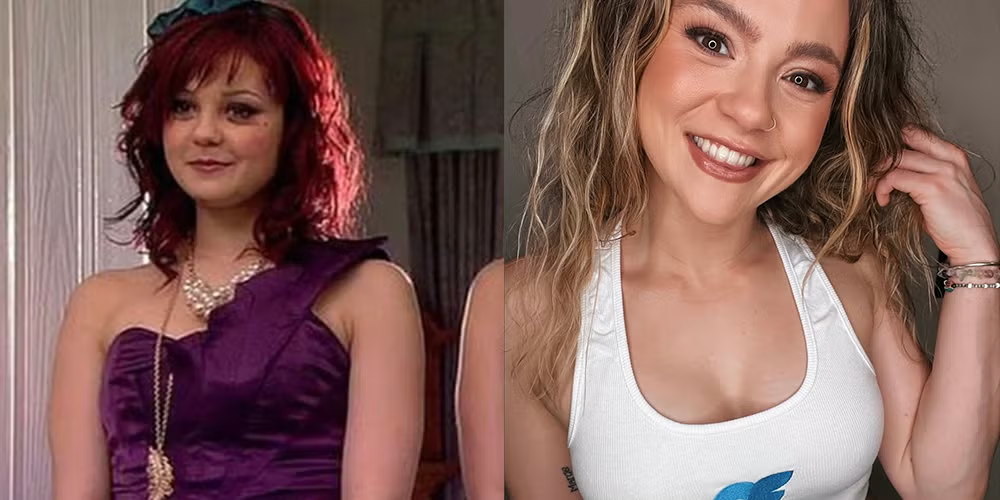
At 16-years-old Megan Prescott was starring in the cult, critically acclaimed drama Skins. By the age of 23, she was working as a stripper. But this isn’t (as so many might try to frame it) a ‘tragic’ story. Instead, embarking on a career in sex work was exactly what Prescott needed: she had been sexualised throughout her childhood, in ways that were vastly out of her control. Others profited, she didn’t.
When we sit down to chat, in early November, in Cosmopolitan UK’s Leicester Square offices, she sums her decision to enter into sex work (first stripping, followed by OnlyFans) perfectly: “I’m going to profit off of my body because you taught me it was profitable.” But her journey to get to where she is now, at aged 34, an actor, director, writer and sex worker has seen her have to witness, first-hand, how many different industries use women’s sexuality for their own gain. And that they get away with it, banking on how, as women, we have been conditioned to stick to the ‘good girl’ script and ‘not make a fuss’ by keeping our mouths firmly shut.
But Prescott is talking, and she’s talking loudly. “The hypocrisy has always stuck with me,” she says. “I was on TV, as a child, having sex scenes, on a show where a lot of people made a lot of money… if we are collectively OK with that (which whether or not we should be or not is a different story) then why can’t I, as a grown woman, take ownership of my image and sexuality back and earn three times as much?” Today, the woman who sits across from me is sweet, funny and fiercely intelligent, outspoken and firm in her beliefs. But, as she tells me, she wasn’t always this way. This is how she got here…
Everyone’s clicking on…
The early days
With pillar-box red hair and huge hoop earrings, Prescott hit our screens, in season three of Skins, playing “Katie f*cking Fitch”, opposite her sister, Kathryn, who played the shyer, more reserved of the twins, Emily. Skins, which first aired 18 years ago but is still just as relevant as it was back then, was praised for highlighting the reality of teenage life. Few of us come-of-age neatly, instead, as shown in Skins, we’re messy. We’re not only clumsily experimenting with drugs and sex but also new identities, as we try to figure out the people we want to become.
Tim P. Whitby//Getty Images
Megan with her Skins cast mates – twin Kathryn, Lily Loveless and Kaya Scodelario – in 2009
Through Katie Fitch, Skins showed (and still does, now airing on Netflix) that, from a young age, women are often taught that pleasing men, agreeing with them and doing exactly what they say (even when it makes us uncomfortable, even when we have to swallow down tears) is what makes us ‘liked’ and what gives us power. Katie embodies this, as she proudly proclaims: ‘I’ve never been without a boyfriend, since age seven.’
“I would have done anything to have been on that show,” reflects Prescott, of her time on Skins, from age 16 to 18. “I’m still 100% glad that I was but, it’s a weird one, I was so insecure.” One of Prescott’s first storylines involved her having an older, footballer boyfriend. “I had only ever had a boyfriend that was my age, and the [actor playing my boyfriend] was very nice but he was 30. This was before there were intimacy coordinators, before #MeToo. No one had the language of ‘Are you comfortable? Do you want to talk about how this scene is going to go?’”
Growing up under 00s diet culture, which was all-consuming, comprising of celebrities’ extra flesh being circled angrily in gossip magazines, and ‘nothing tastes as good as skinny feels’ being touted as genuine diet advice, Prescott had the added pressure of being on television and being a twin. “My sister was a lot skinnier than me, and they wanted us to look the same, so I had to lose some weight… then I was doing these scenes and I was so aware that everyone was looking at me. I did have a choice, I could have [said no] but I really wanted the job.”
The show was a launching pad for young British talent, with the likes of Nicholas Hoult and Dev Patel starring in the season before Prescott’s, and Kaya Scodelario and Jack O’Connell catapulting to fame in hers. But the very thing that made the show stand-out was held against Prescott when, at 18, she was auditioning for other roles. “I had a hard time getting any acting work because of being associated with the [sex and drugs of] the show. Then, a couple of years after it was ‘Well, you’ve not been in anything for a while.’ I didn’t go to uni, so I didn’t have a degree to fall back on. I was doing all of these part-time or zero contract jobs.”
Sex work was a huge sigh of relief because it was black-and-white
Customers of the Wetherspoons she worked in, for three years straight after the show, struggled to comprehend why she was there. “People would be like ‘What happened to you?’” she laughs. “People think we made a lot more money than we actually did in Skins. We worked it out by the hour once, and it was minimum wage. Of course, £400 a week to a 16-year-old I was like ‘I’m rich’ but when you look back… Our contacts also meant we don’t see any money from any streaming platforms.”
Financially, she was really struggling. A friend of hers introduced her to stripping, something Prescott was reluctant to do, because she was so afraid of being recognised and the stigma surrounding sex work impacting her future career. “But then, I realised, I Iiterally have nothing to lose.” She initially wore wigs to avoid being recognised, but entering into the industry and meeting other sex workers showed her that the way she was treat by men, on the strip club floor, was no different to a lot of the other jobs she had had. “Only there if someone talks to me badly, or doesn’t pay, I can get this enormous security guard over.
“Sex work was a huge sigh of relief because it was black-and-white. You want me to get naked for you and do a dance? OK, I know what to expect. In acting… it’s not like that. It’s very vague… I’m done blaming one industry for the problem, as these are worldwide, generic problems that permeate every industry. There’s no industry where you don’t get treated differently because you’re a woman, or because you’re working class or because of your immigration status but, in some industries, particularly, sex work and acting, it becomes more prominent.” We speak about how, post #MeToo, the impression that the ‘casting couch’ (when actors are offered parts in exchange for sleeping with someone) is gone. “People think ‘Oh it’s fixed’ but it’s not, it’s much more insidious, as it’s all grey areas, and there’s room for exploitation.”
As an example, she talks about an agent whose books she really wanted to get signed on who asked her to do “a bunch of self-tapes” which she did as she “desperately wanted to be represented by him.” Eventually, he told her that he couldn’t convince the team to take her on board but asked for her number. For the next five years he sent her creepy, and flirty messages. “There’s a power dynamic there that I don’t like, as if I say ‘fuck off you creep’ then he could blacklist me.” She also details the time she showed up on set, to discover that a cleavage shot had been added to her scene. “I said ‘I can give a clavicle’ but they weren’t getting cleavage. I now know the value of [my breasts]. But, in doing that, I was very aware that this production company aren’t going to hire me again.
Damian Robertson
“[In acting] you never have to say why you didn’t give someone a job. They just say ‘you’re not right for the part’ – you could have someone who didn’t like you because of your race, sexual orientation, or your gender, or because you didn’t seem like you would want to sleep with them.”
It was in 2020, when lockdown hit, that Prescott joined OnlyFans. She had left stripping a few years earlier and was back working part-time jobs to fuel her acting, writing and directing ambitions. “People always say ‘Did you give up on acting?’ But I had to, for a few years, because I couldn’t afford it. I can only afford everything I can do now, all of my creative projects, because of OnlyFans.”
For the majority of her acting career, Prescott had been pressured, by various agents and others within the industry, to keep quiet about who she really was. She was told not to speak about her ADHD and autism diagnoses, and certainly not to be open about her sex work, to make her more palatable to producers and casting agents. They, it turns out, were wrong. “The second I started speaking out about my stripping and my experiences, that’s when things started happening [for me].”
While stressing that she’s not part of the “1%” highest earners on OnlyFans, the financial freedom selling content offered her lifted a cloud of stress that had hovered over her for so long. “I could afford to keep a roof over my head, food in my fridge and then I had the mental space to be creative. Creative work relies on you being able to work for free, for so much of the time. I finally had the capacity to do that work.
“I’m incredibly grateful for Skins and nothing I have now, I would have if it wasn’t for [that show] but I wish that OnlyFans existed then, so I could get the money I should have made off of Skins then.”
However, the stigma that surrounds sex work looms large. “A lot of the comments I got when I started were ‘That’s so sad’, but if you really have a problem with sex work, you need to look at why people do it,” she says. “There are those who do it because they genuinely like it – it suits them – but other people do it because they think ‘I don’t have that many options and this is the most viable one at the moment.’ If you want people to stop doing sex work, sort out the benefits system, sort our student loans, sort out the class barrier… But it doesn’t surprise me that it’s so demonised as there’s two things we don’t like: Women having sexual freedom and financial freedom, and sex work can be a way to get both.”
It doesn’t surprise me that [sex work] is so demonised because it’s two things people don’t like: Women having sex and financial freedom.
For Prescott, the double-standards of when a woman ‘is’ and ‘isn’t’ allowed to sexualise her body for profit felt crystal clear. “When I went into OnlyFans my friend said to me ‘There are already men getting off to you, so wouldn’t you rather them get off to you as an adult than this sex scene you did when you were 17?’
“We see it with child stars all the time. They’re highly sexualised, but then as soon as they get to an age where they’re like ‘You’re right, this does make money but I am going to be the main benefactor of it’, people are like ‘Stop, I don’t like the idea of you selling sexuality.’ They want women to be sexual, but only under their control.”
Early in 2022, Prescott joined National Ugly Mugs’ Board Of Trustees after becoming passionate about sex work activism. “I’ve always done privileged forms of sex work, and noticed that people would say ‘Oh well, I guess that’s OK’ [as I don’t touch anyone]. I want to challenge why one form is viewed differently from another. I could also see the way people treated working class sex workers, compared to those who are middle class.”
A lot of the activism she does with Ugly Mugs, and through her own work, is to try to change public perception of sex work and to challenge ideas surrounding what is needed to ensure sex workers safety. “A lot of big organisations, that get government funding, when Ugly Mugs don’t, only support people to get out of sex work. [That’s] saying you only deserve to be safe if you’re leaving. When what we say is that people deserve to be safe, full stop.”
As part of her mission to make people recognise and change their views around sex workers, Prescott wrote and starred in the one-woman show Really Good Exposure, which had an award-winning run in the Edinburgh Fringe before selling out Soho Theatre earlier this year. It follows ‘Molly’, a child star, now considering getting into porn (sound familiar?) “I wanted to pimp out the whole ‘Remember the girl from Skins? Look what she’s doing now’ thing, and then from that, show how we love talking about sex, we love sex but we don’t want to support sex work.”
Steve Ullathorne
She does believe that the public’s view on sex work is slowly changing – and it is. A new poll commissioned by Amnesty UK has shown that more than half of UK adults agree that consensual adult sex work should be fully decriminalised, which is what Prescott wants to see happen. “It’s proven to be the only way to improve safety conditions, reduce trafficking and coercion. Sex work shouldn’t be dangerous but it is because of the stigma and shame.”
When we meet, Prescott has also just returned from Iceland, where, along with other Ugly Mugs representatives, got to put forward objections towards the Nordic Model which they practice there and which criminalises those buying sex. It is currently being proposed by the Scottish government. Research has shown that the model does not prevent exploitation but instead makes life more difficult and dangerous for sex workers, by pushing the industry underground. “People are forcing their own morality views into law, and it’s always ‘what about the children?’ but, if it was really about the children, then [more money] would be funnelled into education to give them the tools to navigate the world and teach them porn literacy and consent. But instead, as always, all the blame is piled upon sex workers.”
When we chat, Prescott tells me how she’s had to break free from the conditioning that she has to present herself one way to be considered loveable. “I got so fed up of men. I was spoken to better by my subscribers on OnlyFans than I was by men on dating apps, so I made my dating profile with photos of me with no make-up, at protests, all the things where I’d think ‘Oh no, they won’t like that.’ A couple of weeks after that, when I was actively trying to put men off, that I met this open-minded, amazing man.”
As she sets off to leave, excited by the kittens she’s going to adopt over the weekend, it’s clear that Prescott is no longer that shy, awkward teenager who exhausted herself pretending to be someone she’s not. The red hair has gone, blonde and brunette highlights in its place. She’s a woman who truly knows her worth.
“I am valuable,” she says. “I see that now.”
Catriona Innes is Commissioning Director at Cosmopolitan, you can follow her on Substack and on Instagram.
Related Stories
Catriona Innes is Cosmopolitan UK’s multiple award-winning Commissioning Editor, who has won BSME awards both for her longform investigative journalism as well as for leading the Cosmopolitan features department. Alongside commissioning and editing the features section, both online and in print, Catriona regularly writes her own hard-hitting investigations spending months researching some of the most pressing issues affecting young women today.
She has spent time undercover with specialist police forces, domestic abuse social workers and even Playboy Bunnies to create articles that take readers to the heart of the story. Catriona is also a published author, poet and volunteers with a number of organisations that directly help the homeless community of London. She’s often found challenging her weak ankles in towering heels through the streets of Soho. Follow her on Instagram and Twitter.