Sign up to Simon Calder’s free travel email for expert advice and money-saving discounts
Get Simon Calder’s Travel email
Get Simon Calder’s Travel email
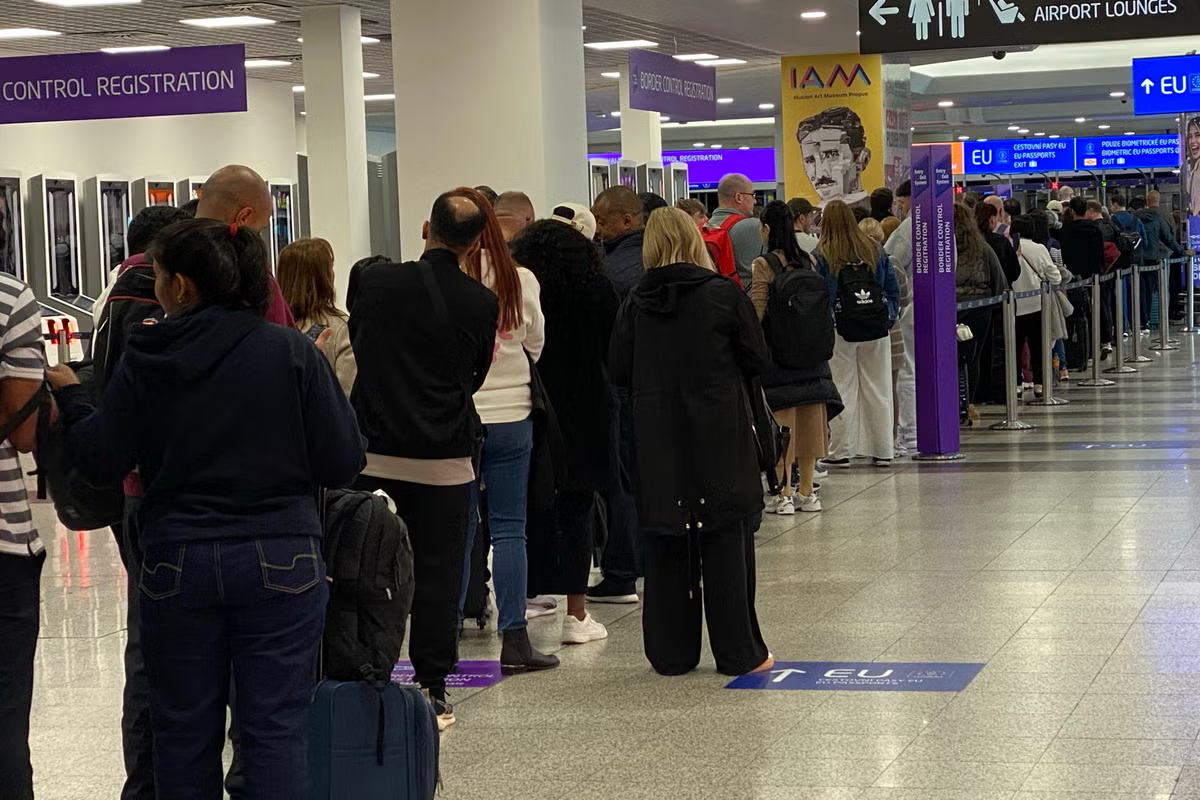
The EU digital border scheme is causing three-hour waits at passport control as officials struggle with a 70 per cent increase in the time taken for border checks, says the group representing Europe’s airports.
Airports Council International (ACI) in Brussels is calling for an urgent review of the entry-exit system (EES), which began to be rolled out across Europe in October. During the six-month introduction, third-country nationals such as British travellers continue to have their passports examined and stamped by frontier staff. But in addition, the EES requires fingerprints to be registered and a facial biometric to be taken. Many airports have had kiosks installed for that purpose.
At present, only one in 10 travellers is required to undergo digital registration. By 9 January 2026, the percentage is due to be raised to 35 per cent.
But Olivier Jankovec, director general of ACI in Europe, warned: “Significant discomfort is already being inflicted upon travellers, and airport operations impacted with the current threshold for registering third-country nationals set at only 10 per cent.
Simon Calder at entry-exit system kiosk at London St Pancras International (Elanor Forster)
Read more: I am travelling to the EU. What has changed with the entry-exit system?
“Unless all the operational issues we are raising today are fully resolved within the coming weeks, increasing this registration threshold to 35 per cent as of 9 January – as required by the EES implementation calendar – will inevitably result in much more severe congestion and systemic disruption for airports and airlines.
“This will possibly involve serious safety hazards.”
“The EES cannot be about mayhem for travellers and chaos at our airports.”
ACI says the worst impact is being felt at airports in France, Germany, Greece, Iceland, Italy, Portugal and Spain.
The group is calling for the rollout schedule – which is due to be complete by 9 April 2026 – to be moderated. It highlights several operational issues with the deployment of the EES:
- “Regular EES outages undermining the predictability, regularity and resilience of border operations”
- “Persistent EES configuration problems, including the partial deployment or unavailability of self-service kiosks used by travellers for registration and biometric data capture”
- “Unavailability of an effective pre-registration app”
- “Insufficient deployment of border guards at airports, which reflects acute staff shortages”
The Independent has asked the European Commission for comment.
Dr Nick Brown, a data scientist who has studied the entry-exit system in detail, told The Independent: “The airports have had a long time to prepare, including an extra year (compared to the initial launch) during which they already had the kiosks and could have run any number of simulations and tests with volunteers.”
Read more: Simon Calder tests the new EU entry-exit system – the questions, scans and fingerprints demanded at the border