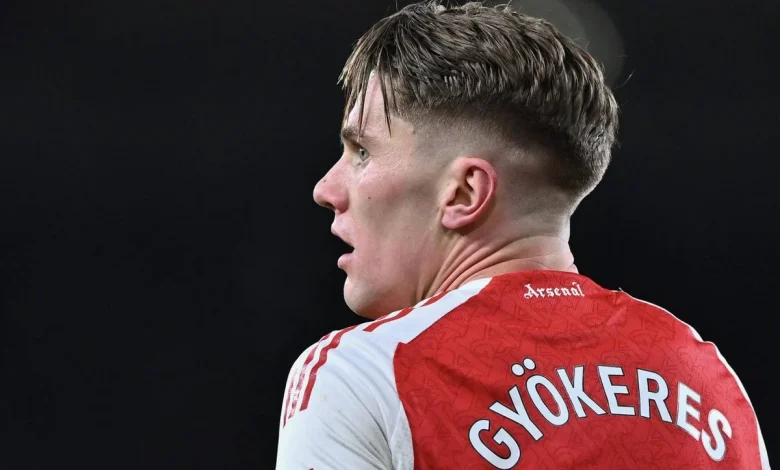
Arsenal finally ended their search for a top centre-forward when they completed the signing of Viktor Gyokeres from Sporting CP in July.
Injuries to attacking players last season left manager Mikel Arteta with few options and led to midfielder Mikel Merino being used as a makeshift striker. Gyokeres was brought in for €63.5million (£55.7m/$74.8m at current rates) to give greater variety to Arsenal’s game up front, after the 27-year-old Sweden international scored 79 goals in 83 games for the Lisbon club.
Once again, however, Arsenal have been blighted by medical-related absences, with Kai Havertz and Gabriel Jesus missing the early part of it with knee issues. This has again limited what Arteta has been able to do in forward areas and meant Gyokeres has taken on a greater workload than he may have expected. He has also just returned from a muscular injury picked up last month.
The Swede has scored six times in 19 appearances for the north London club, but there have been questions over how well he fits into Arteta’s system.
Our Arsenal writers, James McNicholas, Art de Roche, Nnamdi Onyeagwara and Dan Sheldon, discuss Gyokeres’ impact so far.
What were the expectations when Gyokeres signed? And has he lived up to them?
James McNicholas: The simplest way to answer this is to look at how Arsenal framed his arrival.
“Viktor is an exceptional talent and has consistently demonstrated he has the qualities and winning mentality required of a top-level centre-forward,” said their sporting director Andrea Berta. “His physicality, intelligence and work ethic make him a perfect fit for our vision.
“We are confident Viktor will have a major impact on the pitch and become an important figure in our dressing room.”
The fans were equally excited. Gyokeres’ No 14 shirt broke sales records for a new Arsenal signing.
Expectations were high — and so far, Gyokeres has not met them. The “major impact” Berta anticipated has not yet come. It is, however, still early in his Arsenal career. Gyokeres is just a matter of months into a five-year contract, so it’s reasonable to believe things will improve.
Art de Roche: There was an acceptance that Gyokeres was not a technical player whose play would connect the team. Scoring frequently was the main expectation from him. Yet the shortage of goals means he has so far fallen short of what many hoped to see.
In recent seasons, Arsenal have craved someone up front to apply the finishing touch to attacks. Gyokeres’ goal against Nottingham Forest in September was exactly what they were missing — he made up the ground well to be in the right place at the right time.
The timing of his movement into the six-yard box has been disappointing since, though.
Against Wolves and previously Aston Villa this month (see the GIF below), he did not start his runs until Bukayo Saka and Declan Rice had already played their passes intended for him.
A similar incident occurred against West Ham United in October, where he seemed to engage in an unnecessary tussle with the defender marking him, and it happened again in the Wolves match last Saturday:
So far, Gyokeres has come across as a square peg in a round hole.
Either he makes a run that isn’t found, or a pass is made that he did not anticipate. It’s rare he gets involved in general play, so games feel like an uphill battle for him at times.
Dan Sheldon: Not yet. He was their marquee signing. Many thought he was the missing jigsaw piece in Arsenal’s quest to win their first Premier League title in more than two decades.
Even though it was extremely unlikely Gyokeres could match his incredible scoring rate at Sporting, you would be forgiven for wanting a better return than six goals in 19 games.
Yet there is still plenty of time to find his scoring touch and go on the type of run that many Arsenal fans envisioned when they flocked out in record numbers back in the summer to buy replicas of his shirt.
How did the absence of Havertz and Jesus affect his start at Arsenal?
Nnamdi Onyeagwara: Due to the ongoing injuries to Havertz and Jesus, instead of becoming one of several attacking options, Gyokeres has often been Arsenal’s only one.
He started 10 consecutive Premier League games, in addition to three in the Champions League and another four for Sweden. There was no bedding-in period. He then sustained a muscle injury on November 1, just as it looked like he was starting to understand his role.
McNicholas: On the one hand, the absences of Havertz and Jesus placed a physical and psychological burden on Gyokeres. Arteta had planned on starting Havertz in big games against the likes of Liverpool and Manchester City, and has been robbed of that option (Havertz hasn’t played since the season’s opening weekend in August).
On the other, this also gave Gyokeres a free run at the position, and an opportunity to cement himself in the team. He hasn’t yet produced a compelling case as to why he should be the de facto starting No 9.
Sheldon: Given the fee Arsenal paid, Gyokeres didn’t join to sit on the bench. But a fit Havertz and Jesus at the beginning of the season would likely have helped wean him into life as a Premier League forward instead of needing to carry the striker department on his back for those first few months.
Gabriel Jesus, right, has impressed since his return (Ben Stansall/AFP via Getty Images)
What does he offer Arsenal? Are they playing to his strengths?
Onyeagwara: He has a different style to Havertz and Jesus (and to Merino). Gyokeres can stretch defences, engage in physical battles and take away some of the defensive attention that Saka regularly attracts — all of which he has done. But Arsenal are continuing to adapt to Gyokeres as he is simultaneously learning what he has to do to thrive in this team.
Arsenal could look to play quicker to get the ball to him to fully benefit from Gyokeres’ speed and directness. However, he also needs to understand what Arteta demands from his centre-forward. A significant improvement in his technical ability and link-up play is needed, as well as his positioning in attack.
De Roche: There have been matches when he has been an option in-behind defences.
His early-season goals against Leeds United and Forest came from Arsenal breaking quickly, which has not happened as much recently. So there is an element of his team-mates needing to get on the same wavelength, and vice versa.
Gyokeres and Martin Odegaard also seemed to be building chemistry before they suffered respective knee and muscle injuries in October and November. Arsenal’s captain was roaming more across the width of the pitch, threading passes into the left channel for the Swede to chase.
That connection hasn’t been reignited yet, as they have not started a league game together since coming back from those enforced layoffs, which makes Gyokeres’ stylistic differences more noticeable.
Gyokeres and Odegaard built up a good relationship before injury hit both players (Harry Murphy/Getty Images)
McNicholas: Arteta demands a lot from his centre-forwards. A striker in his system needs to be more than just a goalscorer. The Arsenal manager seems to insist they also hold up the ball, provide an outlet, bring others into play and lead the press. Gyokeres is not the first to struggle to meet all those requirements.
Aside from his excellent finishing, what Gyokeres primarily offered Sporting was a fearsome physicality that enabled him to overpower most defenders he faced. His time at Arsenal has been interrupted by injury, but the early evidence would suggest he is not going to find Premier League back lines as easy to push around as those in Portugal.
With that physical advantage reduced, his movement becomes all the more important. There is no doubt Gyokeres keeps defenders busy with his relentless running — but perhaps he will have to add a little more sophistication to his movement patterns.
That onus lies not just with the player: it is also a coaching issue. It is the job of Arteta and his assistants to get the best from Arsenal’s new striker.
How do you think his season will pan out from here?
Onyeagwara: He’ll get better. With the return of Jesus, Arteta now has other options, so Gyokeres should have the opportunity to be in and out of the team, build on relationships with other players and not have as much pressure on him to be Arsenal’s main source of goals.
It could also give him the luxury of coming on later in games against tired defences, as Arsenal would have surely intended when he joined. His strength, running power, and tendency to shoot whenever he gets the chance against a back four that has been dealing with Havertz or Jesus for 60 minutes should see Gyokeres’ goal tally increase.
De Roche: It’s hard to say. The need to rationalise his performances with each passing game is not a good sign, though.
Against Wolves on Saturday, there was a moment in the second half when the ball was played forward to him and the Emirates Stadium crowd was vocally willing him to hold it up. When there is a desperation for something positive to cling to, that should tell you where most people’s heads are.
These teething problems could be just that. After joining in June 2023, Havertz struggled in his first six months before becoming a vital part of the club’s recent title charges. Arsenal will certainly hope these are teething issues, but there has to be an improvement in how Gyokeres imposes himself. If he does not score, he needs to be a presence, and that has not been the case often enough so far.
Arteta will have to decide how best to use Gyokeres now other forward options are returning to fitness (Vince Mignott/MB Media/Getty Images)
McNicholas: Speaking about his attacking options in early December, Arteta said: “The whole summer I was thinking, ‘If we bring in a No 9, what is going to happen with Gabi (Jesus) and Kai? I have a lot of nines. I like them so much. What are we going to do? How are we going to handle it?’
“So far, we haven’t had a problem, because they’ve been injured. So, live the present, live the moment and deal with the situation when it comes.”
That situation — that degree of choice — is imminent. Jesus is now back playing, Havertz is supposedly close to a return and Merino has thrust his own name into contention. Gyokeres is about to face major competition for that sole striking spot in the team.
Put simply: his performances will have to improve, or he is likely to find his playing time reduced.
Sheldon: As James notes, if Gyokeres’ struggles continue, Arteta will be left with little choice but to drop him in favour of Jesus, Havertz or Merino — especially as the title race between themselves and Manchester City heats up.
Once Havertz is back from injury and up to speed, and if Gyokeres is still languishing in front of goal, then taking him out of the starting XI wouldn’t be the worst thing. Although it will do little good to his confidence, it is arguably no more damaging than his confidence being sapped away by a string of below-par performances.
Who should start up front at Everton on Saturday?
Onyeagwara: Gyokeres. This is not a game that suits Jesus, just as the deep block of Wolves last weekend was not a game that suited Gyokeres.
It is a tough Premier League away match against physical centre-backs (likely to be James Tarkowski and Michael Keane). He can be an outlet should Arsenal decide to go long and pin Everton’s defence back, and be a threat in the opposition’s box, as he was in his 45-minute performance against Burnley on November 1 (his best performance in an Arsenal shirt so far).
De Roche: Gyokeres is still expected to start. Jesus looked sharp in his two cameo appearances last week, but is still being eased back in after nearly a year out with an anterior cruciate ligament (ACL) injury. With Gyokeres now back fit, getting dropped for Merino would feel harsh.
If he does not impress though, with or without a goal, debate over whether he deserves to start at the turn of the year would be justified.
McNicholas: My gut feeling is this game will be too soon (and perhaps too physical) for Jesus.
Arteta will be tempted to go with Merino, who was remarkably consistent in an unfamiliar position until a disappointing first half against Aston Villa saw him withdrawn at the interval.
I believe he will stick with Gyokeres. Goalscorers thrive on confidence, and dropping him at this point could be quite damaging.
Sheldon: Gyokeres, for sure. It doesn’t make sense for Arteta to overload Jesus too soon and risk another injury. Jesus has shown in the past two matches he is a viable option off the bench, and there is no need to change that.
However, if Gyokeres’ struggles continue, the debate over his place in Arsenal’s starting XI will only intensify.