Listen to this article
Estimated 4 minutes
The audio version of this article is generated by AI-based technology. Mispronunciations can occur. We are working with our partners to continually review and improve the results.
U.S. President Donald Trump signed an executive order Thursday that could reclassify marijuana as a less dangerous drug and open new avenues for medical research — a major shift in federal drug policy that inches closer to what many states have done.
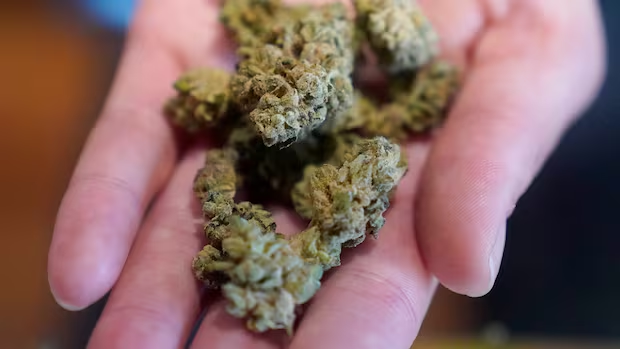
The switch would move marijuana away from its current classification as a Schedule I drug, alongside heroin and LSD.
Cannabis would instead be a Schedule III substance, like ketamine and some anabolic steroids. Reclassification by the Drug Enforcement Administration would not make it legal for recreational use by adults nationwide, but it could change how the drug is regulated and reduce a hefty tax burden on the cannabis industry.
The Republican president said he had received a deluge of phone calls supporting the move and its potential to help patients. “We have people begging for me to do this. People that are in great pain,” he said.
Similarly, the Justice Department under Trump’s Democratic predecessor, Joe Biden, proposed reclassifying marijuana to a Schedule III substance.
Trump displays an executive order to reclassify marijuana as a less dangerous drug, signed on Thursday in the Oval Office at the White House. (Evan Vucci/The Associated Press)
Unlike Biden, Trump did not have open encouragement from across his party for the move.
Some Republicans have spoken out in opposition to any changes and urged Trump to maintain current standards. Such a switch typically requires an arduous process, including a public comment period that has drawn tens of thousands of reactions from across the U.S.
The DEA was still in the review process when Trump took office in January. Trump’s order is expected to speed the process along, though it was not immediately clear how long it might take.
Many states have legalized the recreational use of marijuana for adults or allow it for medical purposes. But U.S. laws have remained stricter, potentially leaving people subject to federal prosecution.
Polling from Gallup shows more Americans back a less restrictive approach: support for marijuana legalization has grown significantly, from just 36 per cent support in 2005 to 68 per cent last year.
Trump’s order also calls for expanded research and access to CBD, a legal and increasingly popular hemp-derived product whose benefits are debated by experts.
A new Medicare program would allow older adults to access legal hemp-derived CBD at no cost, if recommended by a doctor, said Dr. Mehmet Oz, who heads the Centres for Medicare and Medicaid Services.
WATCH | This province has made the most tax money since Canada legalized pot:
Alberta collects the most cannabis tax revenue per capita
Federal statistics show how much cannabis tax revenue has been collected from the provinces since legalization. Alberta has brought in just over $1 billion and it leads in cannabis revenue collected per capita. Travis McEwan looks at why that might be the case.
Some Republicans resist reclassification
More than 20 Republican senators, several of them staunch Trump allies, signed a letter this year urging the president to keep marijuana a Schedule I drug.
Led by North Carolina Sen. Ted Budd, the group argued that marijuana continues to be dangerous and that a shift would “undermine your strong efforts to Make America Great Again.”
They argued, too, that marijuana negatively affects users’ physical and mental health, as well as road and workplace safety.
“The only winners from rescheduling will be bad actors such as Communist China, while Americans will be left paying the bill,” the letter said, referring to China’s place in the cannabis market.
As for decriminalizing marijuana, Trump has not previously committed to such a move, though he had considered reclassifying it for much of his second term. He once said as a candidate that it should remain a state-by-state issue.
As president, he has made his crusade against other drugs, especially fentanyl, a feature of his second term, ordering U.S. military attacks on Venezuelan and other boats the administration insists are ferrying drugs.
He signed another executive order declaring fentanyl a weapon of mass destruction.
WATCH | Why more people are showing up at hospitals after consuming cannabis drinks:
How does high-potency cannabis affect our brains?
The Saskatchewan Health Authority says the number of people showing up at emergency rooms across the province with cannabis-induced psychosis grew to 165 last year from 116 in 2022.