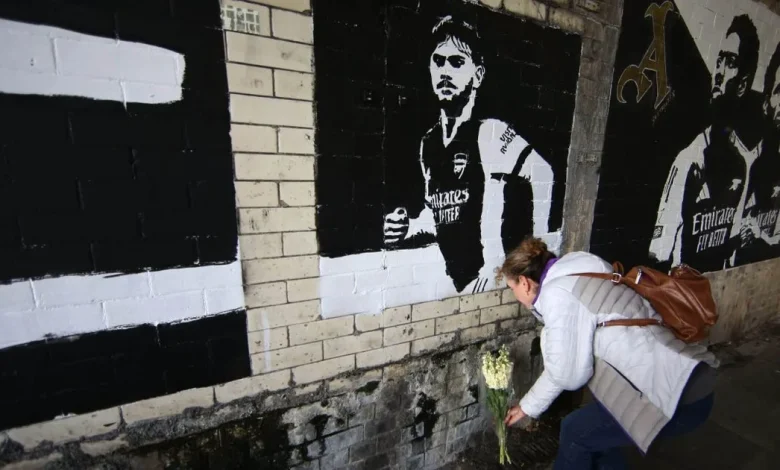
On one side of the pitch where Billy Vigar used to go hunting goals, they have placed a protective matting over the perimeter fence. Strictly speaking, the matting doesn’t need to be there, but the staff at Chichester City thought it important to set the right example anyway. “Heaven has gained a striker,” is written across the pads.
Seventy miles away, there have also been changes at the Maurice Rebak Stadium, home of Wingate & Finchley, since the terrible events that led to a 21-year-old footballer losing his life playing the sport he loved.
In the weeks after Vigar’s death, Wingate & Finchley set about demolishing the concrete perimeter wall where the player was left with catastrophic brain injuries on a Saturday afternoon in north London in late September.
More clubs will inevitably follow suit now the English Football Association (FA) is midway through a nationwide review that, in theory, should prevent a similar tragedy happening again.
The banner erected in Billy Vigar’s honour at Chichester (Darin Killpartrick)
At Wingate & Finchley, however, they felt compelled to tear down the walls before returning to their ground on November 17. “Everything we are doing now has Billy at the forefront of our thoughts,” says Joe Sharpe, the club’s vice-chairman.
“There’s no such thing for us now as ‘normality’ or ‘business as normal’. It’s a relief to be back at our stadium again, but there’s a deeper layer to the football club now because of what’s happened, what people have seen, what the players have gone through, and, more importantly, because we can’t ever imagine what Billy’s parents have been through.”
On Tuesday, Keith and Camilla Vigar were present at the Coroner’s Court for North London for the first hearing to establish what exactly happened to their son.
A full inquest will take place in the new year. After that, it is likely the coroner, Andrew Walker, will announce his views and recommendations about the presence of concrete walls surrounding football pitches and whether, perhaps, the relevant authorities ought to have done more in the past to eliminate the dangers.
Vigar, a former Arsenal academy player, is not the first footballer to lose his life this way. In 2015, 30-year-old Ben Hiscox died after colliding with a clubhouse wall during an amateur game at Stoke Gifford, near Bristol. Others have been seriously injured, ranging from fractured skulls to bleeds on the brain, while one player at Walsall in League Two suffered concussions and seizures in an incident last season.
Billy Vigar playing for Arsenal’s under-18s in 2022 (David Price/Arsenal FC via Getty Images)
The Athletic has spent the past few months speaking to the relevant people and has established, unreported until now, that the English Football League (EFL) is holding its own safety review.
Will every pitch-side wall come down? That would be a massive undertaking when it is estimated there are around 250 grounds, at all levels of the pyramid, that are in this position. But there is clear support for the idea from, among others, Vigar’s former club.
“I understand that some clubs will struggle because it’s a financial thing to pull down the walls and put up something else,” says Darin Killpartrick, Chichester’s first-team coach. “However, there is no price on safety.
“Everybody is coming back with, ‘But this is money, it will cost this…’. Until it actually happens to them, they won’t know what it feels like. And I can guarantee that if it did happen to them with people they know, or if it was their son or daughter, they would be saying something very different.
“If you put yourselves in Keith and Camilla’s shoes, you would be campaigning for every wall to come down in the country. People have no idea what that poor family is going through and what this club is going through. The walls need to come down.”
In the week after Vigar’s death, a petition was launched to ban concrete walls around football pitches. That petition, calling for the introduction of ‘Vigar’s Law’, now stands at more than 17,000 names.
The FA announced it would conduct an immediate safety review of the National League system — the fifth to 12th tiers of men’s football in England — and subsequently sent a letter, seen by The Athletic, to every club at that level.
Every ground, it stated, would be assessed by a “third party with appropriate expertise in health and safety”. After that, there would be recommendations about what work, if any, was required.
“We will work with clubs to support them in implementing recommendations,” the letter, sent on October 3 by James Earl, head of the FA’s National League system, explained. “The FA, working with the Premier League and other football stakeholders, recognise the financial implications … (we) are considering the best way forward in parallel with this work.”
Change is coming, in other words, even if there are still a number of unanswered questions about why the FA did not take this form of action after the death of Hiscox and several other near-tragedies.
“Hopefully we will be able to look back one day and see that we have made the FA open their eyes,” says Clive Hiscox, father of Ben. “I’m sure, in time, we will have safer grounds and hopefully we’ll be able to go to football matches knowing our sons and daughters will be coming home without anybody else having to suffer what my family has, and what poor Billy’s parents are now going through.”
The FA has commissioned a Liverpool-based safety expert, Chris Purcell, to undertake the site visits in his role as a senior consultant for Marsh, an international firm headquartered in New York and which specialises in risk management.
Two months on, however, it has become clear that the costs are going to be significant. Early estimates are that it will work out at £20,000 to £90,000 for every club that needs to replace perimeter walls. Clubs from 57 leagues, incorporating 84 divisions, form part of the review. The final bill, in other words, could run into tens of millions of pounds.
“I suspect that’s why there has been no change for all these years,” says Danny Clarke, another footballer whose story should compel the football authorities to do whatever is necessary. “It’s going to need something big from the FA because it will be impossible for the clubs to fund.”
Clarke suffered a fractured skull and bleeding to the brain when he collided with the perimeter wall surrounding Barton Town’s pitch during a game for North Ferriby in 2021.
Now campaigning for better safety measures, Clarke’s belief is that the walls might not all have to be demolished if other clubs follow Chichester’s lead and use “some form of protective matting, which could be covered in sponsors’ names and cost-effective”.
He also wants the FA to consider extending the ‘runoff’ — the stipulated distance, depending on each league, between the touchline and perimeter wall — and allow clubs, if necessary, to reduce the width of pitches to fall in line. Otherwise, he says, it is inevitable that another player will be seriously hurt, perhaps fatally.
“My first thought when I saw the news (about Vigar) was how lucky I’d been. I was in hospital for four days and, on the first night, I remember asking the doctor, ‘Am I going to live?’.
“It was pure luck — an inch to the left or right, I might have hit a different part of the brain and it (the skull) might have cracked even further.
“I don’t remember anything about the incident apart from the early bits of the game. Then I woke up at the side of the pitch.
“They (the doctors) told me it was a clean break and that now it’s been welded back together, that part of the skull is probably the strongest. But, long-term, I’m not sure. I get headaches and wonder if it’s related. I find myself making spelling mistakes and I’m not sure if that’s because of what happened. I wasn’t allowed to drive for a year, and being a brain injury, I’d get massive fatigue. It’s been devastating, but I also know I was very fortunate.”
And the pitch where it happened? “Nothing has changed,” says Clarke. “Nothing has been put in to prevent the same thing from happening again.”
Two hundred miles south, the same cannot be said of the ground that Wingate & Finchley have called home since 1938.
“We weren’t comfortable going back to how it was,” says Sharpe, who witnessed the incident with Vigar. “We had to be sensitive to the situation, as well as being respectful of Billy’s family and mindful of ensuring that nothing like this can happen again. That was a big reason why we didn’t want to play another game at home until we had a solution.”
The club rearranged their schedule to play nine successive away fixtures while workmen replaced what the developers described as “outdated concrete structures” with mesh fencing. The club have also increased the size of their run-off, even though the previous measurements adhered to FA guidelines.
“It was really important that the players thought they were listened to,” says Sharpe. “We talked a lot with the players and the manager and asked them, ‘What do you guys feel is the right way forward?’. Rightfully, the players were uncomfortable going back to what it was, with the wall around the pitch.”
Wingate and Finchley removed the wall that once ran along the front of their stand and replaced it with this fencing (Photo courtesy of Wingate and Finchley)
But what about the sport as a whole, when there is clear evidence that this ought to be an issue for clubs higher up the football ladder, too?
In November last year, Walsall had an FA Cup second-round tie at home to Bolton Wanderers, winning 2-1 in a game that, on reflection, ought to have raised wider concern than it actually did.
Approaching the last quarter of an hour, Walsall’s Harry Williams sprinted to the touchline to prevent the ball from going out for a throw-in. Williams was running at full speed and, as he cleared the ball upfield, his momentum sent him flying, head-first, into the perimeter wall.
It was almost a month before the centre-half, then 22, was able to play again. “I’ve had concussions before, but this was a nasty one,” Williams told reporters after making his comeback. “I was knocked out and I had a seizure. I had to listen to the doctor and the physios to make sure I was right to come back.”
Walsall’s Harry Williams suffered a serious head injury in 2024 (Barrington Coombs/PA Images via Getty Images)
Mat Sadler, Walsall’s manager, talked about being “thankful, fortunate and lucky that everything was fine”. But nothing, it appears, has been done about the wall.
Are Walsall taking it seriously? Is their American ownership, at the multi-club Trivela Group, aware of the importance of this issue? It has been difficult to know because, until yesterday, the club had not responded to any of The Athletic’s approaches, from September 30 onwards.
“I’m appalled by their silence,” says Hiscox, who has written a book, Our Ben and Us, about his family’s story. “It saddens me because I would have thought all the clubs would have responded in a positive way.
“The least they could do is explain themselves and acknowledge they are aware of this situation. It’s abysmal that they have not responded and I’m sure, if their supporters were aware, the vast majority would also be appalled.”
Informed of these comments, Walsall responded yesterday via an email from James Gibbins, the club’s experience and engagement director. “Of course this is an important subject and we are in dialogue with the league,” he said. “However, we are not willing to comment at this moment.”
The EFL says it will survey all its clubs to pinpoint what changes, if any, need to be made.
Peter Mitchell, secretary of Barton Town, where Clarke suffered his injury, has told The Athletic the north Lincolnshire club are “working with the FA to resolve any issues”.
With Keith and Camilla listening intently, the pre-inquest hearing was told by Detective Superintendent Colin Chandler that their son’s death remained the subject of an ongoing police investigation.
No details were given about the circumstances leading to Vigar’s collision with the wall, but speaking directly to the investigating officer, the coroner said he would like the Metropolitan Police to examine “the nature of contact between the two players involved”.
Players from both clubs have been offered counselling via the Professional Footballers’ Association (PFA), the players’ union in England, and, mentally, the damage threatens to be long-lasting. “I can’t go back to Wingate in my career,” says Killpartrick. “I’m going to struggle to go back there myself, let alone the players.”
Another investigation is being led by Obi Orani, a health and safety expert for Barnet Council. Vigar’s parents, meanwhile, are searching for answers themselves. They have contacted Sir Mark Rowley, the commissioner of the Metropolitan Police, and also reached out to Lisa Nandy, the UK secretary of state for culture, media and sport, to explore the possibility of new legislation being put in place.
Andy Ambler, director of professional game relations at the FA, has visited the Vigar family at home, where they made clear that the governing body’s existing guidelines and recommended criteria for perimeter walls raise a lot of uncomfortable questions, including around the material that’s used, the run-off distances, and a lack of focus on player safety.
The FA, meanwhile, wrote to all the relevant clubs on December 1 to inform them that the next phase of the safety review — namely, what work needs to be done and how it will be funded — will begin once the site visits are completed in March.
But should the FA have done all this much earlier? Ben Wright, of the PFA, told the coroner’s hearing that the presence of concrete walls around pitches was “an issue of player safety for our wider membership” and one that his union had been trying to resolve for “a number of years”.
This included the PFA chief executive, Maheta Molango, writing a joint letter with the then UK sports minister, Stuart Andrew, to the FA’s chief executive, Mark Bullingham, after the incident that left Bath City’s Alex Fletcher fighting for his life in 2022.
Alex Fletcher in hospital after his serious accident playing for Bath City (Adrian Sherratt)
Fletcher suffered brain damage, as well as multiple fractures to his skull, and was left deaf in one ear after hitting a pitch-side wall during a match at Bath’s Twerton Park. He spent 11 days in intensive care, including five in a coma, and was forced to retire from playing a year later, aged 25. He now campaigns for the PFA and has described the current position as “a ticking time bomb waiting to happen again while stadiums are still able to operate in this way”.
Documents seen by The Athletic also show that the coroner who took charge of Hiscox’s inquest in 2015 sent a strongly worded letter to the FA’s legal department to express serious concerns that another tragedy could happen. “There is a risk that future deaths will occur unless action is taken,” Terence Moore, then assistant coroner for the Avon area, wrote. “I believe you (the FA) have the power to take such action.”
The FA has not made public its response and there have been no opportunities for the media to ask Bullingham about it personally. The governing body has told The Athletic that since the Fletcher incident, it has reviewed 890 National League grounds and used the relevant information for its ‘Stadium Accreditation Criteria’, namely the FA’s guidelines about minimum safety standards. It is then up to the clubs to fall in line with these requirements and the local councils to issue safety certificates.
Nothing, though, has been done until now to bring down the walls, and that leaves the FA in a difficult position at a time when the sport is mourning a talented, popular 21-year-old whose death prompted tributes from, among others, Arsenal manager Mikel Arteta.
“The first thing people want is to see the FA take responsibility and some public accountability,” says Luca Hodges-Ramon, Vigar’s agent. “Then we can match actions against words and also understand that something is being done this time. Because clearly, after what happened to Alex Fletcher — and there have been other incidents — not enough was acted upon.”