By Amy Goodman & Denis Moynihan
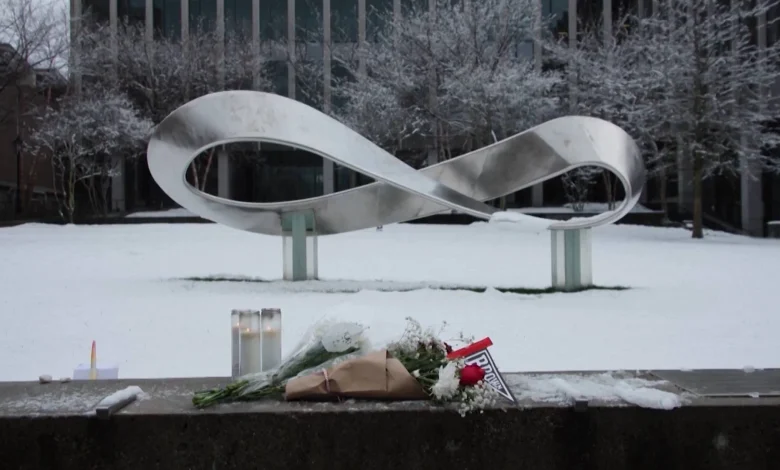
On Saturday afternoon, December 13th, a gunman entered a Brown University classroom in Providence, Rhode Island, and started firing. He killed two students and injured nine, then escaped. Days later, Providence Police Chief Col. Oscar Perez admitted at a news conference, “He could be anywhere…We don’t know where the person is or who he is.”
According to the Gun Violence Archive, this was the 389th mass shooting in the United States in 2025. At least four more have occurred since. Gun violence is not unique to this country, but its sheer magnitude and frequency here is without equal. The gun industry and its gun lobby have created a 50-state free fire zone, a killing field in the very country where, 250 years ago, its founders declared “life, liberty and the pursuit of happiness” to be inalienable rights. Those rights have been forever stripped from Ella Cook and Mukhammad Aziz Umurzokov, the two students killed in the attack. Of the nine injured, six remain hospitalized, one in critical condition.
Mass shootings, especially at schools, have become so common in the US that we now have a growing population of people who have survived not one but two of them. We interviewed two such survivors on the Democracy Now! news hour after the Brown shooting.
“Because I’ve already processed all the grief and the sadness before — I’ve been grappling with that for the past seven years — my most predominant emotion right now is, honestly, anger,” Brown sophomore Zoe Weissman said. She was at the Westglades Middle School in Parkland, Florida, which abuts the Marjory Stoneman Douglas High School, where, on Valentines Day, 2018, a former student arrived with an AR-15-style assault rifle and killed 17 people, mostly students, injuring 18.
Zoe continued, “If politicians actually want to show they care about their constituents and want to be reelected, they need to show a concerted effort to pass gun violence prevention legislation on a federal level. If they don’t, we’ll make sure to vote them out, because we are the only country where this happens.”
Mia Tretta is a junior at Brown. She was shot by a fellow student with a handgun at Saugus High School in Santa Clarita, California, on Nov. 14, 2019. He killed her best friend and one other student and injured two more before taking his own life.
“I came to Brown as someone who was shot in the stomach at 15 years old,” Mia said on Democracy Now! “When something as horrific and terrifying as a school shooting happens to you, you want to find as much sense of safety as possible, because, at least for me, my entire innocence, my childhood was taken from me by someone I didn’t even know. A big reason I chose Brown was because of the safety I felt on campus, the community I felt, the fact that Rhode Island is a blue state that values gun laws.”
Since surviving the shooting in high school, Mia has become a tireless gun control advocate. In 2022, at the age of 18, she spoke at the White House:
“Ghost guns are untraceable…as a student, I don’t just have to worry about Spanish tests, but about my life. School shootings with ghost guns are on the rise. The most lasting thing I’ve learned, other than the loss of friends or the shattering of my youth, is that nothing has relieved the pain in my heart like working to prevent more senseless shootings.”
Like Mia, Zoe Weissman promises action:
“We are a very politically active group of students…I think that you’re really going to see a large concerted effort, once we get back on campus in mid- to late-January, from students. I think I can speak for all of us that we’re angry and we’re ready to do something, not just on the state level, but on a federal one, as well.”
The US Supreme Court is scheduled to hear what has been described as a “pile up” of 2nd amendment cases, including one challenging an Illinois ban on AR-15 assault rifles, the mass shooters’ weapon of choice. Other cases involve whether certain classes of people can have their gun rights restricted, like those with felony convictions, habitually addicted people, or those under the age of 21. If history is a guide, the court’s 6-3 rightwing majority is likely to reject any form of gun control as unconstitutional.
So it will take grassroots action to contain this uniquely American scourge of mass gun violence.
“America is the only country that takes gun violence as this fact of life, and it makes no sense,” 21-year-old Mia Tretta said. “There’s no world where walking down the street and being scared, or sitting in a classroom and getting shot and killed, is normal. This doesn’t have to happen.”