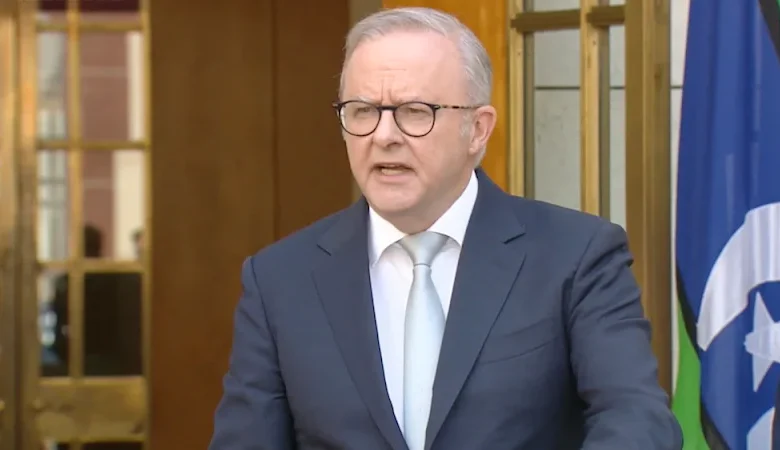
“Anyone in this position would regret not doing more, and any inadequacies which are there. But what we need to do is to move forward. We are taking action. We have taken action … We’ll continue to do more, and today as well won’t be the end. This is an evolving process.”
Jewish representative bodies cautiously welcomed the government’s crackdown on Thursday, but lamented it only came after a targeted terror attack. “It shouldn’t take the mass murder of Jews to spur action to stamp out hate,” said David Ossip, president of NSW Jewish Board of Deputies.
“For too long, Australian Jews have been targeted through social media, hate preachers and university campus activities. It was conveniently ignored until it was too late. The gaslighting and dismissal must end.”
Labor gives response to antisemitism report from July
A key flashpoint since Sunday has been the absence of Labor’s formal response to the report of its handpicked antisemitism envoy, Jillian Segal, which was delivered in July. Albanese has spent this week pointing to several recommendations he already followed, but on Thursday he gave an official reply.
Loading
Labor outlined a response to 46 of Segal’s 49 recommendations, including by launching an antisemitism education taskforce, which will run for a year and be headed by sector leader David Gonski to ensure the education system “prevents, tackles and properly responds to antisemitism”.
The government will also give the home affairs minister greater power to cancel or reject visas for people who spread hate and division, and commission esafety advice for curbing antisemitism online.
But Labor reserved its response on three of Segal’s most controversial recommendations – such as stripping funding from universities, broadcasters and cultural institutions that don’t address antisemitism, and giving the envoy the power to monitor media organisations – which have been criticised as overreach.
Ley released her own plan from opposition on Thursday afternoon, saying she would implement all aspects of Segal’s report, including new laws to terminate funding for arts institutions if they support antisemitic activity.
The opposition also proposed banning visas for people from “terror enclaves”, unless they passed a detailed intelligence and character review, and stripping Australian citizenship from dual citizens who commit terrorism offences.
Ley vowed to introduce several private members’ bills to give effect to those reforms. “The prime minister is missing in action,” she said.
“In that absence, the Coalition will drive the full implementation of the antisemitism envoy’s report, attempt to strengthen Australia’s counter-terrorism response and undertake direct and ongoing engagement with Jewish community leaders.”
Hate speech laws to test controversial phrases
But the government will press on with plans to introduce an “aggravated hate-speech offence” for preachers and leaders who promote violence, and a federal offence for serious vilification based on race or advocating racial supremacy.
It will also increase the penalties for promoting violence, make hate an aggravating factor when sentencing people for online threats, and create a regime to list organisations whose leaders promote violence or racial hatred.
Loading
Home Affairs Minister Tony Burke said it would “take Australia into new legal territory, creating new offences that have never before existed”.
“For too long, there have been two sorts of occasions where people have gone right to the limits of the law but have managed to stay on the legal side of it,” Burke said.
The first, he said, were organisations whose behaviour and philosophy sought to sow division. The second were people who have “gone right to the limits of language that is clearly dehumanising, unacceptable, having no place in Australia”.
Jewish leaders had called on the government to introduce stronger anti-vilification laws to deal with increased antisemitic speech since October 2023. While Labor passed stronger hate laws, it did not proceed with a vilification clause.
Central to the concerns of many Jewish Australians were the antisemitic slogans chanted at the Sydney Opera House protest in October 2023 – as well as the use of more disputed phrases such as “globalise the intifada” and “from the river to the sea” in pro-Palestinian protests since.
Asked if the new laws would capture those phrases, as police in the United Kingdom made arrests over chants of “globalise the intifada” this week, Burke would not speculate. “The hate speech laws, obviously will set a test,” he said.
“But we have all seen vision of hate preachers where we are shocked that that is happening in Australia. It is not representative of what people expect in Australia and they’re certainly not representative of the Muslim community in Australia either.
“There have been repeated checks as to whether they have crossed legal thresholds. They haven’t. The thresholds are changing.”
University of Queensland professor Katharine Gelber said the laws must draw the line between what is harmful and what is not, without excessively infringing on free speech. When it came to phrases such as “river to the sea”, she said context would be essential.
“If someone uses that phrase in a context with other hate speech or banners suggesting Israel should cease to exist, that bolsters the argument that it crosses the line,” Gelber said.
Loading
“However, if used in the context of supporting Palestinian human rights and ending suffering, while acknowledging Hamas is a terrible organisation, that would not cross the line.”
Albanese said the government was open to recalling parliament over summer to pass the laws, but drafting would be complex and they would have to withstand legal challenges. “We want to also consult to make sure that there is broad support across the Parliament for this,” he said.
Constitutional law expert Anne Twomey said it would be unwise to rush legislation without proper scrutiny. “It can lead to laws that are unworkable, or unconstitutional, or have unintended consequences,” she said.
“Moreover, laws about matters such as university and [research] funding are not going to have any immediate practical effect over the summer break.”
The Coalition has indicated it will support a crackdown, while the Greens were cautious about limiting free speech. “We must not head down a path where academic freedom and freedom of speech on university campuses are compromised,” Greens deputy leader Mehreen Faruqi said.
“That will not make anyone safer. We can and must address antisemitism, Islamophobia and all forms of racism in our society without criminalising debate or peaceful protest.”
With Shane Wright
More Bondi terror coverage
Cut through the noise of federal politics with news, views and expert analysis. Subscribers can sign up to our weekly Inside Politics newsletter.