TONYA MOSLEY, HOST:
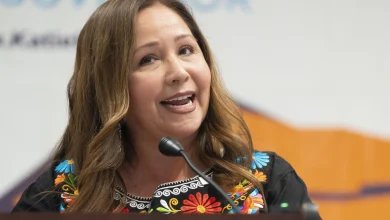
This is FRESH AIR. I’m Tonya Mosley. My guest today is Lucy Liu. Over the past three decades, Liu has become one of the most recognizable faces in film and television, from her breakout role on “Ally McBeal” to the stylized violence of “Kill Bill” and her reinvention of Dr. Watson on “Elementary,” Liu has expanded representation of Asian American women on screen. She also directs and creates visual art, exhibiting her mixed media work internationally.
Her latest project is a film she spent years shepherding, and as the lead, she takes on one of the most emotionally layered roles of her career. It tells the story of Irene, a terminally ill Chinese immigrant living in California’s San Gabriel Valley who discovers that her teenage son who has schizophrenia has become fixated on school shootings. In a community where mental illness is rarely discussed openly, Irene confronts this fear largely on her own. And as her own time runs out, she becomes haunted by a question she can’t escape. What if her son becomes violent? In the end, she chooses to take matters into her own hands by choosing violence herself.
The film is called “Rosemead,” and it’s inspired by true events. Liu signed on as both a producer and star, and it’s her first dramatic leading role in a feature film. We spoke last week before the disturbing acts of violence at Brown University, Bondi Beach in Australia and the murders of the Reiners.
Lucy Liu, welcome to FRESH AIR.
LUCY LIU: What a thrill to be here.
MOSLEY: I’m so happy to have you. And I’ll tell you, I was so moved by this movie. I read that you were kind of terrified when you first read this – the script for this. And I can understand why as we talk more about it. But what was it about that script that made you say, I can’t really look away from this; I have to take this on?
LIU: I think that this story is so devastating, and I also realize that there’s nothing like this in our lexicon. We don’t have a story about a family, an immigrant family, struggling with cancer or even mental health. And I wanted to highlight the love in this family. I think sometimes the title of the article or things like that, it’s very clickbait and not a way to humanize this woman and her son and to really talk about what happened behind closed doors. And I know for myself there’s a lot of cultural stigma and there’s a lot of fear about being seen in a true light, thinking that it would be judged or, I guess, you’ll be shunned from the community. And I think that there’s something about exposing that in a positive way that might help spark conversation for not just the AANHPI community, but for so many other cultures.
MOSLEY: You mentioned an article because I said in the introduction that this is based on a true story. And the articles you’re referring to are the articles after a crime happens. And this mother makes this decision that really is such a hard one without giving it away. How did you find a way to humanize her after reading about the choices that she made in the end as she faces terminal cancer and she also sees that her son is very disturbed?
LIU: I think understanding that she had a fragmentation in the language. I think when she was home and she was speaking Mandarin fluently with her son, you can see that there was nuance and poetry and love and humor. And when she was outside in the world, there’s a vulnerability that she has. And I think that was a really important part of understanding how she was, in many ways, marginalized and also that she did not have an advocate. When we start the movie, you know, you see the love between these two, a parent and a child. But also, we have to recognize that she’s coming from a place of grief and of loss.
MOSLEY: Because she lost her husband several years before.
LIU: That’s correct.
MOSLEY: So I want to slow down a little bit because when you talk about language, there are two languages here we’re talking about. We’re talking about the literal language. She’s an immigrant and she speaks Mandarin Chinese, and she’s here in the United States as an immigrant. So that’s – there’s that cultural thing as well. There’s the cultural language in addition to the literal language – that she’s isolated.
LIU: She’s very much isolated, but she also sequesters herself as well. And I think that is because there’s a lot of judgment within the community, and I think that they are not as open oftentimes to mental health services, like therapists. I mean, the extreme of that is Western medicine, taking, you know, SSRIs or whatever it is. And I…
MOSLEY: It’s sort of suspicion.
LIU: Even her own friend in the movie says – when Irene, who’s the character I play, says he’s getting better, you know, he seems to be getting better in therapy, her own friend says, you sound like a foreigner. You know, so there’s that – when I mentioned sequestering earlier, it’s because there’s really – even with a dear friend, there’s that feeling of – I guess the stigma of, well, that’s not how you do it. We’ve got herbal medicine. We’ve got other ways to exercise literally this demon out of him or, you know, thinking that it’s not a real diagnosis, not understanding that it’s a medical thing and, I guess, steering it away towards superstition. And there’s a lot of that in our community as well.
MOSLEY: Language, as you said, plays a big part in this story. I want to play a scene that really goes a little bit deeper into the comfort that she feels speaking her own language and also sort of a disconnect with her son over this. So the scene that I want to play, Irene and her son Joe are having dinner together. He has gotten in trouble in school, and she’s tried to help, but she doesn’t know what to do. And she’s asking him questions in Mandarin, but he is answering in English. And then it all explodes. Let’s listen.
(SOUNDBITE OF FILM, “ROSEMEAD”)
LIU: (As Irene, speaking Mandarin).
LAWRENCE SHOU: (As Joe) I heard you there in the hallway.
LIU: (As Irene, speaking Mandarin).
SHOU: (As Joe) You were there. I heard you. And you were trying to…
LIU: (As Irene, speaking Mandarin).
(SOUNDBITE OF CHOPSTICKS CLATTERING)
MOSLEY: We hear him get up and throw the chopsticks at that point. He can speak Mandarin. He chooses not to in that moment. What’s happening in that choice for him and for her?
LIU: I think there’s just this void between them. There’s this communication where she’s trying to reach out and say, you know, if there’s anything going on, you have to really think about, you know, your choices. And she’s trying to communicate, but it’s not really connecting. And I think that oftentimes happens in families. And he’s also not really taking his medication. He’s throwing it away. He’s starting to become more paranoid. And his way of trying to protect her is really going off in a very different direction. He’s becoming paranoid, and she’s also becoming very paranoid. And so the two of them are trying to protect each other, but they’re not really on the same wavelength.
MOSLEY: You are speaking Mandarin…
LIU: Yes.
MOSLEY: …Chinese. You spoke Mandarin until you were 5 years old, but you had a coach work with you in this film. Can you tell me a little bit about that experience as you were trying to really master the language and the importance for you to really get that tonal quality and the exactness of it.
LIU: Yes, when I was living at home, we only spoke Chinese. So when I went to public school, I was under the age of 5 and really got dropped into the immersion of public school and just trying to understand what was going on. And we were also very insular in our home. So we never really, you know, did anything except for maybe hang out in the alleyway, you know, in Queens and played or was just at home, really, at that age. But I really didn’t have a grasp of, I guess, the bigger picture of what was happening and how everything was happening. And so when this project came up, it was really vital to make this authenticity sing.
And I worked with this wonderful coach, Doug Honorof, who’s just a master at all different kinds of languages. And he really understood the nuance. And we went into the dialogue. And we dissected the language and made sure that it was conversational when it was in Chinese and also made the English very, I don’t want to say stilted, but very clear, because I think when somebody speaks a different language, it’s much more direct. There’s not this nuance, let’s say, of us, you know, going back and forth. It’s more direct.
So when it’s more direct, I think there’s a vulnerability that shows. And that was something that I thought was very important to bring that humanity to Irene, to show that she was not able to really express herself fully when she was outside the home, and also to, I guess, receive information from the therapist or from her own doctor when she was outside the home. And I think that feeling of those gaps were really important to show how porous she was and how vulnerable she was.
MOSLEY: If you’re just joining us, I’m talking to Lucy Liu. We’ll be right back after a short break. I’m Tonya Mosley and this is FRESH AIR.
(SOUNDBITE OF MATT WILSON, ET AL.’S “HUG”)
MOSLEY: This is FRESH AIR. I’m Tonya Mosley. And today, I’m talking with actor, director and visual artist Lucy Liu about her new film, “Rosemead,” inspired by true events and set in California’s San Gabriel Valley. The story follows a terminally ill Chinese American mother who discovers her teenage son has developed a dangerous fixation on mass violence.
Were there people that you patterned or you thought about as you were embodying Irene? Because you do transform in this film. And I feel like I’m getting a sense of a person. I mean, you don’t seem like Lucy Liu. Like, I’m watching Irene. And Irene is an immigrant that is here and is experiencing all of these things. Your parents?
LIU: Absolutely. I think that for me, I really had grown up in that environment of seeing my aunties or my mother or my parents and just living in that world of going to Chinatown, going to Flushing, you know, very immersed in that community and understanding, you know, that this was just what it was and how it looked and how it felt. And I think what I really brought, I guess, to Irene was not so much my parents as much as it was myself as a child watching my parents. And it’s a very different thing to see how my parents were at home or in Chinatown or in Flushing, and then how they were outside of that.
MOSLEY: How would you describe it?
LIU: I think, as a child, when you are the one to advocate for your parents and to translate for your parents when you become more fluid with the language, even though you don’t have the experience to understand exactly what you’re translating, it really changes the dynamic of yourself and your parents. So you become the parents in that situation, even though they’re the ones who have the authority. So there’s a very strange dynamic that occurs. And I think that a lot of people that are children of immigrants have experienced that, too. And that’s something that I wanted to imbue in Irene, that she was still very childlike when she was outside of her home and outside of her community.
MOSLEY: You use this word vulnerability when you talk about the language in particular. And so I can’t help but think about 5-year-old Lucy stepping into the classroom for the first time. You only speak Mandarin, and so everyone around you is speaking English. Do you remember when those pieces of yourself you had to let go, when English then became a day-to-day practice for you and maybe what that was like? I mean, that’s such a moment of having to grow up at such a young age.
LIU: It’s funny because I’ve forgotten a lot of my childhood. And I think it’s probably because there was a lot of trauma (laughter) of, you know, not feeling like you belonged or, you know, wanting to seem like everything was perfectly normal and not looking like everybody else. I think that was also, I guess, difficult, you know, because on television there was, you know, “I Dream Of Jeannie” and “The Brady Bunch” and all those shows that really indicated, you know, what life was like outside of your own home. And I guess not having that and trying to aspire to something that you could never be or look like is a very strange, I guess, amalgamation of conflict, you know, as a child not understanding, like, why don’t I see myself on television?
MOSLEY: Do you remember feeling that as a child as you were watching TV and looking out at the world?
LIU: I remember thinking, like, why can’t I just get into that “Get Smart” world? Just I thought that there was – I didn’t really understand that there were laugh tracks. I thought that there was so much more entertainment and lightheartedness outside of the home. And I really wanted to fall into that world and just walk right into that TV set.
MOSLEY: Wait a minute. So you thought like, oh, everyone’s having a great time in these other houses.
LIU: (Laughter).
MOSLEY: They’ve got people laughing at them (laughter).
LIU: Yeah, they just are just, you know, people are just amused. And, you know, to me, I really thought that comedy was, you know, the way to someone’s heart.
MOSLEY: You tell this story about seeing how people treated your mother. I think there was a particular story where you all were in a store, and you saw her being disrespected. And that kind of really told you something or taught you something about how you wanted to live your life and be treated.
LIU: I think as a child seeing that, you know, that she was kind of treated in a way based on her fragmented English and also based on what she looked like, based on what we looked like, it was really infuriating as a child to see that. And I think there was a helplessness and a feeling of wanting to stand up for your parents. But then also feeling like you didn’t have a voice.
MOSLEY: Let’s get into your career, Lucy. We talked a little bit about how, at a very young age, you knew you wanted to be an actor. You wanted to actually step inside of the TV and be…
LIU: (Laughter).
MOSLEY: …With those families, which I find remarkable because at the time when you were growing up, you didn’t see many people who looked like you on television and in movies. Where do you think that knowing came from without a map to follow?
LIU: I don’t know, but I feel like it was like an angel on my shoulder. And I think the person that I could connect to was this – it was an – well, I know now that she was an actress, but I thought she was a real person that worked in a laundromat, and it was a Calgon ad.
MOSLEY: (Laughter).
LIU: And she would say, Calgon, take me away.
MOSLEY: God. Yeah (ph).
LIU: And that was the person that I really thought, oh, I see myself. So there’s somebody in that set that looks like me, you know? And so it’s pretty funny to think about that now. But yes, it was something that I really was – just dreamed about. And I didn’t – I mean, the fact that I’m even here at NPR is just a dream come true.
MOSLEY: Well, it was something that was your desire, but there were also people who saw it in you. Is it true that someone saw you – like, a scouting agent or someone saw you, discovered you on a subway?
LIU: There was a manager on a subway. They gave me his card, and I was, of course, very suspicious because we’ve lived this very insular life, you know, and who’s this person giving me this card?
MOSLEY: And how old were you about?
LIU: I was a teenager because I was going to high school at that point and taking the subway by myself. So I was definitely in high school at that point. And I remember – I mean, we only had Yellow Pages back then. So I called the Better Business Bureau to find out if this person was real, and it turned out he was real. And…
MOSLEY: What did he say to you when he saw you on…
LIU: He just said, you have an interesting look, and I feel like you might, you know, be very successful doing commercials or something. Give me a call. I mean, I’m pretty sure that’s what he said. And then I did call him. He did send me out on, you know, some interesting auditions, and they were real. I ended up getting a commercial for school supplies back in the day. But there were some – also kind of some sketchy auditions as well.
MOSLEY: Like what?
LIU: I remember going into a – like, an audition where the person seemed a little bit off. And, I mean, luckily, I have that kind of New York commonsense wherewithal where I was like, I’m not comfortable being here, and I left.
MOSLEY: You have also talked about how, you know, your counterparts, they would go on, like, 10 auditions a day, and you might have 10 auditions a year…
LIU: Yeah.
MOSLEY: …And what those auditions were like and how you kind of, in spite of the fact that you were only getting a few, could bring your whole self, knowing that there was a really big possibility of rejection.
LIU: I think rejection was on my resume.
MOSLEY: (Laughter).
LIU: You know, it should’ve been like, rejection – takes it pretty well. I think that there was so – there were so few auditions that I really didn’t know how to get better ’cause when you audition, you really need to know how to…
MOSLEY: The reps.
LIU: …Understand the room.
MOSLEY: Yeah, the reps.
LIU: You have to understand what you’re doing. There’s a certain way to, I guess, introduce yourself. And because I kind of was very raw and unpolished, maybe that worked in my favor. I think the unknowing of it, the naivete and the – I mean, really the sincerity of going in and just, like, doing your best and not having any expectation was really a saving grace for me.
MOSLEY: Do you remember a time where it worked for you? You walked in, you had no idea what was going on and it, like, really worked out for you.
LIU: Yeah. I did – I went into this audition for “Beverly Hills, 90210,” and there was a room of, like, 10 or 15 people. You know, it was an under-five role, which I didn’t really know what that meant, but it really means, like, you have under five lines.
MOSLEY: Oh, OK.
LIU: And I went in. I shook everyone’s hand. Then I just did my lines, and I left. And I think the – I guess the confidence of shaking people’s hands and looking at them in the eye and just, you know, going in there and being very welcoming and warm was, I guess, the ticket. I have no idea. I mean, you never know what’s going on behind closed doors. But for me, I just felt like I have nothing to lose. You know, this is just who I am.
MOSLEY: Yeah. Did you get that role?
LIU: I got the role.
MOSLEY: Yeah.
LIU: I played a waitress on “90210.” Like, you know, I had four lines or something like that. And it was a thrill.
MOSLEY: Let’s take a short break. Our guest today is Lucy Liu. She stars in the new film “Rosemead,” a drama about a mother confronting her son’s violent fantasies as her own health declines. We’ll be right back after a short break. I’m Tonya Mosley, and this is FRESH AIR.
(SOUNDBITE OF SONG, “INDEPENDENT WOMEN PART I”)
BEYONCE: Lucy Liu with my girl Drew, Cameron D and Destiny. Charlie’s Angels. Come on.
UNIDENTIFIED MUSICAL ARTIST: Come on.
BEYONCE: (Vocalizing).
(Singing) Question, tell me what you think about me. I buy my own diamonds and I buy my own rings. Only ring your cellie when I’m feeling lonely. When it’s all over, please get up and leave. Question, tell me how you feel about this. Try to control me, boy, you get dismissed. Pay my own car note and I pay my own bills. Always 50/50 in relationships.
DESTINY’S CHILD: (Singing) The shoes on my feet. I bought them. The clothes I’m wearing. I bought them. The rock I’m rocking. I bought it.
(SOUNDBITE OF BELA FLECK AND THE FLECKTONES’ “THE CHRISTMAS SONG”)
MOSLEY: This is FRESH AIR. I’m Tonya Mosley. Let’s continue our conversation with actor, director and artist Lucy Liu. Her new film “Rosemead” is inspired by true events in California’s San Gabriel Valley. It follows Irene, a terminally ill Chinese American mother who discovers her teenage son has become fixated on mass shootings and violent fantasies. As her health declines, she’s forced into an impossible moral dilemma – how far must she go to protect him and the people around him?
Lucy Liu first gained national attention as Ling Woo on “Ally McBeal,” went on to star in “Charlie’s Angels” and “Kill Bill,” and later redefine the role of Dr. Watson in the long-running series “Elementary.” She also directed episodes of “Elementary,” “Luke Cage,” “New Amsterdam,” “Why Women Kill” and “American born Chinese.” Outside of film and television, Liu is a visual artist whose work spans mixed media, collage and large-scale paintings. She’s also back in theaters as her character in “Kill Bill.” Both volumes were just re-released under the title “Kill Bill: The Whole Bloody Affair.” When we last left off, we were discussing her early start in acting.
Being a shy little girl, I mean, describing yourself as shy, how did that girl learn to survive built on rejection? Like, you know?
LIU: I guess I didn’t even remember that I was shy until I found those report cards that my mother had saved for me. She gave me this manila envelope. I think it was during the pandemic. And…
MOSLEY: Oh, just a few years ago.
LIU: Yeah, not that long ago. And I looked at them. I was sort of, you know, shredding all these things and getting rid of all these things that had come from Los Angeles ’cause I had, you know, lived there for so long. And then I looked at them, and I was so surprised because that was somebody that I had forgotten. And in some ways, it’s kind of sad, you know, that I forgot this little girl that didn’t have a voice. And I also felt like, wow. Not just, you know, look how far I’ve come, but, wow, this poor child, you know? She must have felt so completely confused in these classrooms to not be able to even, you know, participate and have a conversation because everything was like, she doesn’t talk, she doesn’t participate, she’s too shy, you know, she needs to really, you know, step up. I just – I don’t know who that was. And remembering that is sort of a shocking thing to feel like, wow, I really left her behind.
MOSLEY: When did you start to feel like that you weren’t anymore?
LIU: When I left for college. That’s when I really started to find my own voice and literally my own footing ’cause I was out of the house and I was in my own room. And I think that it was the first time I really didn’t have to, you know, compare myself to where my family was and where I was. You know, ’cause you didn’t want to be too far away from them. But I think being in college, being as far as I was out of the house, was really helpful, and it helped me find my individuality. And I think more of my interiority, as well.
MOSLEY: You majored in – you didn’t major in theater or acting.
LIU: No.
MOSLEY: Yeah. I was something like Asian…
LIU: Asian languages and cultures. Yeah.
MOSLEY: Did you have an intention to do something with that degree?
LIU: You know, what happened was when I went to college, it was sort of a free-for-all, and I was so excited to take, you know, all these multiple courses like ceramics and Chinese, you know, which I had rejected so much when I was a child, we would go to Chinese school on the weekends, and I would just absolutely despise going to Chinese school.
MOSLEY: Why?
LIU: Because it was just this, you know, Saturday morning…
MOSLEY: Right.
LIU: …And here we are, you know? We didn’t – I just wanted to have a childhood. I wanted to run around and just, you know, I guess ride my bicycle and do all the things that everyone else was doing. And here I was sitting in a classroom, you know, I guess repeating these vowels and these tones. And I just didn’t – it wasn’t my interest.
MOSLEY: Yeah.
LIU: And I think that also, I was trying to get away from – you know, I was struggling with, like, in my Chinese and my American. Where am I? And so, here I am trying to be American and try to find a voice, but then I’m stuck in Chinese school. And so I think when I got to college, I was like, I can choose this now. And it was a choice. And that’s a very different feeling to make that decision for yourself. So I was taking all these, you know, all these courses that were interesting to me, and then all of a sudden, they’re like, you need to have a major, and I thought, oh, my gosh. What am I going to do? And, you know, all the things that I was learning, like Chinese philosophy and the language itself and art. I then saw, OK, these are the most credits I have. I better just…
MOSLEY: Find something.
LIU: I better find something that’s going to get me out of this school in time (laughter). So that’s how Asian languages and cultures came to be.
MOSLEY: OK. So your breakout role came in 1998. You had smaller roles before then, but Ling Woo on “Ally McBeal.” Sharp-tongued. That’s how she’s described. A lawyer who made no apologies. And I actually want to play a scene because I want to familiarize the audience to this character. The scene I’m going to play is from Season 2. Ling is on the witness stand, defending her side business – a mud wrestling club that a mother’s group is trying to shut down, and Portia DeRossi plays her attorney. Let’s listen.
(SOUNDBITE OF TV SHOW, “ALLY MCBEAL”)
LIU: (As Ling Woo) The idea that it degrades women is ridiculous. Every woman wants to be thought of is desirable. Imagine – they can go home at night and say, even in mud, I look good.
PORTIA DE ROSSI: (As Nelle Porter) You have to admit this activity does objectify them.
LIU: (As Ling Woo) So?
DE ROSSI: (As Nelle Porter) Ling, how can it not be a little degrading? Women strutting around in bathing suits, guys whooping?
LIU: (As Ling Woo) Could I respond to that?
DE ROSSI: (As Nelle Porter) I wish you would.
LIU: (As Ling Woo) First, the women there make nearly $100,000 a year. How? These drunken neanderthals hurl money at them. Go into that club. You come out with a lower opinion of men, trust me.
DE ROSSI: (As Nelle Porter) That could be true. But these girls do make that money with their bodies.
LIU: (As Ling Woo) They make it by teasing men with something they’ll never get their hands on. That goes to the very essence of a woman.
DE ROSSI: (As Nelle Porter) Excuse me?
LIU: (As Ling Woo) Sex is a weapon. We all use it. We tease, we tantalize, we withhold. It’s something we do in almost every walk of life, be it marriage, business. God gave us that advantage by giving men the dumb stick. It’s hot in here, and there’s no water.
DE ROSSI: (As Nelle Porter) The dumb stick?
LIU: (As Ling Woo) Penis. They’ve all got them.
(LAUGHTER)
MOSLEY: What do you think when you hear yourself? Your face says a lot.
LIU: Oh, my gosh. I can’t even – It’s been so long, and, you know, hearing that Ling Woo voice just makes me giggle because she was so – she was so blunt. And that’s what I loved about her. There was an honesty, and she really had a point of view. And I really appreciated that about her. And obviously, David E. Kelley was just an incredible writer and very prolific. And he just would be able to create these monologues for her that would just make absolute sense – you know? – for her. And she just really believed it. I mean, she had to really believe it. And she really, I think, was a feminist in so many ways. She just saw things as they were.
MOSLEY: You actually auditioned for a different role. And after David met you, he created this role, right?
LIU: That’s right. Yeah, I auditioned for Portia’s role, Nelle Porter, who I thought was just fantastic. And he, I guess, liked the way that I read that audition. And then he said that he would write something for me. That’s the feedback that I got after the audition. And I didn’t have a lot of hope for that. I just thought, OK, that’s very nice. And people have said that before, but no one’s ever written anything. And then they came back and offered this guest star role to come on and, you know, be this character, Ling Woo.
MOSLEY: Let’s take a short break. If you’re just joining us, I’m talking to Lucy Liu. Her new film is called “Rosemead.” This is FRESH AIR.
(SOUNDBITE OF AARON PARKS’ “SMALL PLANET”)
MOSLEY: This is FRESH AIR. Today, I’m talking with actor, director and visual artist Lucy Liu.
There was this article. And I know you’ve been asked about it many times. But I want to ask you about it now, to talk about this dragon lady stereotype. So you didn’t engage with criticism for a long time about Ling Woo’s character and O-Ren from “Kill Bill,” which we’ll talk about a little bit later. But then there was this essay in Teen Vogue that singled out O-Ren in particular. And you responded with your own op-ed, pointing out that no one calls Sharon Stone a dragon lady for “Basic Instinct” or other women who play really strong characters. What made you decide to finally speak up about it?
LIU: I actually didn’t even know the article existed. A friend of mine sent it to me. I just found it really surprising that we were all women, assassins, and that I was singled out as a dragon lady but nobody else was. And we all were doing the same thing. You know, that was our job. Our career was, we were assassins.
MOSLEY: Yeah.
LIU: And that really indicated to me that there was some undercurrent, to me, of, I guess, racial profiling.
MOSLEY: There’s this thing that I read that I found so fascinating, first off, that you spoke up about it. You wrote this op-ed for The Washington Post. You really laid out those same arguments that you’re saying now. But you’ve also talked about how the characters that you’ve played, some of them have had names that, you know, are not Asian names. And you wanted to keep those names because you wanted there to be evidence that these parts weren’t written for an Asian woman. Talk to me about that idea and why that was important to you.
LIU: I just think it’s imperative to know that these roles, although they were not written for someone Asian, that they could be and they should be retained as those names because it shows that having been cast in that role, it’s become something that’s more ubiquitous. It’s more accepted. It’s there. And I think that, I guess, the vision for what people do and how they present their writing or how they present the description of a character does not necessarily have to be that limited, you know? And I think that leaving that name in there, to me, shows the history of how things can change and how they have changed, and they can continue to change.
MOSLEY: So, for instance, like, your role in “Charlie’s Angels” with Alex as your name.
LIU: Alex Munday, yeah.
MOSLEY: Yeah. Or “Lucky Number Slevin.” What was your name in that?
LIU: Lindsey.
MOSLEY: Lindsey.
LIU: Yeah. And I remember the description said, like, I think it was like, an energetic, bouncy blonde, you know, knocks at the door.
MOSLEY: (Laughter).
LIU: And I just thought, we have to keep that in the script, you know, because it’s kind of great to know that you can also be an energetic, bouncy person but not be blonde.
MOSLEY: Right, right.
LIU: You know what I mean? Like, they definitely had a different idea of what it was. But I think, to me, it’s about, you know, chipping away and understanding that, you know, these are the ways that things can shift and change. And it’s definitely not going to be overnight. But it is so, for me, important to remember, you know, those moments because I feel like those are huge leaps forward.
MOSLEY: “Kill Bill” was rereleased this month.
LIU: I cannot even believe it. I have to say that when “Rosemead” opened last week in New York City for that one week, we waited upstairs in the projection room. That was our green room.
MOSLEY: Yeah.
LIU: And so there’s “Rosemead” playing on one projector. And then right next to it, there’s a 70-millimeter of the film playing on the other…
MOSLEY: “Kill Bill.”
LIU: …Projector in the theater. And you can see the audience. And it was just mind-blowing. I had no idea. That was not my plan, but what a plan. It was masterful, to have two. Twenty-two years apart.
MOSLEY: Twenty-two years apart.
LIU: Yes.
MOSLEY: We’ve got to play an iconic scene from “Kill Bill.” Your character, O-Ren, has just taken over the Tokyo underworld when Boss Tanaka challenges her with a slur about her heritage. And she takes his head off. Let’s listen to it.
(SOUNDBITE OF FILM, “KILL BILL: VOL. 1”)
LIU: (As O-Ren Ishii) As your leader, I encourage you, from time to time, and always in a respectful manner, to question my logic. If you’re unconvinced a particular plan of action I’ve decided is the wisest, tell me so. But allow me to convince you. And I promise you right here and now, no subject will ever be taboo, except, of course, the subject that was just under discussion. The price you pay for bringing up either my Chinese or American heritage as a negative is I collect your [expletive] head, just like this [expletive] here. Now, if any of you sons of [expletive] got anything else to say, now is the [expletive] time. I didn’t think so.
(SOUNDBITE OF HEAD THUDDING)
MOSLEY: That’s my guest Lucy Liu in “Kill Bill” as O-Ren. And you learned Japanese for this role, right?
LIU: I did.
MOSLEY: Yeah.
LIU: I did.
MOSLEY: You said that it changed the way you held yourself in the character.
LIU: It did because it’s such a beautiful language, and there’s so much about it that’s smooth and also staccato. And that’s very different from Chinese, from Mandarin Chinese at least. It’s not a staccato. And there’s a gentleness to it that I just find so graceful. And the costume – you know, we had somebody that came in from Japan specifically for my costume, to create my costume for O-Ren. And they also flew somebody in – because we were shooting in China, actually – from Japan who only was my costumer, who – every time that I would finish a scene, she would come and rearrange and fix and redo my entire costume. Because the thing about the kimono and the beauty of it is, like, it’s covered, but the – kind of the central part of the kimono is the wrist and the back of the neck. So those were things that had to be very, very…
MOSLEY: Precise.
LIU: …Precise. And so she would kind of arrange it, undo the whole belt and redo it. And that’s why when I was working with a samurai sword, when she kind of pulls up her sleeve, you see part of her skin. And that’s very revealing, and that’s very intimate.
MOSLEY: What a subtle storytelling device.
LIU: Isn’t it?
MOSLEY: Yes. What other things do you really remember about embodying O-Ren that really stick with you?
LIU: Oh, just, I guess, how she – where she came from because she really had a backstory. There was the anime that created this real feeling of survival for her and understanding that she was never going to die of old age. She was going to die by the sword most likely. And seeing that she had been through so much and she really understood life at a young age – this, I guess, revenge and what life and death was, I think, gave me such a strong base for her. You know, just because a lot of the other characters didn’t have that, you know, backstory…
MOSLEY: Yes.
LIU: …That was given, and she did. And there’s this – I think that it gives you this feeling of rooting for her, even though she is on the list…
MOSLEY: Oh, yeah.
LIU: …As we all know.
MOSLEY: Yes, we all know.
(LAUGHTER)
MOSLEY: Let’s take a short break. If you’re just joining us, I’m talking to Lucy Liu. Her new film is called “Rosemead.” More after a break. This is FRESH AIR.
(SOUNDBITE OF OSCAR PETERSON’S “O CHRISTMAS TREE”)
MOSLEY: This is FRESH AIR. Today, I’m talking with actor, director and visual artist Lucy Liu about her new film, “Rosemead.”
What’s a role that people associate with you the most or come up to you to talk to you about the most? Yeah.
LIU: You know, it’s so funny. It just depends on where people are from. I find a lot of people from Europe are very much into Ling Woo. Isn’t that funny?
MOSLEY: With “Ally McBeal.” Yeah.
LIU: Yeah. They – I don’t know what it is, but it’s – something really connects to them about her character. Of course, there’s the cult classic of O-Ren that people really love. And then I find a lot of parents and teenagers are really big Joan Watson fans.
MOSLEY: Oh. Yeah, yeah.
LIU: I think that there’s a very big community of people that grew up with Alex Munday, you know. And that’s – it feels like I’ve kind of hit a lot of different areas and different groups, and it’s a good feeling to know that it’s not just one group. And it’s funny to think that, you know, the career has been over 30 years because it feels like it just started yesterday.
MOSLEY: I watched a panel discussion where a young woman asked you a question, and she was named after you.
LIU: That’s right. It was so funny. I couldn’t believe it. I thought, wow, that’s such a strange thing. Also, when somebody has a tattoo…
MOSLEY: Yes.
LIU: …Of one of your characters on their body, it’s really kind of – it really jolts you awake, like, to have that kind of impact.
MOSLEY: Or when you’re in a song. I think I counted five songs…
LIU: (Laughter).
MOSLEY: …Out there where your name is referenced. Of course, Outkast’s “Hey Ya!” You know, now to all the Beyonces and Lucy Lius (laughter).
LIU: I know. I love being connected to Beyonce. Come on. That’s not going to be something I’ll forget anytime soon.
MOSLEY: Take me back to when you first heard that particular song or that line.
LIU: I was driving down Laurel Canyon towards Sunset Boulevard from Mulholland, and then somebody said, you know, your name is in this song. And then it came on and I thought, what are you talking about? And then it just – I heard ice cold, and then I heard my name. And it was such a fast thing. It was a blur. And, you know, back then, you couldn’t just – you know, you didn’t have – they didn’t have the ability to play something right away. It was, like, played on the radio.
MOSLEY: Yeah.
LIU: And that’s when it was, you know? You’d have to listen to it again when it played. And so it was so shocking to me. And it was – it didn’t really occur to me what it meant, you know, because I wasn’t really – I don’t think I was as present as I am now…
MOSLEY: Oh.
LIU: …Back then because I was so busy just doing. And I wasn’t really just in the moment as I am now. Like, when I was working, I was in the moment, but I was always just going from one place to another. And I think that could have been a sense of anxiety even. You know, I wasn’t really as present as I am now, and I’m not sure if it’s because I’m a parent.
MOSLEY: Yeah. I was just going to say, parenthood does change things. It kind of forces you to be present.
LIU: Yeah. I guess it does. And I think it’s also an appreciation for knowing that, you know, time is sliding by so quickly.
MOSLEY: Yeah. You know, tying this back to “Rosemead,” you’re raising a son. You’re teaching him Mandarin. Is that right?
LIU: He’s learning Mandarin. I don’t know if he’s feeling the same way that I felt when I was in – you know, on the weekend school classes.
MOSLEY: (Laughter).
LIU: But I really want him to remember part of his culture, you know, that he – where he comes from, where – you know, where we all hail from. And, you know, maybe it’s something that he’ll decide not to do later on.
MOSLEY: Yeah.
LIU: But if I want to be a part of that moment for him and have him understand me when I’m talking to him and just not forget, you know? I think it’s really vital.
MOSLEY: Yeah. And I’m thinking about Irene in “Rosemead,” and, of course, that was a tragic story, but it allowed you to take stock and take a look at your own life and your parents, you know? And so as you are now a mother, has this movie in any way kind of, like, informed or made you think about your role as a mother?
LIU: You know, it’s so fascinating. I have not thought about myself and my son as much at all, actually. But I’ve thought about my parents and myself as a child. And it has really brought me so much compassion, so much more compassion for my parents and for myself as a child. You know, I think that – I think it was just a little bit more difficult not having a childhood. But now seeing that and kind of seeing it from the side, it really gives me a great deal of healing to know that and to feel that and to also sense that, you know, and give that to my child, as well – give that to my child self and to give it to my child.
And it’s – this is the greatest gift I think I could have been given, you know, to see that and to feel that. ‘Cause I think you kind of forget how difficult it can be and also seeing their struggle but not really knowing it as much. Because you really wanted them – I wanted them to stand up and be like, no, you know? This is who I am. I’m incredibly intelligent. You know, I’m a civil engineer. And they couldn’t do that. And so as a child, you kind of are frustrated. But also, there’s a vacancy there that needs to be filled, and I think that this movie helped me to really see that that vacancy was really for compassion.
MOSLEY: Lucy Liu, thank you so much for this conversation.
LIU: (Laughter) What a pleasure it’s been. Thank you for having me on the show.
MOSLEY: Actor, director and visual artist, Lucy Liu. Her new movie, “Rosemead,” will be in theaters around the country on January 9.
(SOUNDBITE OF SONG, “HEY YA!”)
OUTKAST: (Singing) Shake it like a Polaroid picture. Now, all Beyonces and Lucy Lius – shake it, shake it, shake it – and baby dolls – shake it, shake it, shake it – get on the floor. Get on the floor – shake it, shake it, shake it like a Polaroid picture. You know what to do – shake it, shake it, shake it. You know what to do – shake it, shake it, shake it. You know what to do. Hey ya. Uh oh. Hey ya. Uh oh. Hey ya. Uh oh. Hey ya. Uh oh.
MOSLEY: If you’d like to catch up on interviews you’ve missed, like our conversation with writer Zadie Smith on her new collection of essays, “Dead And Alive,” or with Vanity Fair journalist Chris Whipple on Trump’s White House chief of staff Susie Wiles, whom he interviewed 11 times this year, check out our podcast. You’ll find lots of FRESH AIR interviews. And to find out what’s happening behind the scenes of our show and get our producers’ recommendations for what to watch, read and listen to, subscribe to our free newsletter at whyy.org/freshair.
(SOUNDBITE OF DAVE MCKENNA’S “SANTA CLAUS IS COMING TO TOWN (INSTRUMENTAL)”)
MOSLEY: FRESH AIR’s executive producer is Danny Miller. Our technical director and engineer is Audrey Bentham. Our managing producer is Sam Briger. Our interviews and reviews are produced and edited by Phyllis Myers, Roberta Shorrock, Ann Marie Baldonado, Lauren Krenzel, Therese Madden, Monique Nazareth, Susan Nyakundi, Anna Bauman and Nico Gonzalez-Wisler. Our digital media producer is Molly Seavy-Nesper. Thea Chaloner directed today’s show. With Terry Gross, I’m Tonya Mosley.
(SOUNDBITE OF DAVE MCKENNA’S “SANTA CLAUS IS COMING TO TOWN (INSTRUMENTAL)”)
Copyright © 2025 NPR. All rights reserved. Visit our website terms of use and permissions pages at www.npr.org for further information.
Accuracy and availability of NPR transcripts may vary. Transcript text may be revised to correct errors or match updates to audio. Audio on npr.org may be edited after its original broadcast or publication. The authoritative record of NPR’s programming is the audio record.