Bonheur’s lawyer declined to comment. Alsime’s lawyer didn’t immediately respond to a request for comment. Court documents said Alsime is 24, but a statement from prosecutors said he’s 21.
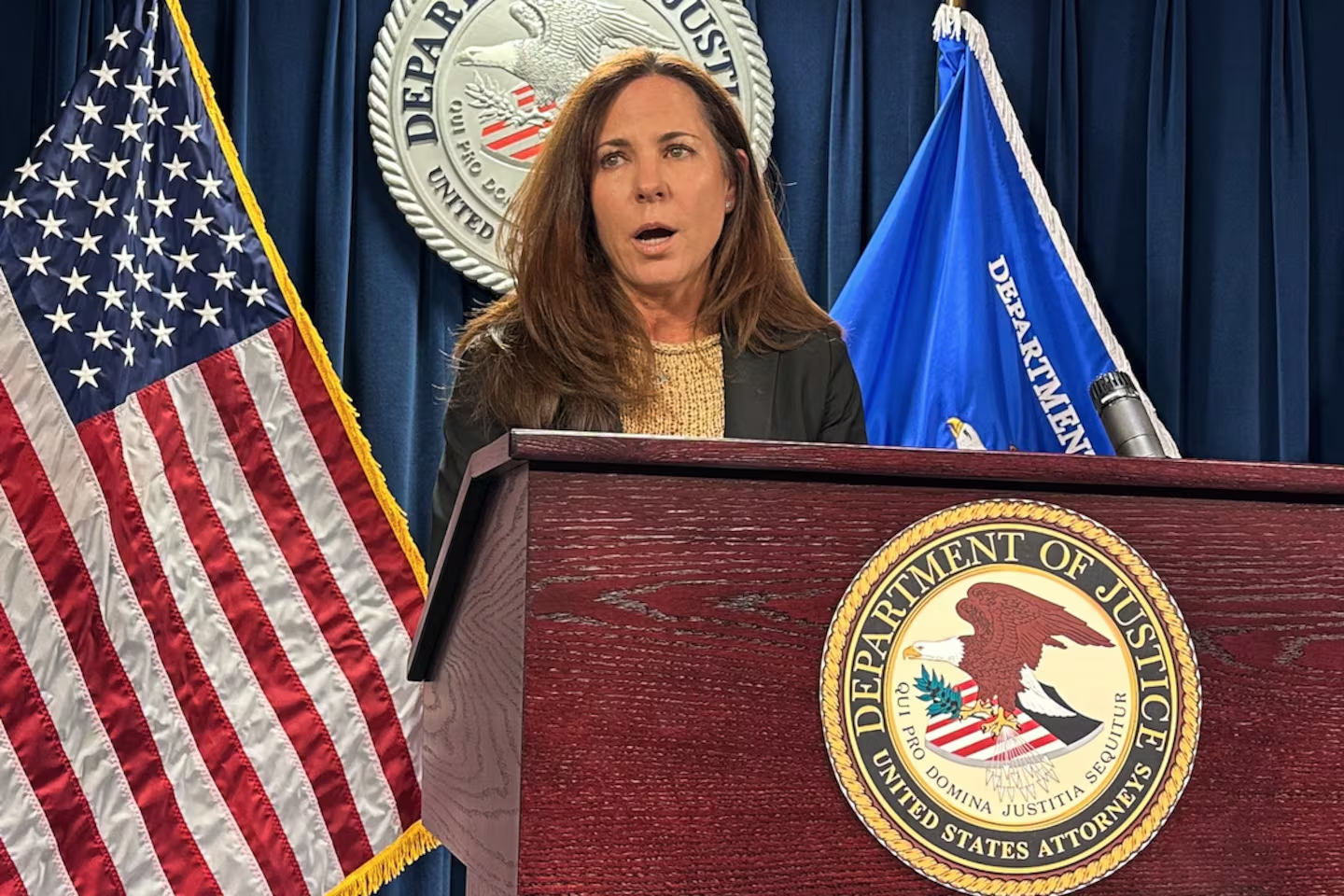
“As alleged in the charging documents, these men abused one of government’s most critical safety net programs for their own financial gain,” US Attorney Leah B. Foley said at a news briefing. “These defendants exchanged SNAP benefits for cash, which they pocketed.”
Their stores are located in the same building on Blue Hill Avenue, according to legal filings.
Foley said “one legitimate supermarket” in the same area as the two stores redeems about $80,000 a month in SNAP food assistance benefits. But over the past 20 months, the Jesula Variety Store was “redeeming between three and six times that amount monthly, with nowhere near the space, inventory, customers, or infrastructure to support it,” she said.
Alsime’s store, meanwhile, “redeemed over $120,000 in SNAP benefits in the last six months,” Foley said.
“Simply put, there is no plausible way SNAP-eligible food could have been purchased from these stores for this long, yet these two stores are alleged to have illicitly trafficked nearly $7 million in SNAP benefits,” she said. “The fraud was shocking and glaring.”
The two were slated to appear in US District Court on Wednesday.
Court papers said Bonheur began accepting SNAP benefits in September 2021, while Alsime started accepting them in March of this year.
“During the course of this investigation, undercover officers used EBT cards to traffic SNAP benefits for cash” at both stores, Foley said.
The “defendants themselves were working the cash registers and both exchanged SNAP benefits for cash with the undercover officers,” Foley said. “Observations made by the undercovers showed that it was just as easy for anyone with an EBT card to walk into either store and convert hundreds of dollars in SNAP benefits into cash, all tax free.”
Court papers detailed several of those undercover transactions.
On June 11, 2025, at Alsime’s store, an undercover officer purchased a bag of rice for $25 and a bag of cornmeal for $10, prosecutors said in court records. The officer also traded $120 in SNAP benefits for $100 in cash, prosecutors said.
During a visit to Bonheur’s store on July 24, an undercover officer bought a bag of cornmeal, a bag of MannaPack rice, and an energy drink for $20, and also exchanged $124 in SNAP benefits for $100 in cash.
Foley said it was especially galling that the MannaPack rice was part of the alleged scheme.
“These are meals manufactured by the nonprofit Feed My Starving Children, which are paid for entirely by charitable donations and are intended to be shipped directly to food-insecure children overseas, including children in Haiti,” where both defendants are from originally, Foley said. “These products are not for sale anywhere. Yet Bonheur and Alsime were selling them in their stores for nearly $10 a pack.”
Authorities allege that Bonheur also received fraudulent SNAP aid himself as he trafficked SNAP benefits valued at more than $6 million over more than three years, while Alsime allegedly trafficked about $122,000.
Foley said her office will continue investigating such fraud and faulted the state Department of Transitional Assistance for what she said was its lax oversight of food aid programs.
When Bonheur sought SNAP benefits for himself, she said, “it appears that the Massachusetts Department of Transitional Assistance conducted virtually no due diligence when reviewing his application.”
She said an Associated Press article on Monday “mentioned that Democratic-led states, including Massachusetts, refused to turn over to the USDA data on its SNAP recipients, arguing that doing so would violate recipients’ privacy, and claiming that the states already have systems in place for wrongdoing. Really? There is no privacy right that protects your fraudulent criminal behavior.”
Support through the Supplemental Nutrition Assistance Program became a key issue during the 43-day government shutdown that ended in November, with many people around the country having difficulty accessing benefits.
Nearly 42 million Americans receive SNAP benefits, formerly known as food stamps, for help buying groceries. Most have incomes below the poverty line, which is about $32,000 for a family of four.
An individual can receive a monthly maximum food benefit of nearly $300 and a family of four up to nearly $1,000, although many receive less than that under a formula that takes their income into consideration.
The delay in payments during the shutdown led to a surge in demand at food banks and pantries across the country, as well as long lines for free meals and drive-through giveaways.
The alleged fraud comes at a sensitive time for Massachusetts.
Governor Maura Healey was vocal about the harms of curtailed SNAP benefits during the shutdown, and has pushed back against changes from the Trump administration that increased work requirements and will make states pay more for food stamps. While $7 million is a significant number, it’s a small fraction of the more than $230 million the state receives from the federal government for SNAP benefits each month.
On Wednesday, Healey said her administration had reported the suspicious activity to the federal government over a year ago.
“As a former Attorney General and now Governor, I will always support prosecution to the fullest extent of the law for anyone who engages in fraud or abuse of a federal program or any program,” Healey said in an emailed statement.
According to court documents, the USDA first conducted a site visit to one of the stores, Jesula Variety Store, in 2021, again in 2024, and then in 2025.
The federal agriculture agency, not the state DTA, is responsible for retailers’ applications to process SNAP, Healey said, and the alleged fraud began before she took office as governor.
For years, SNAP recipients in Massachusetts and other states have had millions of dollars of their SNAP benefits stolen by criminal rings, largely because SNAP cards are not protected by encryption chips. That makes it relatively easy for crooks to clone legitimate SNAP cards and steal benefits.
But the SNAP fraud that allegedly occurred in Mattapan was extremely unusual.
“SNAP is one of the most audited federal programs in the country,” said Vicky Negus, senior economic justice advocate at the Massachusetts Law Reform Institute, where she focuses on SNAP. The rate of SNAP fraud is less than one-tenth-of-one-percent in the state of Massachusetts, she said. “We’re talking a couple hundred cases a year,” out of roughly 1 million residents in the state that currently rely on the program.
Yet, the Mattapan case comes after President Trump claimed that the program was rife with waste, fraud, and abuse, part of his administration’s rationale for expanding work requirements and making states pay for more of the program.
Material from the Associated Press was used in this report.
Travis Andersen can be reached at travis.andersen@globe.com. Mara Kardas-Nelson can be reached at mara.kardas-nelson@globe.com.