Showboating is not to be encouraged in Hollywood types; the exception that proves the rule in The Princess Bride, in which screenwriter William Goldman indulges in a non-stop cavalcade of clever dialogue, scenes turned on their heads, and ingenious narrative improvisations. It’s a story about the art of storytelling, and smarty-pants thinkers from Umberto Eco to Italo Calvino would approve of the post-modern take on the classic fairy-tale offered here. A pleasure for kids, it’s also worth commending to adults looking for a break from the norm; the late Rob Reiner’s film offers a unique sense of humour that made it a word-of-mouth classic.
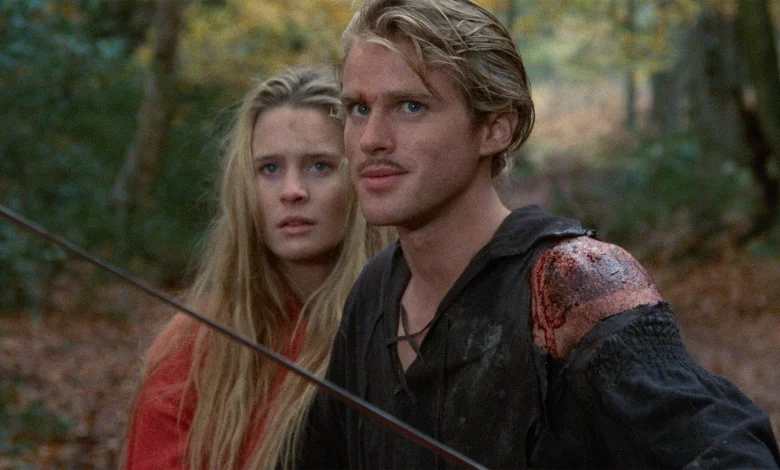
In a gambit that has worked for precisely no-one since, this is a tale within a tale, told by a grandpa (Peter Falk) to his grandson (Fred Savage). The kid doesn’t seem too ill, but feels the pull of primitive video games; his antipathy to hearing a story read to him is meant to mirror the audience’s apprehension. Neither he nor we should worry; The Princess Bride starts with a lovely, romantic trope, as Princess Buttercup (Robin Wright) and Wesley (Cary Elwes) fall for each other to the refrain of his reply; ‘As you wish’. Wesley meets an off-screen demise at the hands of the Dread Pirate Roberts, and Buttercup is kidnapped by a gang of amusing mercenaries before her arranged marriage can take place. Buttercup somehow survives, and aided by a mysterious masked man, sets out to right the rotten-ness within the crooked society of Guilder…
Reiner seems to know intuitively that Goldman’s story opens better than it closes; it’s hard to fault anything in the first forty minutes, with Goldman turning clichés inside out to dynamic effect. Revenge mantras (‘My name in Inigo Montoya, you killed my father, prepare to die’), left and right handed swordsmen, building up immunity to poison over many, many years; the script is the real star here. The later stages of the film rely a little heavily on cameos (Billy Crystal, Carol Kane, Peter Cook, Mel Smith) and the room-to-room climax lacks the visual wit of the early stages. But the whole package is still irresistible, with a poetic, lyrical score from Mark Knopfler to paper over any cracks.
A writer’s writer, Goldman spoke and wrote persuasively about exactly how stories do and don’t work; this project, adapted from his own novel, seems him play the equivalent of trick shots, setting up impossible contrivances and then solving them with the most elegant of strokes. Not an example for anyone to follow, The Princess Bride is the kind of film top talents can only make after decades at the top; a witty, refreshing and seasoned modern variation of the age-old story of love and adventure.