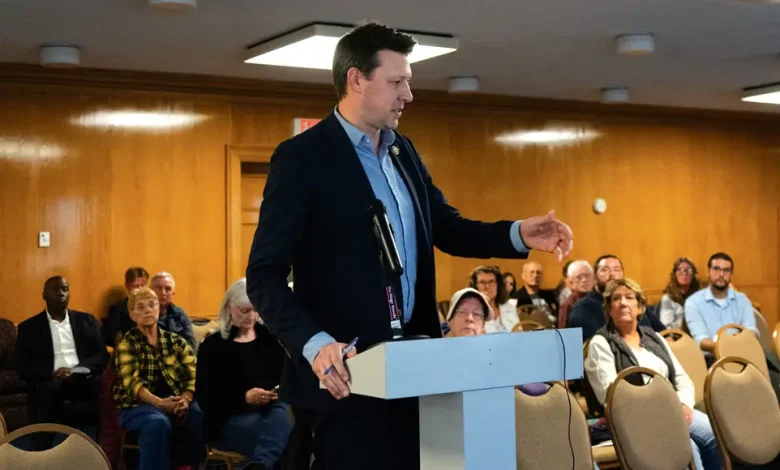
Rep. Josh Riley has made opposition to NYSEG’s proposed rate hike a top priority of his. He spoke at a public hearing held by the Public Service Commission in Oneonta on October 15. (Photo by Eric Santomauro-Stenzel)
Riley Introduces Bill to Limit Utility Executive Pay Bonuses
By ERIC SANTOMAURO-STENZEL
WASHINGTON, D.C.
Rep. Josh Riley, a Democrat representing upstate New York including Otsego County, has paired up with Republican Rep. Jeff Van Drew of New Jersey to introduce legislation that would set new restrictions on pay bonuses for utility company CEOs.
The brief bill, titled the “No Bonuses for Utility Executives Act,” would prohibit utility company executives from receiving bonuses when rates rise faster than inflation. It would also require that, when rates remain stable in a given year, bonuses cannot exceed 25 percent of the median compensation earned by non-executive employees. To assess this, the bill would require utility companies to submit wage and rate cost information to the Federal Energy Regulatory Commission every fiscal year.
“We have folks across upstate New York who are getting crushed with the NYSEG bill,” Riley told AllOtsego in an interview. “I’ve talked to parents who have to cut back on the Christmas presents this year because they can barely keep things together with these rising utility costs. And meanwhile, while we’re getting crushed, the corporate executives in Spain who own NYSEG are getting rich.
“We’re not going to allow people to get rewarded for ripping us off anymore,” Riley said.
Rep. Van Drew, who left the Democratic Party to join the GOP in 2020, said, “People are getting hit with higher and higher utility bills, and they are tired of seeing executives get big bonuses while they struggle to pay,” in a statement. “This bill is about basic fairness. In no world should executives be getting big bonuses if they are raising rates faster than inflation. This bill will make these companies think about the families they serve before they decide to jack up prices. I am proud to be a co-lead on this effort.”
A press release for the bill called out the CEO of Avangrid, the owner of NYSEG, receiving a $10.6 million bonus last year. The proposed legislation comes amid NYSEG’s request to increase its monthly bill by around 23.7 percent for a typical ratepayer, according to the New York State Department of Public Service.
At public hearings hosted by the New York State Public Service Commission, the body responsible for deciding whether to approve the rate hike, Riley has spoken against it. The rate hike proposal has drawn bipartisan opposition from many elected officials and community members in the area, including Republican State Senator Peter Oberacker, who is challenging Riley for the NY-19 seat.
Riley doubted how much of ratepayers’ money is actually going to upgrades.
“Where are the upgrades? Seems like every time the wind blows, the lights go out. You can’t just keep coming to us and saying you need money for the same thing over and over when we’re not seeing results.”
Riley argued the model of electricity cooperatives, where consumers are shareholders in a utility, is “a model that we should seriously look at.”
“This is a case of cherry picking facts for effect,” NYSEG and RG&E spokesperson Shelby Cohen said in a statement, “targeting NYSEG to score political points rather than dealing with the real drivers of utility bill increases: unregulated supply prices, passthrough costs from the state for policies and programs that get socialized to all ratepayers, and the very real need to upgrade an aging grid (as inflation drives up the cost of materials and parts).”
Cohen said that the company’s rate increases only happen through the PSC process and that “65% of charges on our customers’ bills are passthrough costs that go directly to suppliers and statewide programs.”
Cohen said the portion that goes to NYSEG is invested in “long overdue” grid upgrades. She added that statements about sending profits overseas are “not accurate” and that the “fact is that from 2015-2024, NYSEG received a net $990 million in capital contributions from our corporate parent, not the other way around.
“Without that support, we simply would not be able to sustain daily operations,” Cohen wrote.
Riley hopes that the growing national concern over electricity prices and the bipartisan nature of the bill will bring it support. At the same time, he said, “I think we are up against an entrenched machine that is run by special interests.” The “big utility monopolies” make “hundreds of millions of dollars in profits off of us” and then “shove it in the pockets of politicians with corporate PAC [Political Action Committee] checks.” Riley said he does not take any corporate PAC money.
Asked whether the bill’s bonus limits being tied to worker pay was a policy he would consider more broadly to combat wealth inequality, Riley told AllOtsego “all options need to be on the table.
“We are living in an economy right now where the top 1 percent have more wealth than the entire middle class combined, and the economy is rigged against people, because the political system is rigged against people,” he said.