Fare evasion: MTA to install turnstile spikes, paddles at most remaining subway stations to deter cheats

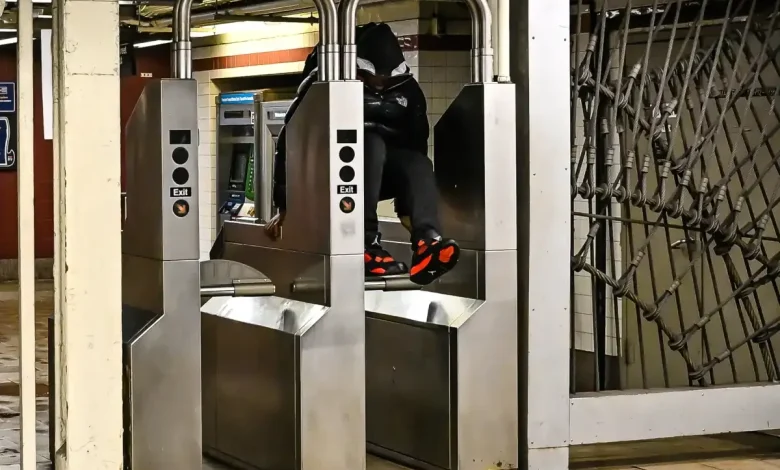
A subway rider jumps over the new turnstile metal shields that are supposed to prevent fare evasion.
Photo by Gabriele Holtermann
The MTA’s ongoing battle to stop fare evasion will bring spikes and half-moon-shaped plastic paddles to almost every subway station turnstile in the city, agency brass said Monday.
The devices aim to deter people from trying to hop or climb over the turnstiles and avoid paying their fare. The spikes and paddles have already been installed and tested out at hundreds of subway stations throughout the system in an effort to combat fare evasion, which costs the MTA hundreds of millions of dollars every year.
Through its contract with Boyce Technologies, Inc., the MTA will outfit 129 additional stations with the anti-fare evasion modifications by January, according to agency documents. Thus far, the MTA has installed 2,900 of the spikes and paddles at 327 of the 472 stations in the system.
The MTA is set to shell out $7.3 million on the upgrades overall, agency documents indicated.
A gate guard at the emergency exit near turnstiles in Penn Station.Photo by Barbara Russo-Lennon
New York City Transit President Demetrius Crichlow, during the MTA Board’s New York City Transit Committee meeting on Dec. 15, said the stations that already have spikes and paddles have seen fare-beating drop by as much as 60%.
“Some members of the public may think that these innovations just look funny,” Crichlow said. “But the truth of the matter is, these modifications work.”
The spikes are mounted on top of metal fins inserted between each turnstile, while the paddles are installed on top of the turnstile bars themselves. Both features are designed to make it harder for fare beaters to propel themselves over turnstiles, either by grabbing the sides of the fare gates or by placing their feet on top of the bars.
The New York City Transit Committee ratified the agency’s contract with Boyce Technologies during its meeting on Monday, although it was first awarded earlier this fall.
Louis Montanti, an MTA procurement manager, said the contract was first awarded under an “emergency order,” which allowed the agency to get it approved internally, without getting the board’s green light.
“We declared an emergency because of the fare evasion, we received internal approval to go forward with it,” Montanti said. “The provision for this immediate operating need indicates that we would seek a board ratification as opposed to approval. So this is the ratification after the fact.”
One board member, Midori Valdivia, raised concerns about MTA officials not informing the board exactly when they signed the contract.
“One of, obviously, our roles as a board, is to approve procurements,” Valdivia said. “There are very few transit agency boards that don’t approve procurements for the board. So, whenever we’re using that I just want to be judicious about that.”
The features are just the latest of many that the MTA has installed at fare gates throughout the subways to combat fare evasion, which it has identified as a major financial drain on the system year after year.
Others include retrofitting turnstyles to prevent so-called “backcocking,” when fare evaders maneuver the turnstyle backward to get through it without paying, and installing delayed emergency exit doors manned by unarmed guards.
Meanwhile, the MTA is also testing four different prototypes of new fare gates at 20 stations with the goal of choosing a new fare evasion-proof design to install at many more stations in the coming years.