NYC subway fare jumpers easily beat anti-theft ‘fins’ as MTA spends $7.3M to bring program to nearly every station

Stand clear of the closing snorts!
The MTA will dish out $7.3 million to expand its anti-fare evasion gadgets to nearly every subway station in the five boroughs — even though rule breakers have been laughing their way right past them.
The MTA signed off this week on a deal with Boyce Technologies to add more fare‑evasion “sleeves” and vertical “fins” at subway entrances, ultimately bringing the hardware to 456 of the city’s 472 stations by January.
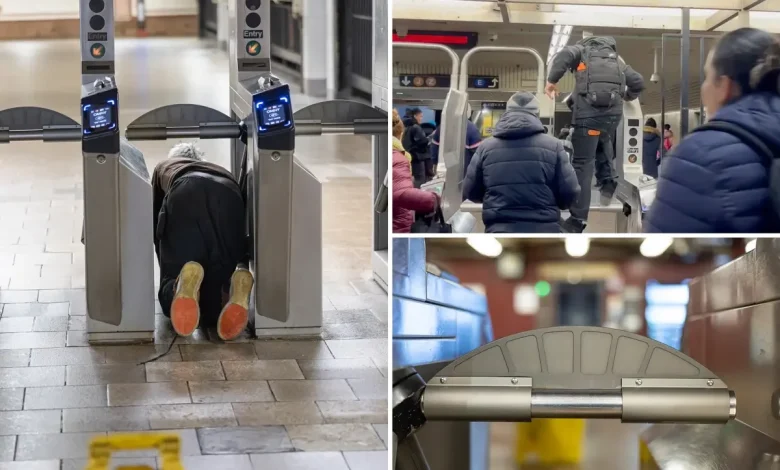
The jagged metal “fins” are designed to stop people from jumping or using the turnstile housing as a launch point. Christopher Sadowski
But straphangers doing the right thing say jumpers are easily bypassing the jagged metal “fins” that are designed to stop people from jumping or using the turnstile housing as a launch point. And the thieves are getting by the “sleeves” that are fitted over the arm of the turnstile to prevent riders from sneaking through.
“Homies are coming through the whole night,” musician Kevin Lightfoot told a Post reporter after paying his fare.
Lightfoot, 59, said the MTA is wasting taxpayer money on barriers that don’t work.
“Put something in the bottom so that they can’t go under it — but then they gonna hop over,” he said.
Roughly 2,900 of the sleeves and fins have already been slapped onto entrances at 327 stations, with the remaining 129 stations expected to be completed by January, according to the MTA.
The “sleeves” are fitted over the arm of the turnstile to prevent riders from sneaking through. LP Media
Yet on Thursday, Post reporters still caught many people effortlessly dodging the fare.
At the Jamaica Center station in Queens, one man coolly vaulted over the fortified turnstile, barely glancing at his hands as he planted them just so to avoid getting pricked by the spikes.
A woman avoided the drama altogether and simply crawled under the turnstile.
Within a two-hour span at the Brooklyn Bridge/City Hall subway stop, two men jumped over the turnstile, one man simply stepped over the turnstile and three others crawled under the turnstile. Additionally, one teen followed his card-using friend through while two other men were able to walk through the emergency door left often by an exiting rider.
A man handily sails over the MTA’s effort to block fare evaders Thursday. NY Post/Georgett Roberts
At Union Square, in a little over an hour, six people went over and under at different entrances all of which had the fins and sleeves — plus gate guards.
“The guys they have outside, they’re just getting a free paycheck,” Lightfoot said. “If anything happens, he can’t stop it.”
An MTA worker at a different station who declined to give their name for fear of losing their job told a Post reporter employees see people thwart the new devices “all the time.”
Yet another MTA unnamed worker told the Post the same thing.
“Oh they’re going over, and we’ve got the spikes here. Nothing will stop them,” the worker said.
When the MTA first started piloting the shark-toothed apparatus in February, a Post reporter also caught several people easily defeating the transit agency’s effort.
The MTA said it hired a consultant to design and test the fins and sleeves, but did not respond to an inquiry from The Post regarding the nature of that testing.
A subway rider defeats MTA’s anti-fare evasion effort by crawling under the turnstile Thursday. NY Post/Georgett Roberts
Brie, an aesthetician who lives in the Bronx, said it was not worth the spending even though it’s a fraction of the MTA’s $21 billion operating budget.
“They’re gonna do whatever they want to do. I’ve seen many people doing it,” Brie said. “Like they will go over, under, without any repercussion.”
The MTA also plans to drop a whopping $1.1 billion testing new “modern fare gates” explicitly aimed at reducing fare evasion.
That money will go toward installing supposedly harder-to-bypass gates at around 150 subway stations systemwide, according to the MTA’s proposed 2025 to 2029 Capital Plan.
Testing of those is expected to begin at the end of this month, MTA chairman Janno Lieber said Wednesday.
Fare evasion cost the MTA about $400 million in 2025 for subways alone, according to the MTA.