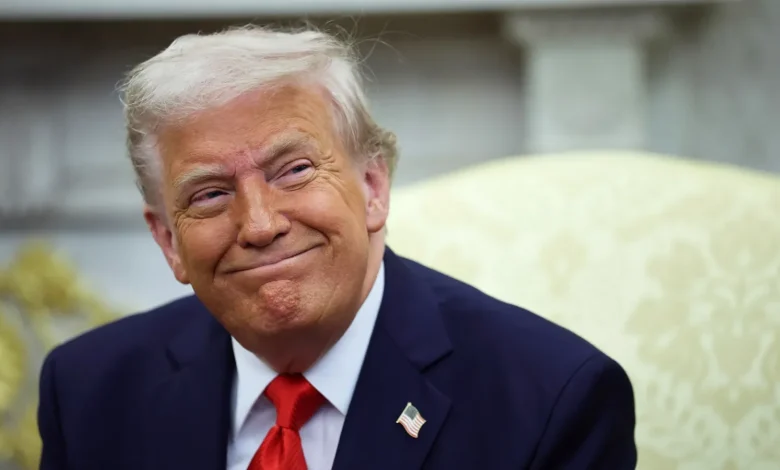
On Thursday afternoon, President Donald Trump signed an executive order enacting to reschedule cannabis under the Controlled Substances Act (CSA). The order directs the Attorney General to move cannabis from Schedule I, a category of drugs with high risk for addiction “no accepted medical use” that includes heroin and LSD, to Schedule III, reserved for drugs with “moderate to low potential” for addiction. This marks the first significant shift in federal marijuana policy since Richard Nixon declared a “war on drugs” in 1971.
Despite it being a Biden-era initiative, Trump did not hesitate to take credit for the decision. “We have people begging for me to do this, people that are in great pain for decades,” Trump said. “This action has been requested by American patients suffering from extreme pain, incurable diseases, aggressive cancers, seizure disorders, neurological problems, and more — including numerous veterans with service-related injuries and older Americans who live with chronic medical problems that severely degrade their quality of life.”
While some Republican lawmakers urged Trump not to sign the order, opposing cannabis as a “harmful drug that is worsening our nation’s addiction crisis,” advocates are touting the reform as a watershed moment in the march towards federal legalization that will open up research, ease tax burdens, and attract investment to an industry that exists in a constant state of flux. (Of course, anti-prohibition critics have said the order does not go far enough — that only by completely decriminalizing the plant, and retroactively pardoning the victims of the war on drugs, will we achieve progress.)
Either way, change is coming. Rescheduling is sure to have a massive impact on cannabis commerce — but will it benefit weed consumers and medical marijuana patients, or just make it easier for corporations and the government to cash in?
A Boon to the CBD Market
Because of its classification under the CSA, research on marijuana has been illegal under federal law for more than five decades. The Schedule III reclassification puts cannabis in the same class as drugs like Tylenol with codeine, ketamine, and anabolic steroids, acknowledging its medical properties and legalizing it for research, clinical trials, and pharmaceutical regulation. Rescheduling is controversial in some circles; most drug policy activists and cannabis entrepreneurs want to see cannabis descheduled and removed from the CSA entirely.
Editor’s picks
Trump’s executive order doesn’t legalize marijuana under federal law; it’s simply an acknowledgment from the government that cannabis possesses “currently accepted medical use.” Oncologist Brooke Worster, M.D., chief medical officer at Ethos, hopes that rescheduling will open the floodgates for research funding. She says that regulated studies “will help us learn what specific formulations and dosing are helpful” for patients, and better understand any harmful side effects of medical marijuana.
Some entrepreneurs worry that rescheduling could subject state-legal operators to newly restrictive regulations from the Food and Drug Administration (FDA). While it’s unclear how state systems will be affected by federal reform, Dr. Worster is hopeful that it will ultimately mean medical cannabis patients are covered by health insurance. “It could enable the cannabis industry to be a legitimate part of healthcare,” she says.
Trump’s executive order proposes allowing Medicare recipients to access cannabidiol, a.k.a. CBD, a non-psychoactive chemical compound found in cannabis, under the federal healthcare plan. Howard Kessler, founder of The Commonwealth Project, an organization promoting CBD, was present at the signing; Trump remarked that Kessler looks “better than he did 20 years ago,” presumably due to his use of CBD, which Trump touted on Truth Social in September as a “game changer” for seniors. The Commonwealth Project website issued a press release applauding Trump for his executive order “unlocking” medical cannabis. (As for where that CBD will come from, it’s anyone’s guess, since a provision in Congress’s recent spending package made it a lot harder for farmers to produce it.)
Related Content
Tax Relief Means Growing Businesses
The policy change also means that marijuana businesses will no longer face punishing IRS levies under 280E, a provision of the tax code that prohibits deducting business expenses from income derived from “trafficking” Schedule I or II substances. Without the tax breaks afforded to “regular” businesses, state-legal cannabis operations are forced to pay tax on their gross income at rates as high as 70 to 80 percent; moving cannabis to Schedule III means they can now take federal tax deductions.
Vince Ning, co-founder and CEO of the cannabis wholesale and distribution platform Nabis, says that getting out from under 280E will make a massive difference for the flagging cannabis industry. He anticipates a surge in spending on marketing, research, and development. “I think people will have 10 to 15 percent back to their bottom line,” he says. “There’s going to be more education for cannabis products, and there’s going to be a lot more innovation, because now those are all deductible costs.” Dr. Worster agrees: “Taxation changes will allow the cannabis industry to shift funding into research.”
What Will Big Pharma Do?
As a sense of jubilation ripples through the weed world at the news, Betty Aldworth, chair of the reform group Marijuana Policy Project, urges cautious optimism. “Patients and consumers should also understand the limits of this moment,” she says. “Rescheduling does not make products safer, more affordable, or more available. It doesn’t protect patients from losing housing or employment. And it does not meaningfully change how the justice system treats cannabis-related activity.”
Trending Stories
Jeffrey Miller, chief executive officer of New Jersey cannabis holding company HoneyProjects, says that once celebrations die down, he expects a sense of unease while federal agencies like the FDA rewrite regulations. “The demise of 280E will end the absurd financial chokehold we’ve labored under for over a decade, and rekindle the hope of survival for small cannabis businesses,” he says. “The new wild card is whether [cannabis reclassification] becomes a tool for Big Pharma or federal regulators to preempt state-legal systems.”
“Cannabis is a $38 billion sector operating successfully across most of the country,” Aldworth says. “Federal policy must catch up to political and scientific realities.” It remains to be seen if the reforms will work in favor of the industry as it currently exists — but, as he signed the executive order, Trump said, “I promise to be the president of common sense.” Rescheduling cannabis allows him to look that way for a moment, at least.