The US department of justice on Friday released a long-awaited and huge tranche of documents related to its investigation into the convicted sex offender Jeffrey Epstein, a major development in the lengthy political saga that turned into one of the biggest setbacks Donald Trump has suffered since his re-election last year.
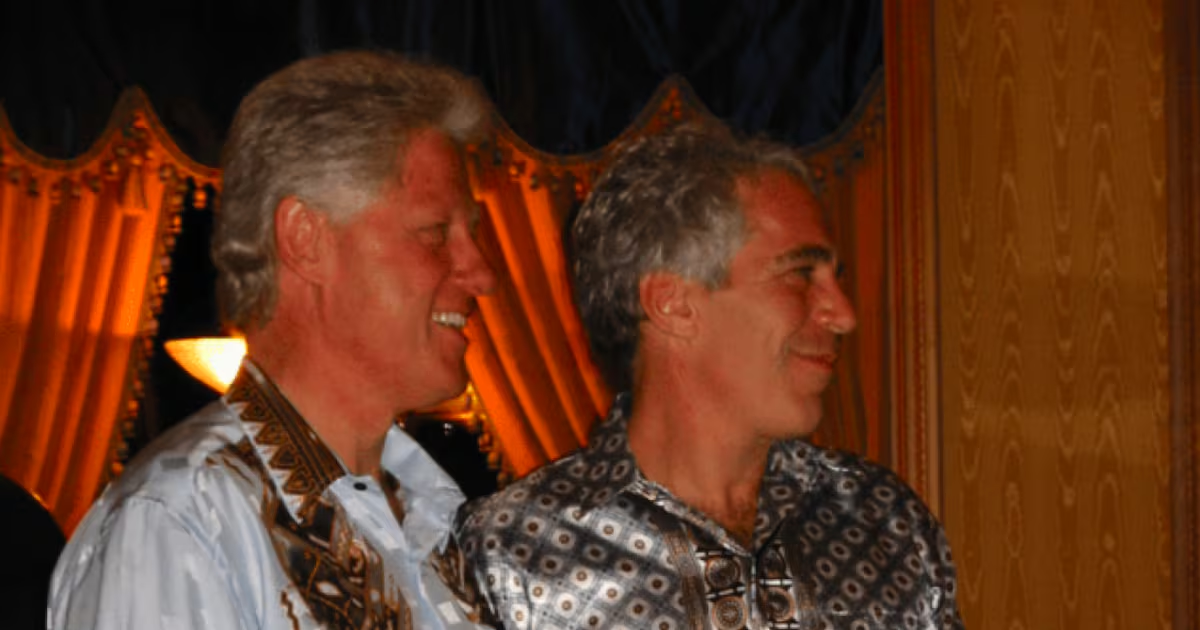
While significant portions of the files are redacted, those that were viewable included images of Epstein socialising with Bill Clinton and former British royal Andrew Mountbatten-Windsor, as well as entertainers like Michael Jackson, Chris Tucker and Kevin Spacey.
Epstein’s case has captivated public attention for years, and been the subject of countless conspiracy theories – largely due to his connections to powerful and wealthy figures in the US and overseas, including Trump.
The documents were made public after Congress passed the Epstein Files Transparency Act, which requires the justice department to release all “unclassified records, documents, communications, and investigative materials” in its possession relating to the investigation and prosecution of Epstein, who died in jail in 2019 while awaiting trial on federal charges of sex-trafficking minors.
The law also requires the justice department to publish any materials from the investigation that relate to Epstein’s longtime associate Ghislaine Maxwell. Maxwell was found guilty in 2021 of aiding Epstein’s sex trafficking of teen girls and sentenced to 20 years in prison.
Abigail Jackson, the White House deputy press secretary, said the documents’ release prove that “the Trump administration is the most transparent in history” and said the administration “has done more for the victims than Democrats ever have” by releasing the files and co-operating with Congress’s investigation into Epstein’s prosecution.
Mr Trump, who as president had the authority to make the documents public, opposed doing so, and said the concern over his ties to Epstein was a “Democrat hoax”. As the House of Representatives neared approval of the Bill in November, the president abruptly reversed his position and said Republican lawmakers should support it. It was later passed unanimously by the Senate, and Mr Trump signed the measure into law on November 19th, triggering a 30-day countdown for the documents’ release.
Although the law mandates the release of unclassified materials, it may not provide the full transparency demanded by numerous Epstein victims, as it does include notable carve-outs, including a provision exempting materials “that would jeopardize an active federal investigation” from being released.
The legislation also states that “no later than 15 days” after the materials are released, the justice department must provide Congress with a list of all categories of records released and withheld, a summary of any redactions made, and a list of “all government officials and politically exposed individuals named or referenced in the published materials”.
Before the release of the materials, experts warned that the disclosure of records may not provide a full accounting of Epstein’s crimes or his network, and that it could still leave many Epstein questions unanswered.
On Friday morning, Todd Blanche, the deputy attorney general, said that he expected that the department of justice would “release several hundred thousand documents today” on Epstein, in compliance with the law, and “more documents over the next couple of weeks”.
Mr Trump vowed to release Epstein-related files as he campaigned for president last year. This summer, his administration sparked backlash after the justice department announced it would not release any files related to the late financier, and said it had found “no incriminating client list” despite earlier claims from Pam Bondi, the attorney general, that such a document was sitting on her desk.
The announcement sparked bipartisan outrage – including from some Trump supporters – and reignited scrutiny of Epstein’s past ties to Mr Trump,with whom he was friendly for at least 15 years before falling out in 2004. The president has consistently denied any knowledge of or involvement in Epstein’s criminal activities.
In mid-November, several days before Congress voted to release the department of justice’s files, Democrats on the House oversight committee released three email exchanges they received from Epstein’s estate in response to a subpoena, from 2011, 2015 and 2019 – including one email in which Epstein claimed that Mr Trump “knew about the girls”.
Karoline Leavitt, the White House press secretary, dismissed the emails, and accused Democrats of “selectively” leaking them “to create a fake narrative to smear President Trump”.
Later that day, Republicans on the committee released over 20,000 documents they received from Epstein’s estate, including emails between Epstein and prominent figures.
In early December House Democrats on the committee released several dozen photographs from Epstein’s estate that highlight his ties to prominent figures, including Mr Trump, Mr Clinton and Mr Mountbatten-Windsor.
The images represent a small number of the almost 100,000 images given to the House committee, and were released without context or captions.
This week, House Democrats on the committee released another batch of photos from Epstein’s estate, as the deadline for the DoJ to release its files loomed.
Among the images were photographs of lines from Vladimir Nabokov’s novel Lolita – which is about a middle-aged man’s sexual obsession with and sexual abuse of a 12-year-old girl – written on different parts of a woman’s body. It was reported earlier this year that photos from inside Epstein’s Manhattan mansion revealed that he kept a first edition copy of Lolita in his office.
The same batch also included photos of travel documents, and notable people like Bill Gates, Woody Allen, Noam Chomsky, and Steve Bannon, Mr Trump’s former adviser.
The images provided by the estate were undated, and provided without context. The appearance of these people in the photos is not evidence of any wrongdoing. – Guardian