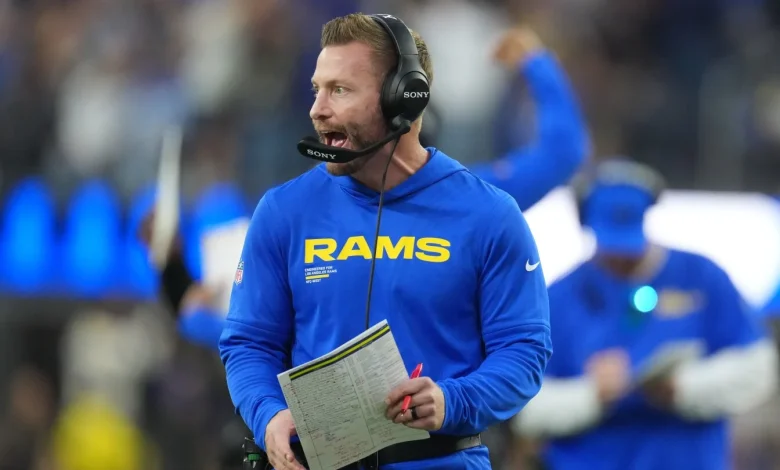
Immediately after Thursday night’s instant overtime classic between the Rams and Seahawks, Rams coach Sean McVay had questions about the nutty two-point conversion that tied the game at 30 in the fourth quarter. He has since gotten some answers, and he doesn’t seem to like them.
“It’s a technicality issue,” McVay told reporters on Friday. “What they said is, ‘You can’t advance a fumble under two minutes on two-point plays or on fourth downs.’ That’s the thing. Because they said it was a backwards pass, that’s how it was able to be advanced. I think we would all be in agreement, and I have a total appreciation for the layers in the semantics of all the rules, especially being on the Competition Committee. There’s a lot of empathy and difficult spots that some of our officials and everybody’s in, but I do believe that is not something that we want in the game.”
That’s a very strong statement. The rulebook distinguishes fumbles from backward passes. The rule regarding the recovery and potential advance of fumbles on fourth down, with less than two minutes to play, or during a try traces to the Holy Roller. A backward pass has always been handled differently, presumably because there’s no plausible way that someone could “accidentally” engineer a backward pass in a moment of desperation with the goal of getting the ball to where it absolutely needs to be.
“When you’re able to review a two-point play, you split hairs on, alright, is it a forward pass? Is it a backwards pass? When you reject it, they casually pick it up, which you always do that. The whistle is already blown dead, mind you. Then they wait [a minute and fifty seconds] in real time to then go back and say, ‘We’re going to review this.’ Then it ends up getting called a two-point play. By rule, because it was considered a backwards pass and not a fumble, they were able to advance that. I do not believe that anybody would be in disagreement that those are not the plays we want in our game. That was not their intent. They were trying to throw a lateral screen. It got batted down and it was not a successful conversion but by letter of the law, it was. Those will be things that we’ll discuss. I do know this, those aren’t the kind of plays that you want to have people converting on. That’s not something that I can imagine anyone would argue with me on that. I would feel the same way if it benefited us, too.”
McVay’s point reminds us of the observation made in the aftermath of the Steelers-Ravens game. Pittsburgh coach Mike Tomlin, who also is a member of the Competition Committee, had a chance to question that convoluted catch rule that was arguably (if not actually) misapplied in a way that benefited his team, twice. Tomlin chose not to acknowledge that the Steelers may have gotten a gift.
Whether the league actually looks at changing the rules regarding the recovery and potential advance of a backward pass remains to be seen. The primary rule change that kept the ball alive after it was seemingly dead traces to 2009, when the league decided to allow clear recoveries during the continuing action of a ball that were determined, via replay review, to still be live. (It’s the Chargers-Broncos example from 2008 that was addressed earlier today on PFT Live, and in this post.)
Ultimately, McVay’s concern relates to the difference between a teammate not being able to recover and advance a fumble under certain circumstances while being able to recover and advance a backward pass under all circumstances.
“It’d be like if you fumble the ball on a toss, you can pick it up and advance it,” McVay said. “But when situations and circumstances arise like that, those will be things that I guarantee you will be addressed and conversed over to try to eliminate plays like that for being able to happen while totally acknowledging and being aware that there are a lot of layers to it where it’s not exclusive to those plays because there are other things that you’re saying, ‘Alright, it opens up a can of worms with that.’ That’s something that I have gotten exposure to behind the scenes on the Competition Committee that there’s a lot of empathy for. What I will say at the end of the day is, I can’t imagine anybody thinks that plays like that should be counted as conversions. I know I would feel that way even if I was a beneficiary and the roles were flipped and that benefited us last night. I can honestly say that.”
Seahawks coach Mike Macdonald, whose team benefited from the crazy two-point play, has expressed no such concerns. The real question is whether the rest of the Competition Committee or, more importantly, at least 24 owners, will agree with McVay’s belief that backward passes should be treated like any other fumble on a two-point conversion attempt specifically, and in other situations where a fumble can’t be recovered and advanced by anyone other than the player who lost the ball generally.