Stranger Things is finally gearing up for its swan song, with season 5 rolling out in two parts: one arriving this Thanksgiving week, the other on New Year’s Day. It’s wild to think how far the series, and its once-preteens stars, have come since its 2016 premiere. Those fresh-faced kids are now bona fide movie stars, Millie Bobby Brown is married, and the show’s place in pop culture is all but cemented (see: Netflix’s plans for multiple spinoffs). Though it’s widely celebrated for its ’80s-infused, coming-of-age sci-fi flair, many have forgotten that the series’ central character pulls from an anime you might not expect.
Most viewers assume Eleven’s arc is a nod to Akira, but the true inspiration is Elfen Lied, a series that, in turn, was shaped by Akira. It’s easy to understand the confusion: Akira is the bigger name, and its influence can be seen across pop culture to this day, to the point that Samus Aran is the latest in a string of other characters to do the famous bike slide, this time as a new attack in Metroid Prime 4.
Back in a 2016 interview, The Duffer Brothers were asked if any images or movies helped shape the series, and although Akira was mentioned, Matt admits, “I haven’t seen it for a long time.” But a slightly deeper cut came up: “More recently I had seen an anime called Elfen Lied that is clearly inspired by Akira. And that was really influential,” he said. “When I watched it I thought it felt like an ultraviolent E.T. There were a lot of things in there that I really liked and that made their way into the show, particularly related to the character of Eleven.”
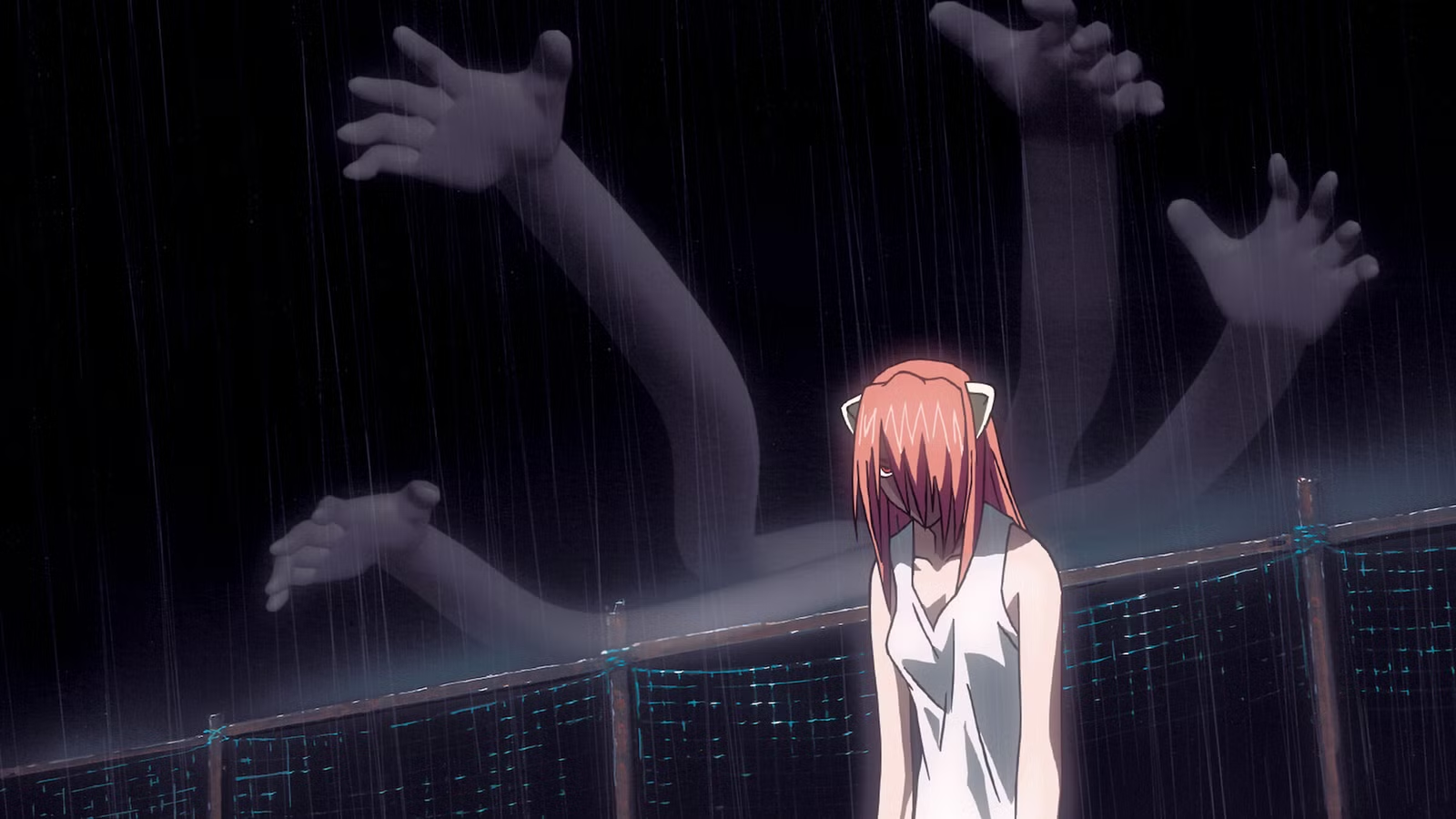
Most people aren’t familiar with every 2000s-era otaku’s favorite edgelord anime, Elfen Lied, or just how closely its story mirrors Eleven’s. The series kicks off with one of anime’s most iconic first episodes, so memorable that Stranger Things mirrors Lucy’s escape from a government lab, itself steeped in Akira-inspired imagery.
At its core, Elfen Lied follows Lucy, a deadly mutant known as a Diclonius who escapes from a government facility and, after suffering a traumatic head injury, develops a childlike alternate personality named Nyu. Taken in by two college students unaware of her violent past, she becomes the center of a brutal conflict between human cruelty, scientific obsession, and the question of whether someone engineered for violence can ever be shown compassion. The clandestine organization now deploys other Diclonius to subdue and recapture Lucy before she causes more devastation. Sounds eerily similar to the first season of Stranger Things, doesn’t it?
Lucy in Elfen Lied, and Eleven in Stranger Things share the same blueprint: young girls with deadly telekinetic powers, raised and weaponized inside secret labs. Both break out in a burst of violence and enter the real world scared, alone, and unsure of who they’re allowed to be. Like Eleven, Lucy is taken in by people who have no idea what danger they’ve invited into their lives. Kouta and Yuka in Elfen Lied, and Mike’s group in Stranger Things, all end up facing armed teams determined to drag these girls back, and they risk everything to protect them. The facility that housed the Diclonius was all numbered, presumably Lucy as well, just like Eleven.
Both stories also hinge on the same internal struggle: reconciling immense, destructive power with the desire to be loved and live a normal life. Eleven wrestles with guilt and belonging; Lucy battles vengeance and compassion.
Image: Arms Corporation
The series is a short 13-episode venture that gets a little repetitive, as if it’s only grazing the surface of its otherwise grandiose premise. The first two episodes are truly the standouts, which went on to carry that reputation for years. Retrospectively, the anime is a bit shallow in its character depiction, as they lack depth or realistic decision-making, feeling like they’re done just to keep the plot moving. Back in the day, anime that showed just enough gore and nudity was propelled to artistic status. With its haunting theme “Lilium” by Kayo Konishi & Yukio Kondo, sung by Kumiko Noma, alongside the series’ rather languid aesthetic, Elfen Lied on the surface projected an appearance of elevated storytelling that never followed through beyond the first few episodes. Today, it may come off as a bit too edgy, or even “cringe,” which is why, despite its previous popularity, it is now mostly forgotten by today’s audience.
Elfen Lied’s anime offers a solid preview of the story, but the manga is on another level. The series closely mirrors the manga up to a point and makes an ideal jumping-off point, though the source material delivers a far stronger narrative as it eventually splinters off from the anime’s plot. The manga delves into the mystery of the Diclonius, offers a more complete conclusion for Lucy, and is much more graphic than the anime.
The similarities between Eleven and Lucy end there, but it’s interesting to see how much Stranger Things has evolved beyond its influence now. Although the series later introduces people with abilities like Eleven’s, the show seems to be moving toward exploring the creatures of The Upside Down rather than focusing on the small batch of teens with supernatural abilities Eleven previously met. It should make one wonder: had the Duffer Brothers stuck to their original anthology plan, would Stranger Things have stayed closer to its Elfen Lied roots, with Eleven clashing with her telekinetic “family” just like Lucy? Well, it ain’t over till it’s over, so don’t be surprised if the series doesn’t circle back on this idea.