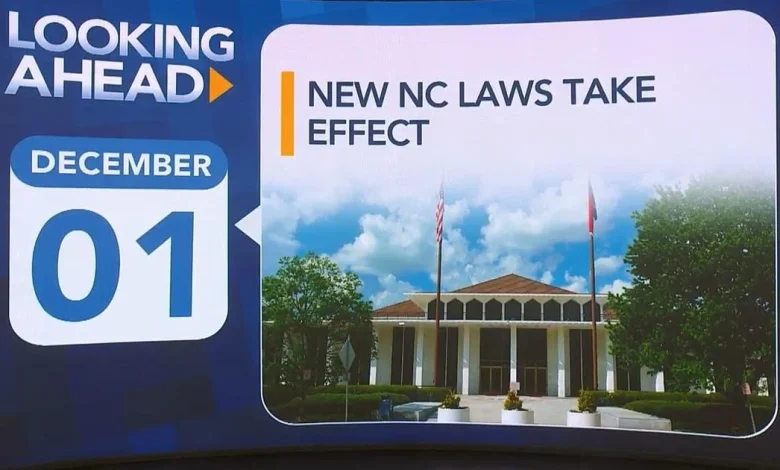
Public safety reforms, new powers for the state auditor and new crimes tied to natural disaster recovery efforts are among the state laws that go into effect Monday.
Some earned near-unanimous support in the state’s Republican-led legislature. But others were more politically contentious, especially new efforts to allow guns in some schools and to restart the death penalty in North Carolina, where no one on death row has been executed since 2006.
Many of the laws taking effect on Monday deal with public safety and the prosecution of crimes. Here’s a breakdown of some of the more high-profile laws:
Death penalty restart
One of the most heavily debated new laws is what sponsors call “Iryna’s Law,” which makes it harder for people to get out of jail on bail for low-level crimes. It also attempts to restart the death penalty in North Carolina.
It’s named for a woman who was stabbed to death on a train in Charlotte. The homeless man accused of killing Iryna Zarutska had been released from jail earlier this year, without being required to pay bail, following his arrest on a separate misdemeanor charge in another case. Police allege he misused the 911 system in that case. He was charged and arrested after calling from a hospital, claiming his body was being controlled by someone else, but then quickly released back onto the street.
After he was later accused of murdering Zarutska in the seemingly random attack in public, many scrutinized the earlier arrest and questioned why he hadn’t been held in jail longer, or potentially committed to a mental hospital.
Iryna’s Law requires stricter scrutiny on judges and magistrates when considering pre-trial release. It bans one type of cashless bail in North Carolina. And it makes it easier for people who have a history of mental health issues to be involuntarily committed to a mental hospital after an arrest.
The law also attempts to bring back the death penalty in North Carolina, ordering the administration of Democratic Gov. Josh Stein to find a solution to get around the fact that lethal injections are essentially banned due to a series of court rulings and other factors. No one has been executed in North Carolina since 2006, even though more than 120 prisoners remain on death row.
The law requires Stein’s top prison officials to recommend new ways of executing people, such as firing squads or the electric chair. Stein is opposed to that piece of the law, saying that as long as he remains governor, no one will be executed by firing squad.
Democratic lawmakers heavily criticized other parts of the law as well, saying it contained no funding for mental health care and does nothing to try stopping violent crime, instead focusing solely on punishments to be doled out after a crime has already been committed.
Stein signed the bill into law but echoed many of those same concerns. He said he signed the bill even though he was “troubled by its lack of ambition or vision. It simply does not do enough to keep you safe.”
Guns in schools
Private schools will now be allowed to start using parents, teachers or other volunteers as armed security guards, due to another law going into effect Monday. Republicans passed it into law this summer over Stein’s veto.
Public schools often have local law enforcement officers on campus to provide security. Private schools are allowed to hire professional security guards, but many either can’t afford it or would rather spend their money on other issues.
Supporters say allowing armed teachers or other volunteers on campus will help private schools save money and could help stop future school shootings. Critics say it’ll cause more security concerns than it solves, by increasing the chances that a gun is found or stolen by students, or that an inexperienced volunteer accidentally fires their weapon or, in an emergency situation, shoots the wrong target.
The law requires some training and vetting: A concealed carry permit, eight hours of training and permission from the school will be required to carry guns on campus at private schools.
Sexual exploitation
Another law creates a new legal process for people whose nude images are on the internet to try getting them taken down, in an effort to fight against sexual exploitation.
It began as a bipartisan effort and passed the state House unanimously. But the state Senate then turned the bill into a grab-bag of social conservative issues by adding various unrelated new laws related to transgender people and LGBTQ rights.
Stein vetoed it, writing that he would’ve signed the original version of the bill into law, but that “instead of preventing sexual exploitation, the General Assembly chooses to engage in divisive, job-killing culture wars.”
Stein urged Republicans to rewrite the bill to its original version, but they didn’t need to. The legislature overrode his veto after one Democrat, Charlotte Rep. Nasif Majeed, crossed party lines to help the GOP pass it into law.
Expanded probes of individuals, businesses
Another law expands the power of North Carolina State Auditor Dave Boliek to investigate any entity — including private businesses and individual people — that receives state or federal funding.
Under the new law, the auditor can demand access to databases, datasets and digital records needed “for any purpose within the authority of the auditor, including performing audits of any type, assessing government efficiency, risk assessment, fraud detection, audit planning, and evidence gathering.” And it gives the auditor the power to seek court intervention when someone doesn’t comply.
The law passed in July after lawmakers overrode Stein’s veto. Stein rejected the bill because he worried it could affect the state’s economy. Many large companies expand their workforces in North Carolina, or build new factories and office buildings, in exchange for state-funded incentives.
“Giving the auditor this intrusive power may undermine our state’s efforts to recruit businesses to North Carolina,” Stein said. “Additionally, the bill would remove the Office of State Auditor from the state’s cybersecurity efforts led by the Department of Information Technology, putting North Carolinians’ personal identifying information at heightened risk of a breach.”
Boliek has said at the time that the new power will help his office maintain independence and that it “enhances our ability to create a more effective, efficient, and accountable government.”
Boliek is the first Republican to serve as auditor in years, and the Republican-led legislature has responded by ramping up his budget and increasing the office’s power. Democratic critics say he’s operating in a more partisan fashion than previous auditors, and the moves are a smokescreen to expand the GOP’s control of state government.
New disaster laws
Another new law will ban political discrimination in disaster relief efforts. After Hurricane Milton, in Florida, a Federal Emergency Management Agency employee was fired after allegedly telling her team to avoid homes with Trump signs.
North Carolina lawmakers reacted by making it a felony for anyone to do something similar here, in a new law that also ramps up criminal penalties for people who loot homes in the aftermath of a natural disaster.
Embalming fluid regulations
A new state regulation will make it harder for members of the general public to buy embalming fluid, the culmination of a Wilson mother’s years-long effort to crack down on sales of the substance that some people, including her late son, have used to get high.
Other public safety changes
A slew of other laws go into effect Monday.
- One wide-ranging new law, just in time for holiday shopping, contains stricter criminal penalties for people who steal gift cards or who steal people’s mail and packages.
- That same law also mandates harsher penalties for assaulting utility workers, reckless driving and street racing, hit-and-run crashes and more.
- Another new law creates new crimes for exposing children to drugs, and for repeat offenders of domestic violence. It also adds religious institutions to the list of organizations whose employees or volunteers can face harsher criminal penalties for child sex abuse.