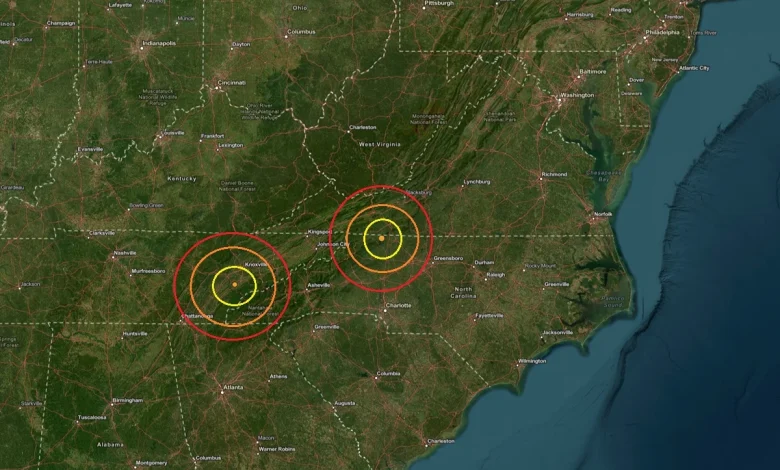
The epicenter of each earthquake was at the orange dot inside the colored concentric circles on the map. Image: USGS
Two unrelated earthquakes struck western North Carolina and eastern Tennessee today; both were weak. According to USGS, the first struck near Lowgap, North Carolina at 7:11 am from a depth of 6.2 km; it was rated a magnitude 2.1 event. Lowgap is between Blacksburg, Virginia and Charlotte, North Carolina near the Blue Ridge Parkway. The second struck near Greenback, Tennessee at 11:53 am from a depth of 12.3 km; it was rated weaker as a magnitude 1.7 event. There were no reports of damage or injuries nor would any be expected at these intensities.
USGS says that earthquakes with a magnitude of 2.0 or less are rarely felt or heard by people, but once they exceed 2.0 , more and more people can feel them. While damage is possible with magnitude 3.0 events or greater, significant damage and casualties usually don’t occur until the magnitude of a seismic event rises to a 5.5 or greater rated event.
Today’s earthquake joins other weak earthquakes that have struck recently in the eastern United States; they include New Jersey Georgia and New Hampshire. None of the earthquakes appear to be directly tied to the others.
While the U.S. West Coast is best known for their earthquakes, there is considerable earthquake risk elsewhere in the country. Image: USGS
Noteable earthquakes in North Carolina from 1874-Present. Image: North Carolina Department of Environmental Quality
Earthquakes are not common in North Carolina, but they do occur, with most being small and not causing damage. While the state isn’t known for frequent or strong seismic activity, occasional tremors can be felt, and some larger earthquakes have been recorded in the past. While the mountains and foothills of western North Carolina are not located along an active tectonic plate boundary, the region still has minor earthquakes linked to old fault lines along the Appalachian Mountains.
According to the North Carolina Department of Environmental Quality, while North Carolina is no stranger to earthquakes, large, damaging earthquakes are rare. Large, damaging seismic events are rare and the few felt in North Carolina had epicenters outside of the state. Most quakes in North Carolina originate from the East Tennessee seismic zone to the west, the Charleston, South Carolina seismic zone to the south, or the Central Virginia seismic zone to the north. The most common and strongest earthquakes to strike the state have been in the western part along the Appalachian Mountains.
Earthquakes like the one that occurred earlier today in the eastern part of Tennessee are unlikely associated with the New Madrid Seismic Zone. However, while USGS says western Tennessee has a higher frequency of damaging earthquake shaking, the risk isn’t that low in eastern Tennessee. In the area of today’s earthquake, USGS says its likely this area would see 50-100 damaging earthquakes over 10,000 years. While this number is low, it is much higher than it is elsewhere in the eastern half of the United States, where it’s likely to have 10 or less earthquakes over the same period.