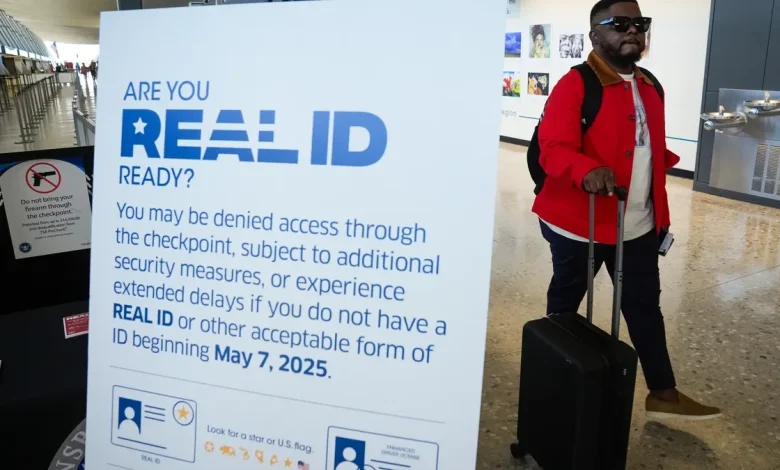
REAL IDs are coming soon, here is what you need to know
A regulation 20 years in the making will go into effect May 7 as adult travelers will need a REAL ID to travel domestically.
For those who are planning to travel by plane this holiday season, more than a ticket will be needed to board. Travelers now need a REAL ID-compliant identification to board a federally regulated commercial aircraft, or face paying a fee for not having the proper identification. But what exactly is a REAL ID?
REAL ID-compliant IDs are state-issued documents of identification — such as driver’s licenses — that comply with “minimum security standards” that have recently begun to be enforced in order to travel by plane.
With more holiday travels on the horizon, here’s what you need to know about the REAL ID and how you can get one.
Why are REAL IDs required now?
The Transportation Security Administration began requiring REAL ID-compliant IDs for adult travelers flying domestically within the United States in May 2025 after 20 years of pushes for stricter identification safety regulations following the 9/11 terrorist attacks. The 2005 law connected to the REAL IDs enacted the Sept. 11, 2001, commission’s recommendation to approve stricter federal requirements for issuing identification cards.
The new regulations outline that every air traveler 18 years of age and older must have a REAL ID-compliant ID, which is a state-issued driver’s license, state-issued identification card, or another acceptable form of ID, such as a U.S. passport, TSA said in a past statement.
Can I fly without a REAL ID?
You can travel without a REAL ID if you have another form of identification approved by the TSA. Here are TSA’s acceptable forms of ID as of Dec. 1, though the list could change in the future:
- REAL ID-compliant driver’s licenses or state photo identity cards issued by the DMV or state’s equivalent
- State-issued Enhanced Driver’s License or Enhanced ID
- U.S. passport or passport card
- Department of Homeland Security trusted traveler cards, like Global Entry
- Permanent resident card
- Border crossing card
- Photo ID issued by a federally recognized Tribal Nation/Indian Tribe
- U.S. Department of Defense ID, including those issued to dependents
- Veteran Health Identification Card (VHIC)
- U.S. Merchant Mariner Credential
- U.S. Citizenship and Immigration Services Employment Authorization Card (I-766)
- Transportation Worker Identification Credential (TWIC)
- HSPD-12 PIV card
- Foreign government-issued passport card
- Canadian provincial driver’s license or Indian and Northern Affairs Canada card
So, if you haven’t gotten a REAL-compliant ID from the list above since the implementation earlier this year, you can now expect to pay $45 to catch your flight.
How do I get a REAL ID?
Travelers can receive a REAL ID when they apply for or renew their driver’s license or state identification card, according to usa.gov. It is during that application process that you can choose to make your new identification REAL ID-compliant, designated by the star icon.
To get a REAL ID, most driver’s licensing agencies will require people to bring multiple items and documents, including ones showing proof of:
- Identity – including a U.S. birth certificate, U.S. passport, or Permanent Resident Card (Green Card) if you are a non-U.S. citizen.
- Social Security number – Travelers can prove this by bringing their Social Security card, Form W-2, or a pay stub or paycheck from their job.
- Residency – Your state agency could ask for a deed, mortgage statement, lease agreement, utility bill, or bank statement to prove your residency, according to usa.gov.
How do I know if I already have a REAL ID?
A REAL ID is designated with a symbol on the upper right-hand corner of your driver’s license or state ID, most commonly a colored circle with a white star.
Some states have other symbols along with the star, like California, which has the star placed inside the outline of a bear.
While the TSA website does not explicitly state what documents would be considered non-compliant, it reiterates that the documents listed above and those marked with the special symbol are “acceptable” and compliant with the new rules. Travelers with documents deemed non-compliant will face the $45 fee.
Kate Perez covers trends and breaking news for USA TODAY. You can reach her at kperez@usatodayco.com or on Twitter @katecperez_.