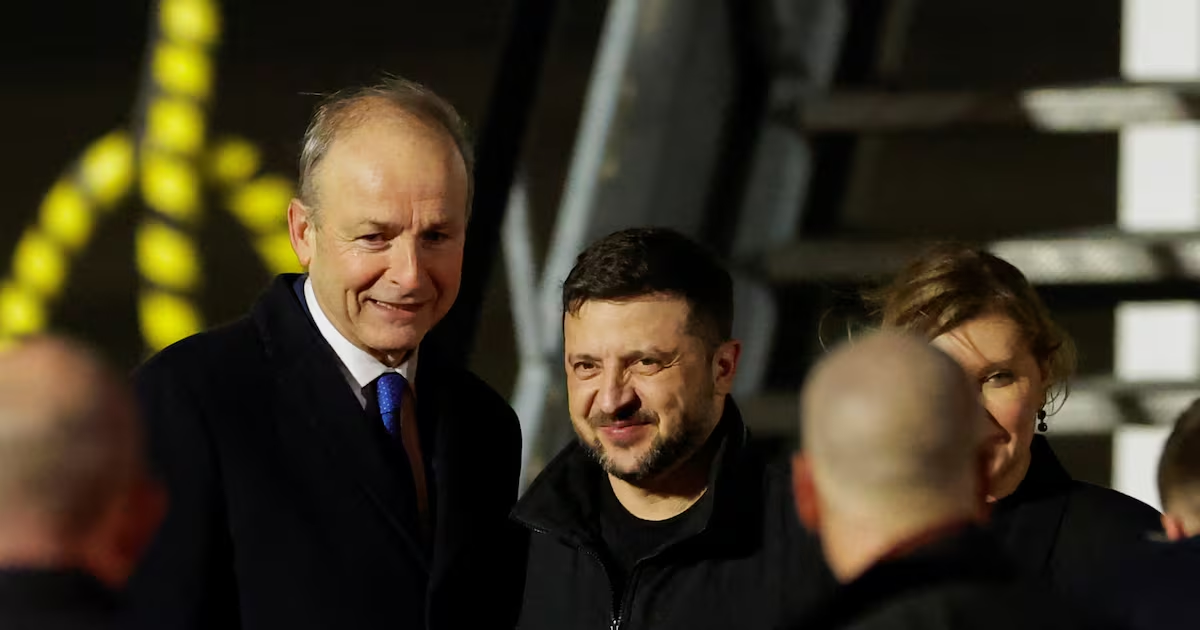
Shortly before 11pm last night, the Ukrainian government’s Airbus A319 touched down on the tarmac of Dublin Airport. Inside were Ukrainian president Volodymyr Zelenskiy and first lady Olena Zelenska, who had made history before they had even got off the plane. Both of them were now here as part of the first ever official visit of a Ukrainian president to Ireland.
On the concrete below, Taoiseach Micheál Martin peered up at the door of the plane as the air stairs and the red carpet were rolled into place. Shortly after landing, the pilot attached a blue and yellow flag to the window of the cockpit. A black Government car parked at the bottom of the air stairs, ready for the VIPs. There was a heavy security presence, from the members of the Garda emergency response unit on the ground at the airport to the force’s helicopter that would hover above Mr Zelenskiy’s convoy as it whisked him out of the airport and on to the M50.
Our lead story today, which reveals that the Irish Government will use the visit to announce an extra €100 million in non-lethal military support and €25 million in energy support for Ukraine, also details the major security operation that has fallen like a thick blanket over the capital city today in advance of the trip. Leinster House is effectively locked down to all but essential staff, and details of the visit were kept under wraps for as long as possible before the Ukrainian president’s arrival.
As the Ukrainian president and his wife, both dressed all in black, stepped out of the door of the plane and into the chill of an Irish winter night, they were arriving into the same country that at least 120,000 of their fellow Ukrainian nationals have passed through since Russia’s invasion nearly four years ago. At least 80,000 of those people are still here. The couple held hands as they descended the staircase and into the warm greeting of the Taoiseach and the Minister of State for European Affairs and Defence Thomas Byrne.
The céad míle fáilte afforded to the special guests brought to mind the welcome offered to many Ukrainians who have sought refuge in Ireland from the war over the last number of years. But Mr Zelenskiy’s first visit also comes just a month after the Government started to drastically limit the accommodation and support that it offers to Ukrainian people, as Ireland’s integration system continues to come under strain. We have also reported that as far back as December 2025, Government officials had been considering cutting all State-funded commercial accommodation for Ukrainian people by March 2026. That proposal has been dropped, but the coming year may well see even more limits placed on the State’s response to Ukrainian nationals who come here.
But for Mr Zelenskiy the priority now is not what European allies are doing to help those escaping the war but what countries such as Ireland can do to stop the conflict that forces Ukrainians to flee in the first place. Mr Zelenskiy needs Europe’s help to ensure Ukraine’s sovereign interests are represented in any peace deal that is being negotiated by the United States.
The Ukrainian government plane travelled to Dublin last night from Paris, where Mr Zelenskiy had spent hours meeting with French president Emmanuel Macron. Those who are keenly following the Ukrainian president’s visit to Ireland today will also be casting a glance at events in Moscow, where US envoy Steve Witkoff is expected to meet Russian president Vladimir Putin.
And back in Kyiv, a senior adviser in Zelenskiy’s office has said the deployment of European peacekeepers to Ukraine should be a “fundamental” part of any deal to end the war with Russia.
Mr Zelenskiy will make a courtesy call to President Catherine Connolly in Áras an Uachtaráin this morning, and later this afternoon will make a special address to both Houses of the Oireachtas. He is also expected to attend the launch of the Ireland-Ukraine Economic Forum, and meet representatives of the large Ukrainian community based in Ireland.
Infrastructure plans
Mr Zelenskiy’s visit has upended most of the quotidian Irish political schedule today, but Ministers will still attend a cabinet meeting this morning. My colleague Jack Horgan-Jones is reporting this morning on what is likely to be the most important thing that Ministers around the table will consider today, which is the long-anticipated report of the Accelerating Infrastructure Task Force. Among its recommendations is a proposal to exempt large extensions to critical infrastructure from requiring planning permission.
Since the Government formed, senior politicians have been voicing their frustrations about the lethargic pace at which planning and infrastructure projects move in this country. There is a strong view within the Government that the issues that tend to plague big projects involving the likes of housing, roads, water treatment plants and energy substations cannot be easily solved by having money thrown at them. It’s because of the Government’s own rhetoric that this new plan, with the express aim of speeding all of those things up, has started to assume so much importance. Some in the Coalition think resolving the blockages in Ireland’s infrastructure will be more important than the recently unveiled housing plan.
The report is expected to propose reforming the judicial review process; with the legal mechanism having become a bête noire for Ministers who insist that such reviews are being used as an extension of the planning process. It comes as it’s reported in the paper today that the High Court has heard that a group of Ranelagh residents is willing to enter mediation in an effort to settle its legal challenge to the MetroLink rail project.
Best Reads
There are two very interesting columns on the issue of immigration in the opinion pages today. The first is by Fintan O’Toole, who is arguing for a “genuine debate” on immigration – but one that interrogates what a drop in migration would mean for the Irish labour market. The second piece is by Nick Henderson of the Irish Refugee Council, who is warning that children and families will be the ones most affected by a recent change in immigration rules here.
Elsewhere in the paper, Colm Keena writes about that mysterious – or maybe now not so mysterious – trip to Syria that President Connolly spent so much of the October election defending.
And Sally Hayden has a really interesting dispatch from the Pope Leo XIV visit to Lebanon. The leader of the Catholic Church praised the diversity of the people of Lebanon, who, he said, “stand as a powerful reminder that fear, distrust and prejudice do not have the final word and that unity, reconciliation and peace are possible”.
Playbook
Cabinet is meeting this morning, and the aforementioned story from Jack Horgan-Jones also details some of the issues that Ministers will bring to the meeting.
The usual Dáil schedule has been upended today for the official visit of President Zelenskiy, who will make a special joint address to both Houses of the Oireachtas at 3.45pm. The Dáil will adjourn afterwards, with normal business only resuming at 6pm this evening.
The schedule for the brief, late sitting of the Dáil is as follows:
6pm: Order of Business.
6.10pm: A motion without debate, to instruct the committee on the Environment (Miscellaneous Provisions) Bill 2025. This will be immediately followed by Government business, which is at the second stage of the Remediation of Dwellings Damaged by the Use of Defective Concrete Blocks (Amendment) Bill 2025.
9.45pm: Private Members’ Business slot is for Sinn Féin’s motion on Irish Coast Guard search and rescue services.
The Dáil will adjourn at 11.45pm.
The Seanad also won’t resume its ordinary business until 6pm this evening, after Mr Zelenskiy has long left Leinster House.
The schedule of the upper house this evening will look like this:
6.00pm: Order of Business.
6.45pm: Motion without debate, regarding proposed approval by Seanad Éireann of the Planning and Development Act 2024 (Modification) Regulations.
7.15pm: Following a 25-minute break, the Government business in the Seanad will be at the committee stage of the Mental Health Bill 2024.
9.15pm: This is followed by second stage of the Finance Bill 2025, which gives effect to Budget 2026.
The Seanad will adjourn at 11pm.
TDs and Senators on the various Oireachtas committees also won’t be meeting until after 6pm. The most interesting is probably the Joint Committee on Housing, Local Government and Heritage, which will hear from a range of academics and interest groups on the Government’s reforms of the rental sector.