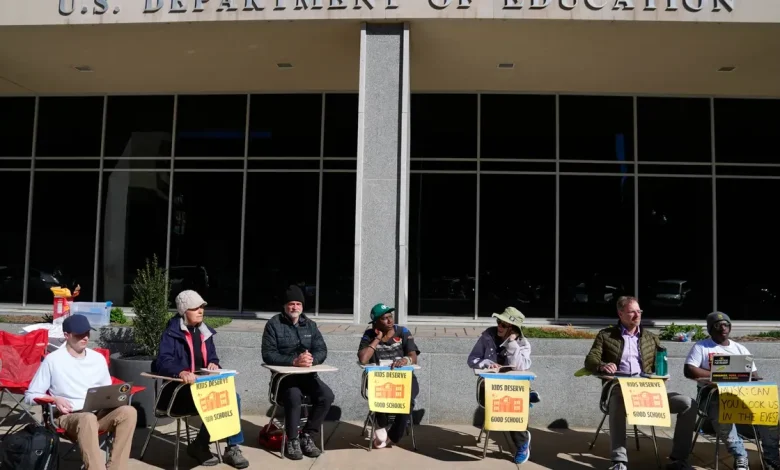
The real reason we have an Education Department
The Education Department was created to level the field. Here’s why students with disabilities and marginalized communities still depend on it today.
On the Tuesday, December 2, 2025 episode of The Excerpt podcast: Trump’s latest Education Department moves target some of the agency’s most important programs. From Title I to special education to student aid, we break down what’s moving, what’s staying and what the changes mean for millions of students. Zach Schermele joins USA TODAY’s The Excerpt to unpack it all.
Hit play on the player below to hear the podcast and follow along with the transcript beneath it. This transcript was automatically generated, and then edited for clarity in its current form. There may be some differences between the audio and the text.
Podcasts: True crime, in-depth interviews and more USA TODAY podcasts right here
Dana Taylor:
President Donald Trump’s quest to dismantle the Department of Education went into high gear late last month, with six interagency agreements that redistributed longstanding functional areas of the department. Well, Congress finally caved in and let Trump abolish the ED. Hello and welcome to USA Today’s The Excerpt. I’m Dana Taylor. Today is Tuesday, December 2nd, 2025. Here to help me dig into all of the changes at the Education Department, now joined by USA Today Congress reporter, Zach Schermele. Thanks so much for coming back, Zach.
Zach Schermele:
Thanks, Dana.
Dana Taylor:
While only Congress can completely act as a federal agency, the Supreme Court has allowed the White House to move forward for now with mass education department layoffs. Walk me through the latest changes.
Zach Schermele:
This is arguably one of the most significant steps that the education department under the second Trump administration has taken to try and fulfill that promise of the presidents to completely eliminate or dismantle the agency. Now, the president has encountered a not insignificant number of roadblocks in actually trying to fulfill that vow, namely some of his own signature legislation. The One Big Beautiful Bill Act put a lot of new responsibilities into the purview of the Department of Education. There also isn’t really the votes in Congress at this particular moment in time to move forward with completely abolishing the agency. So Education Secretary Linda McMahon is doing what she can do, and the Supreme Court earlier this year allowed the agency to continue with an interagency agreement is what it’s called or an IAA with the Department of Labor to allow that agency to oversee and to start to administer some programs with respect to career and technical education.
And because the Supreme Court allowed the secretary to move forward with that transition, she now has identified several other offices and is trying to move a significantly larger piece of the education department’s portfolio over to other federal agencies, including the Department of Interior, the Department of State, the Health and Human Services Department and the Labor Department.
Dana Taylor:
Zach, are the Departments of Labor and the Interior prepared to take on these new responsibilities? Do they have the infrastructure in place?
Zach Schermele:
I think that is a great question and is certainly a question that folks who are going to be reliant on the programs, students and families, as well as schools and states that help to distribute funding for federal education programs are going to continue to be asking over the course of the next weeks and months here. But these are agencies that have not been immune to a lot of the uncertainty and previous reductions, enforced furloughs most recently during the government shutdown that are plaguing all sorts of corners of the federal government here in Washington.
Education Secretary Linda McMahon has projected confidence about how these agreements are going to be implemented, and there are still a lot of questions here. We’re still trying to unpack what exactly this is going to look like, but she has indicated as well as senior department officials with whom I’ve interacted have indicated that folks who are working in particular offices that are going to move over to those other agencies, places like the Office of Post-Secondary Education, which oversees higher education, and the Office of Elementary and Secondary Education, which oversees a lot of funding for K-12 schools, that the folks that are within those particular divisions could just be moving basically over to a different agency. So whether or not that change at the top of the infrastructure of what they do has any larger implications, we’re going to have to keep an eye on.
What Trump’s recent Education Department shake-up means for students
Six new deals shift major Education Department programs to other agencies. Here’s what it means for school funding, special ed and student aid.
Dana Taylor:
And do we have a sense of when these changes will take place?
Zach Schermele:
So when the Department of Labor started this interagency agreement that was sort of the impetus for Education Secretary Linda McMahon to believe that she could continue forward with these other types of agreements, it took a couple of months in order for staff to actually start to transition over to that other agency. Notably, these new agreements were inked right before the federal government shut down on September 30th. And so there was a significant delay as that funding crisis continued in Washington before the secretary was able to announce these particular deals, but it’s going to be certainly a matter of months, if not longer.
Dana Taylor:
A lot of people are worried about how these changes might impact students. Let’s start with K through 12. What are students likely to experience here?
Zach Schermele:
I think the big headline coming out of the transition with respect to K-12 education is that that office that I mentioned earlier, the Office of Elementary and Secondary Education is going to be shifting over to the Department of Labor. And one of the key functions of that division within the education department is oversight of Title I funding. So this is something that even folks who might not be as familiar with education policy have probably heard of. It’s as much as $20 billion in funding that goes toward low income school districts every year, and how those funds are allocated depends on the amount of students in a particular district that are on free and reduced school lunches. This is money that school districts rely on pretty significantly, and it helps to level the playing field. School districts already this past year received their Title I allocations late in the game.
It’s not entirely clear why that occurred, but there’s been a lot of upheaval at the education department. And so it’s those types of administrative delays that can sometimes have real life consequences for students that I think advocates are the most concerned about.
Dana Taylor:
And what about students with disabilities? There was some serious concern about how their needs would be addressed when layoffs to the special education unit happened during the shutdown. Those were ultimately reversed, but parents of students with special needs and disabilities have got to be concerned here.
Zach Schermele:
Yeah. We were the first to report during the government shutdown that the Office of Special Education programs was nearly entirely laid off. And then those firings were ultimately temporarily stopped by a federal judge and then reversed entirely after Congressional Democrats struck a deal with Republicans and the White House to reinstate more than 4,000 federal workers across more than half a dozen federal agencies. Students with disabilities are incredibly reliant on the programs that are administered by this division within the education department. And there’s really widespread speculation according to folks that I talked to inside the department, as well as those kind of on the outskirts, that the agency is mulling a change and potentially shifting the special education division over to the Health and Human Services Department. We’re not entirely sure when exactly that kind of a reorganization could happen. I was somewhat surprised to see that it didn’t occur during this most recent reorganization, but it’s something that students with disabilities and their families and special education teachers across the country are trying to take note of, and they’ll be keeping an eye on that.
Dana Taylor:
Zach, of course, millions of students engage with the department each year with regards to student loans. Let’s start with those who already have loans. What does this mean for them?
Zach Schermele:
So the Federal Student Aid Office, which is arguably the most important function just in terms of the amount of money that it handles, this is trillions of dollars in the federal student loan portfolio, that does not have any plans to be changing as a result of this most recent reorganization. President Donald Trump said several months ago that the Federal Student Aid Office and the student loan portfolio could potentially be shifting over to the small business administration, but there’s no indication at this point that that shift has actually occurred. So if you are a student loan borrower who is seeing the headlines about the reorganization and the continued dismantling of the department, I think it’s important that you realize that the Federal Student Aid Office has not been implicated in some of these most recent shifts to the degree that other federal education programs have been.
Dana Taylor:
And how about for high school seniors who are hoping to secure federal aid for college next year?
Zach Schermele:
So once again, that is a program that it is administered by the Federal Student Aid Office. So the FAFSA, the Free Application for Federal Student Aid is that really important form that over the past couple of years has had some delays that have impacted families across the country, but the education department in more recent months and years has really right-sized that form after what was really a lot of upheaval that touched school districts and college financial aid offices across the country. And we have seen FAFSA applications tick up really significantly much to their normal levels more recently.
Dana Taylor:
And remind us, if you will, Zach, why President Jimmy Carter created the Department of Education in 1979. Why was it necessary in the first place? And are we in danger of losing ground in terms of making education accessible and equitable?
Zach Schermele:
The reason why there is a federal role in education is not so much having anything to do with instruction or trying to control what it is that teachers teach in the classroom at either the K through 12 or the higher education level. Primarily the reason why the Federal Education Department exists and the federal government plays any sort of a role at all in education in this country is because at the state and local level, there are really extreme disparities still in this country in terms of trying to ensure that everybody has the same kind of an access to educational opportunity. I think about students with disabilities, especially who for many years have turned to that special education division and primarily the Office for Civil Rights that’s also housed within the education department to try and ensure that they have the reasonable accommodations that they are entitled to to get the education that is going to best serve them.
So the federal government really tries to play kind of a leveling role. And the reason why President Jimmy Carter housed all of these programs underneath one agency is so that people were in the same buildings, had the same workflows and were coordinating with each other to be on the same page. All of these education policy experts weren’t having to coordinate across different federal agencies. But Education Secretary Linda McMahon has taken a very different view, and she believes that some of these more recent actions breaking up certain functions of the education department are actually serving students better. She said on a call with staff members that she felt that the most recent moves of career and technical education programs over to the Department of Labor actually was working better. I think it’s going to take a while for us to actually be able to assess whether or not those conclusions are accurate.
And of course, the whole apparatus that oversees data collecting for schools across the country has been subject to a lot of upheaval and turmoil in recent months and over the course of the second Trump administration. So it’s going to be a challenge to determine whether or not the success that Education Secretary Linda McMahon is already claiming is ultimately accurate.
Dana Taylor:
Zach Schermele is a USA Today Congress reporter. Really appreciate you sharing your insights here, Zach.
Zach Schermele:
Thanks, Dana.
Dana Taylor:
Thanks to our senior producer, Kaely Monahan for production assistance. Our executive producer is Laura Beatty. Let us know what you think of this episode by sending a note to podcasts@usatoday.com. Thanks for listening. I’m Dana Taylor. I’ll be back tomorrow morning with another episode of USA Today’s The Excerpt.