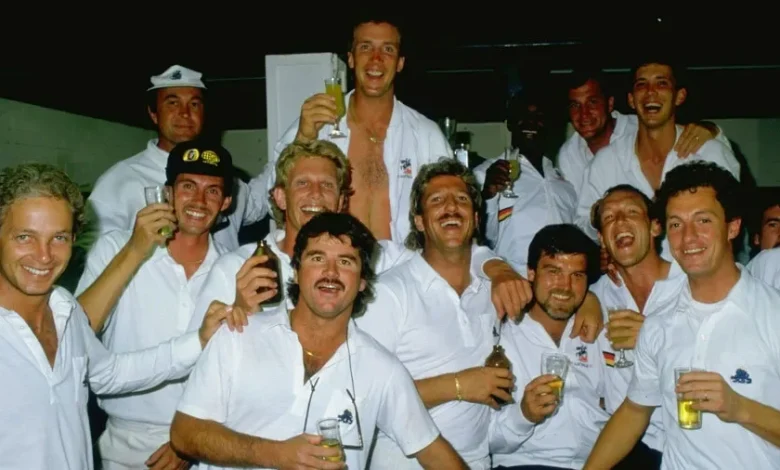
“Dare I say, there would have been a very British satisfaction to it,” David Gower says, recalling the moment 39 years ago when, from the non-striker’s end, he watched Chris Broad carve the winning runs through cover-point in England’s most recent Test victory in Brisbane. “I’m not really the whooping and jumping and shouting sort… I think we’d have had a broad grin.”It was a different world. The Gabba was a cricket ground rather than a stadium, with a greyhound track running around the boundary, and the total attendance on the final day was a mere 1362 as England completed their seven-wicket win. Graham Dilley and Phil DeFreitas celebrated with champagne and cigarettes in the dressing room, and Broad’s son, Stuart, was only four months old.
“The legend of the Gabba has grown since,” Gower tells ESPNcricinfo. “The concept of the Gabba fortress has grown over the last probably 20 years… It is now much bigger, and you have more of that sense of pressure from a hostile crowd. I’ve been there for Sky, standing in the middle before the toss, and it is a cacophony of sound. You are surrounded by it.”
The hostility of the Queensland crowd is notorious. Along with the heat and humidity of the Brisbane climate, and the pace and bounce of the pitch, it has contributed to overwhelming countless England teams. Even accounting for their wider struggles in Australia, their record in their past nine visits to the Gabba is truly abject: lost seven, drawn two, won none.
Ben Stokes insists that his team sees England’s record in Brisbane as irrelevant. “Obviously records for teams go back a long, long time,” Stokes said on Tuesday. “Many teams have gone to the Gabba and lost to Australia, but this is a brand new outfit… It doesn’t hold too much fear.”
Nearly four decades of history suggest that the odds are stacked firmly against them.
“The trick,” Gower says, “is to play against Australia when all their best players are playing for [Kerry] Packer.” His first Test in Brisbane, in 1978-79, coincided with the second season of Packer’s World Series Cricket. “It still felt like a contest. But we were stronger, and they had some weak links.”
England won by seven wickets at the Gabba, and took the series 5-1.
They were beaten four years later, but the most memorable thing that happened in Brisbane on the 1982-83 tour was the surprise appearance of a pig – with the names of Ian Botham and Eddie Hemmings emblazoned on it – on the outfield. “That was the most brilliant, imaginative thing that I’ve ever seen,” Gower says, laughing. “I’ve never seen anything like it.
The England squad celebrate after winning the first Ashes Test in 1986•Getty Images
“Allegedly, it was brought in by some vets who had the expertise to sedate it. They put it in an esky. At the gate, some gnarled old Queenslander said, ‘What’s that mate?’. They said, ‘lunch’. They put the lid back on and carried on, and then, at the crucial moment, revived it, gave it a stimulant, and by god, did it move! I’ve never seen anything like it.”
When England returned in 1986-87, they had been written off as a team with three major problems: “They can’t bat, they can’t bowl and they can’t field.” Botham addressed his team-mates the night before the Test. “His contribution was brief, succinct, and punchy,” Gower recalls. “It was along the lines of: ‘forget about the last month. We start tomorrow.'”
Botham rose to the occasion, belting 138 off 174 balls on the second day. “It was extraordinary,” Gower says. “Beefy was Beefy… If you walk out into that atmosphere and it’s inspiring rather than deflating, that’s a good sign. Ian would feel that, and I would tend to feel the same. It’s the defining thing as to whether or not you have picked the right career.”
By the time England arrived in Brisbane for the start of the 1998-99 series, Australia’s unbeaten run at the Gabba had stretched to a decade – including Ashes wins in 1990-91 and 1994-95. But Mark Butcher does not recall any particular sense of trepidation: “They were redoing the place, so maybe one-quarter of it was missing… We also had a s***load of travelling support.”
Butcher’s tour had started with scores of 0 not out, 2, 5, 2 and 0 in England’s three state fixtures, and a blow on the head from Western Australia’s Matthew Nicholson. “I’d had more stitches than runs,” he says, laughing. “I had the attitude in the nets in the build-up to it that I was going to be a lot more positive.”
Australia batted for five-and-a-half sessions after winning the toss, with centuries from Steve Waugh and Ian Healy digging them out of a hole. But Butcher held firm, scoring 116 in his first Test innings in Australia, and England held on for a draw despite a quickfire third-innings hundred from Michael Slater. “I honestly thought it was the best pitch in Australia,” Butcher says.
It was on the first day of the 2002-03 series that the Gabba truly secured its reputation as the place where England’s Ashes dreams go to die. Nasser Hussain won the toss and infamously chose to bowl first. Ninety overs later, Australia had piled on 364 for 2 through Matthew Hayden and Ricky Ponting’s dominant hundreds, and England had lost Simon Jones to a ruptured ACL.
When Butcher heard cheers from the Barmy Army from the Gabba’s underground dressing rooms on the first morning, he had started to pad up. “We’d all had a conclusion that we would probably bat: it was roasting hot and the pitch looked lovely. When Nass came back in and said, ‘we’re having a bowl,’ I already had my thigh pads and box on.”
Matthew Hayden’s twin centuries at the Gabba crushed England in the Ashes 2002•Getty Images
It echoed a similar call made in Brisbane in 1954-55 by Len Hutton who, long before the Gabba had developed its notoriety, gave Australia first use of a surface on which they piled up 601 for 8 declared before an innings defeat. “If the England fielding had approached any decent standard Hutton might well have achieved his objective,” the Wisden Almanack reported.It was a similar story 48 years later: “Vaughany [Michael Vaughan] fumbled one in the first over, poor old Jonesy left his leg behind on the boundary, and that was all she wrote,” Butcher says. The redevelopment work to turn the Gabba into a multi-purpose modern stadium was largely complete, and the crowd revelled in England’s shortcomings: Jones was called a “weak Pommie b******” as he was stretchered off.Four years later, the opening day went just as badly. Steve Harmison, nervous and underprepared by his own admission, bowled the first ball of the series into the hands of his captain, Andrew Flintoff, at second slip, and another Ponting hundred took Australia to 346 for 3 by stumps. England were duly thrashed by 277 runs, and lost the series 5-0.
Andrew Strauss leaves the field after the high-scoring draw in 2010•Quinn Rooney/Getty Images
For most of the 2010-11 Test, it looked like a familiar story was unfolding. Andrew Strauss slashed the third ball of the match to gully, Peter Siddle took his famous birthday hat-trick, and a mammoth 307-run partnership between Mike Hussey and Brad Haddin gave Australia a 221-run first innings lead.But England launched a memorable fightback, declaring on 517 for 1 after hundreds from Strauss and Jonathan Trott, and 235 not out from Alastair Cook. Australia were deflated, and the final day played out in front of only 7088 fans – the vast majority of them English. “It gave us a lot of belief that this Australian side was there for the taking,” Cook told the BBC recently.No Englishman has scored a Test century at the Gabba since. In 2013-14, they were blown away by the pace and hostility of a reborn Mitchell Johnson, who took nine wickets including, twice, Trott, who left the tour citing burnout straight after. Michael Clarke infamously told James Anderson to “get ready for a broken f***in’ arm”.
The local media also ramped up their scrutiny. Stuart Broad’s refusal to walk after edging to slip (via Brad Haddin’s gloves) prompted Brisbane’s Courier Mail newspaper to announce a ‘Broad Ban’, referring to him only as “the 27-year-old medium pacer”. After five wickets on the opening day, Broad walked into a press conference with a copy tucked under his arm.
“If you are Brendon McCullum or Ben Stokes then you’ll do your best to ignore any talk about the Gabba as a ‘fortress’ and you’ll highlight the other teams who have come here and have won and how they did it – which is just playing good cricket – and stress that whatever happened in Perth was probably an aberration”
David Gower
Stokes’ nightclub brawl ahead of the 2017-18 series meant more fertile ground for the Australian press, and Strauss – as director of cricket – found himself insisting that the players were “not thugs” as a result of a bizarre story involving Jonny Bairstow and Cameron Bancroft. “They were taking every opportunity to try and derail us,” recalls opener Mark Stoneman.
It was Stoneman’s first overseas Test, and his memories reveal the challenge that the Gabba provides for English batters raised on slower surfaces: “I remember standing at the non-striker’s end with Cooky taking the first ball, and thinking, ‘Why are the slips and the keeper so far back?'” He soon found out, when Cook’s edge flew to a tumbling first slip in the third over.
Stoneman and James Vince took the sting out of the game with a 125-run partnership on the opening day, but the Test ultimately followed the same pattern as many England defeats in Brisbane. The 2021-22 defeat was even worse, and the Australian celebrations that followed Rory Burns’ first-ball dismissal reflected the absence of travelling fans, locked out by Covid restrictions.
There are morsels of hope for England this week. Australia have lost two of their last five Tests at the Gabba – to India in 2020-21, and West Indies in 2023-24 – and the dynamics are different. For the first time since 1982-83, Brisbane is hosting the second Test rather than the first, and the day-night aspect introduces several unknowns.
“If you are Brendon McCullum or Ben Stokes,” Gower suggests, “then you’ll do your best to ignore any talk about the Gabba as a ‘fortress’ and you’ll highlight the other teams who have come here and have won and how they did it – which is just playing good cricket – and stress that whatever happened in Perth was probably an aberration.
“If you have another crazy half-hour where three of your best batsmen get out playing egregiously bad shots, then you’re going to struggle. But if you eradicate that, and someone in the top six takes the game by the scruff of the neck, then you’re in the game.”
Even that would mark a significant improvement on England’s usual efforts in this city.
Matt Roller is a senior correspondent at ESPNcricinfo. @mroller98