Betty Allen spent four years in Minnesota living out of her car and bouncing between shelters before moving to El Paso, Texas, to care for her elderly parents during the pandemic. In 2021, they died of COVID a day apart from each other, she said.
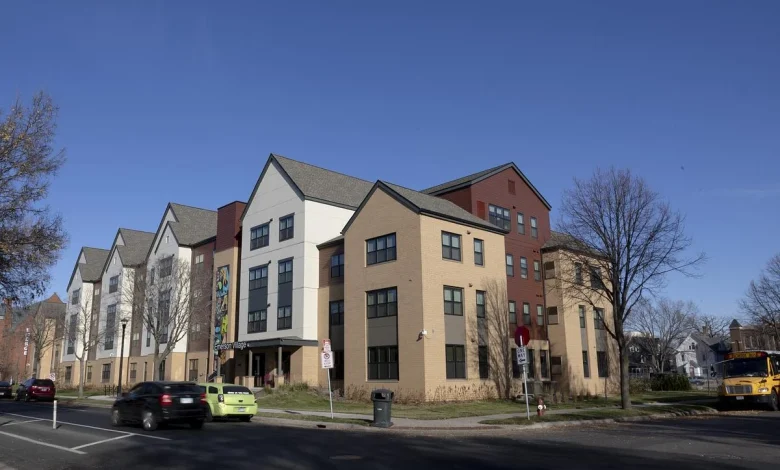
As Allen mounted a slow recovery from her own bout with the virus, she returned to Minnesota but again struggled to find housing. Then, with help from social workers, Allen landed in a Waconia apartment community managed by Carver County. For three years, she has paid about $420 per month in rent, with the remaining $980 covered largely by dollars originating with the U.S. Department of Housing and Urban Development (HUD).
In addition to rental assistance, Allen’s apartment – defined by HUD as “permanent supportive housing” – has access to wraparound services, like health care to manage her anxiety and lupus, a chronic autoimmune disease. And unlike in a shelter, her emotional support dog, Lucky, can live with her.
“I can put my feet down,” Allen said. She credits the stability with giving her time to find her voice as an advocate for Minnesotans experiencing homelessness. But that stability is under threat: A recent HUD order drastically reduces funding for the permanent housing supports Allen and thousands of Minnesotans rely on.
On Nov. 25 – the same day Allen joined a vigil at Minneapolis’ Basilica of St. Mary to draw attention to the changes – Minnesota Attorney General Keith Ellison joined a federal lawsuit against HUD along with 20 other state attorneys general. They allege HUD violated federal law and its own regulations in upending the system that has provided housing funds to people like Allen. They contrast HUD’s abrupt recent move with more gradual funding shifts in the past that were telegraphed to states well in advance.
“These wholesale changes will create administrative chaos and likely result in thousands losing housing,” said a statement from Ellison’s office.
An essential support or an empty promise?
The recent turmoil renews attention on a long-simmering debate over how to end homelessness. In one camp are “housing first” proponents who believe that permanent supportive housing is a life-saving resource for more than 3,600 qualified Minnesota households who would otherwise be at high risk of living on the streets. Housing is the essential first step, they say, to solving problems like chronic illness or substance use disorder, and the government should fund more of it, not less.
In another camp are largely right-of-center thinkers who say spending on permanent supportive housing hasn’t come with long-promised results. The housing is expensive to maintain, they say, difficult to scale up and fosters long-term dependence on government benefits. If it worked, say people like the Manhattan Institute’s Stephen Eide, chronic homelessness wouldn’t be at record highs.
Eide and other critics of “housing first” policies have a powerful ally in HUD Secretary Scott Turner, whose agency oversees about $4 billion in funding for state-led “Continuum of Care” groups – regional coalitions of nonprofits and government agencies with a role in tackling homelessness. Permanent supportive housing is in the Continuum of Care purview.
On Nov. 13, Turner said his agency would end a Biden-era policy of automatically renewing about 90% of that funding each year and instead open most of it to competition among eligible projects, while also capping the amount available to supportive housing programs. People opposed to Turner’s order say the change will divert millions of dollars in funding for permanent housing programs to emergency and transitional housing, such as overnight shelters.
In 2024, Minnesota received about $26.5 million for permanent supportive housing, accounting for about 55% of its total Continuum of Care dollars. Another $12.9 million, or 27%, went to rapid rehousing, another “permanent” housing program that provides temporary rental assistance and social services to people experiencing homelessness.
Opinion: Using fencing to curb homelessness in the Twin Cities is an insult
Some recipients of the funds could see cuts as soon as Jan. 1, putting residents like Allen at risk of losing their homes as winter settles in.
Echoing moves by other federal agencies during the first year of the second Trump administration, HUD also imposed a slew of new funding conditions that “housing first” advocates believe could broadly disqualify organizations whose policies on race, gender, illicit substances and other social issues diverge from the Trump administration’s.
No easy solutions for ‘a five-alarm fire’
Homelessness is indeed on the rise in the United States. According to HUD’s last annual report under former President Joe Biden, the number of homeless individuals overall rose 19% between 2007 and 2024, reflecting fluctuating figures year to year. Between 2023 and 2024, the number jumped 18%, accompanied by a 40% jump in homeless families.
The trend holds true in Minneapolis-St. Paul, where Catholic Charities Twin Cities President and CEO Jamie Verbrugge says the pandemic, opioid addiction and spiraling costs of living have combined to boost demand for his organization’s services by 70% since 2021.
Catholic Charities provides a full range of housing and human services for people experiencing homelessness, from emergency shelter and food assistance to permanent supportive housing, Verbrugge said in an interview with MinnPost.
Critics of “housing first” say the rapid rise in needs on the ground is evidence that a fresh approach to the problem is needed.
In a July paper, Eide wrote that high operating costs and community opposition act as brakes on the creation of permanent supportive housing and reduce its effectiveness over time. Though permanent supportive housing is intended for disabled people who can’t work consistently, like Allen, some tenants need more care than the model can provide, he wrote.
But Verbrugge and others say that whatever the deficiencies of the “housing first” model, HUD’s new policy is not the appropriate response.
“[HUD is] projecting how they would like the world to work instead of recognizing how difficult this work is,” Verbrugge said. “What’s being proposed is a pretty simple-minded solution to a really complex challenge.”
Chris LaTondressee, CEO of Beacon Interfaith Housing Collaborative, is more blunt.
“Anyone who cares about homelessness should see [this] as a five-alarm fire,” LaTondresse said in an interview with MinnPost. Beacon has five Twin Cities permanent supportive housing locations serving 280 households. One of them, Vista 44 in Hopkins, houses families with about 100 children, he said.
The limitations of short-term shelters
In 2024, HUD gave about $48 million to Minnesota’s 10 Continuums of Care, the regional programs that coordinate efforts to extend housing and services to people experiencing homelessness. Historically, more than 80% of that funding has gone toward rapid rehousing and permanent supportive housing.
Under the new policy, HUD would cap funding for both buckets at 30% of the total, and direct the rest to shorter-term “transitional housing,” including emergency shelters.
In a recent paper, Urban Institute researchers Samantha Batko and Pear Moraras said there’s no evidence transitional housing reduces homelessness or “successfully houses people experiencing chronic homelessness.” Studies do show, they wrote, that transitional housing excludes people who most need support and does little to prevent beneficiaries from relying on other forms of public assistance.
“You could double the size of the shelter system and all you’d do is warehouse more people,” LaTondresse said, likening shelters to hospital emergency departments.
Verbrugge added that if HUD’s order pushes people out of permanent supportive housing, frontline groups like Catholic Charities will expend more resources to reach them, exacerbating the very problem HUD aims to solve.
‘We have to save these programs for those of us who can’t work’
For Allen, the biweekly food assistance she receives at her home in Waconia prevents her from rationing food stamps and medication, she said. With her most critical needs addressed, she’s able to be active in her community.
She pushed back on the notion that accepting support means living large on the federal dime. Most people who are able to work earn too much money to qualify for her program, she said.
“Sure, some people may sit on [these] programs, but not many, because it’s not comfortable,” she said. “We have to save these programs for those of us who can’t work: the mothers, the grandmothers, the immigrants, the survivors.”
Earlier in November, Beacon Interfaith and Catholic Charities joined more than 180 organizations – housing services nonprofits, health-care groups, local governments and even private-sector building contractors – in signing a letter to Minnesota’s Congressional delegation urging them to pass legislation that would force HUD to maintain current Continuum of Care funding until 2027 and consult with Congress on significant program updates.
LaTondresse said finding state and local funding to offset the shortfall would be “a significant priority” during the legislative session, but warned that it could take two years to get the state’s 10 Continuum of Care groups aligned on a path forward without the same level of federal support.
In the short term, the letter warned of a rise in unsheltered homelessness in the wake of the funding shifts and broader disruption to Minnesota’s affordable housing sector.
“A rapid shift of funds away from permanent supportive housing … undermines the financial viability of the entire building in which those units are situated, with ripple effects across the entire housing continuum,” the letter said. “Local housing systems and homelessness prevention services cannot absorb the impacts of this change.”
Minnesota lawmakers on both sides of the aisle have also registered opposition to HUD’s policy change.
Rep. Pete Stauber, whose 8th District covers Duluth and much of northern Minnesota, was one of 22 House Republicans to sign an October letter asking Turner to delay the then-rumored policy change. Sens. Amy Klobuchar and Tina Smith joined most of their Democratic colleagues on a separate plea.
Minneapolis’ $14 million investment in affordable rental units
Until anything changes, the Twin Cities are bracing for a rise in unsheltered homelessness after years of visible – if uneven – efforts.
“While it’s too early to know the precise impact of this harmful decision, we can be certain it will increase chronic homelessness and create significant harm in Minneapolis,” said Jess Olstad, a spokesperson for the city, in an email.
Olstad said Minneapolis will continue its efforts to reduce homelessness in partnership with Hennepin County, state agencies and nonprofit groups. That work has helped cut unsheltered homelessness in Hennepin County by one-third since 2020, according to the city’s annual Way Home report.
In a Nov. 20 press release, the city lauded a $14 million investment “to jumpstart 11 affordable rental housing projects,” saying the money would add or preserve nearly 600 affordable homes. It also announced 126 new shelter beds in the city and 123 new units “to help people experiencing homelessness.”
“Our work will continue no matter what,” Olstad said.
Related