By Matthew Daldalian
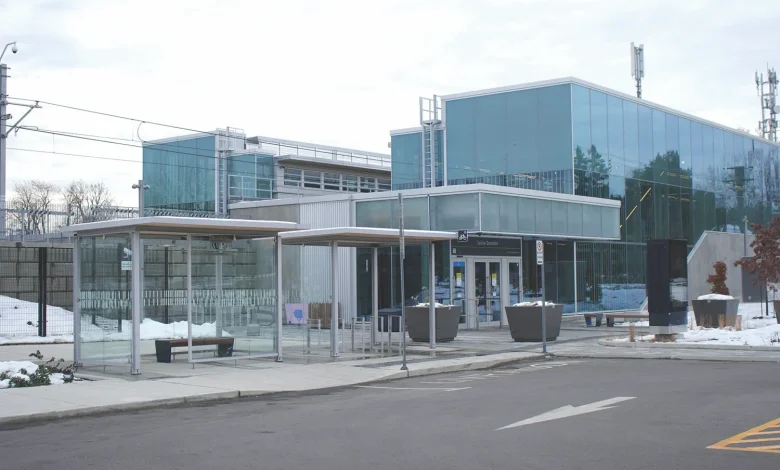
The glass-fronted Sainte-Dorothée REM station during weekday peak return hours. (Matthew Daldalian, North Shore News)
The REM’s new Sainte-Dorothée station is quickly proving essential to Laval commuters, with packed park-and-ride lots and steady afternoon ridership suggesting the service has taken hold just weeks after launch.
Between 3 p.m. and 6 p.m., the station saw a continuous stream of returning students and workers. Nearly every parking space surrounding Avenue des Bois was filled, forcing late arrivals to circle for openings or park farther out on residential streets. For many riders, the convenience outweighs the growing congestion.
Luis Canon, an internet technician who lives nearby, said the REM fits naturally into his routine. “It’s amazing. It’s convenient,” he said. Canon takes the train roughly four times a week, often at peak hours. He said the new system is a welcome return after years of replacement buses. “I used to take [the old line], then they shut it down. Now it’s okay.”
The REM restored direct rail to the North Shore after the former exo Deux-Montagnes line closed for conversion in 2020. The new infrastructure promises faster travel and fewer bottlenecks, with trains running automatically every five to ten minutes during peak periods. Travel to downtown Montreal now averages under 30 minutes once aboard, cutting commute times in half for many west-end Laval residents.
The accessibility has made Sainte-Dorothée a busy endpoint on the line. Parking lots at Sainte-Dorothée were near capacity during the afternoon peak, an early sign of strong demand. Similar patterns occurred when the South Shore REM opened in 2023, when ridership climbed steadily during its first months of operation.
For Dawson College student Ricardo Rodriguez, the REM is now non-negotiable. “I use the REM every day to go to school,” he said. Rodriguez said the line significantly reduces his travel time into Montreal. “It’s very fast. I like that. It’s very quiet. It’s way quieter than the Metro.”
Sainte-Dorothée station’s role is expected to grow further when future REM phases connect west to Anse-à-l’Orme and south into Montreal-Trudeau airport by 2027. The station’s strategic location has already shifted commuting habits in Sainte-Dorothée, where car-dependent neighbourhoods long relied on slow multi-transfer bus connections to metro stations.
The REM’s off-peak schedule remains a limitation, particularly for late-night users. Service between Côte-de-Liesse and Deux-Montagnes currently ends at 9:30 p.m., with continuing evening travel handled by replacement bus service.
University student Yanni Athanasoulias takes the REM daily to reach Place-Bonaventure. The speed has changed his mornings. “It comes every five minutes. It goes to where I need to go,” he said. He once spent over an hour in traffic. Now his travel time is cut by more than half. “This takes about 30 minutes when you’re actually on the REM, so it’s good.”
Like others, Athanasoulias planned for the change long before it arrived. “Ever since I heard it was opening, I’ve been planning to take it,” he said. He drives to the station, then transfers to rail downtown.
By late afternoon, the Sainte-Dorothée lots were full up quickly.
A steady flow of passengers moved from the platforms toward the parking rows, many heading directly to their cars. Trains arriving between 3 p.m. and 6 p.m. were busy, with most seats occupied and some passengers standing through portions of the route; not overcrowded, but consistently full.
The REM was built to shift more commuters away from car-dependent travel and toward electric rail service. Early usage at Sainte-Dorothée would suggest the demand exists, but long-term performance will depend on how well the network accommodates rider growth, travel patterns and future branch openings.
So far, the station is being used. People are boarding, returning, parking, and adjusting their routines around the new service. The next test is endurance, whether the system can support this level of traffic as months pass and peak travel intensifies.