RFK Jr.-appointed panel removes universal hepatitis B vaccine recommendations for U.S. infants

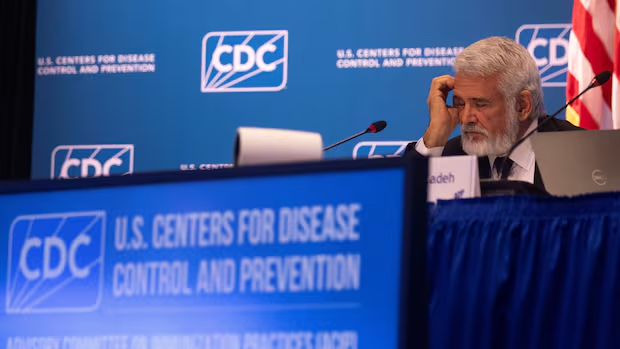
A panel of advisers at the U.S. Centers for Disease Control and Prevention (CDC) has voted to remove the longstanding recommendation to universally vaccinate American infants against hepatitis B.
For infants of mothers who test negative, the panel recommended that parents, in consultation with a health-care provider, should decide when or if their child will begin the vaccine series. Under the scrapped recommendation, the birth dose is followed by two more vaccines, at one to two months and six to 18 months.
The vote does not change the guidance for babies born to mothers who are positive for hepatitis B — they should still be vaccinated at birth, as per the recommendations.
Since 1991, the U.S. has had a universal hepatitis B vaccine recommendation, including administering a dose just after birth. The vaccine cuts infection rates by 95 per cent, studies have found.
The committee also voted in favour of an antibody test after children receive a hepatitis B vaccination to determine if further doses are needed.
The CDC’s Advisory Committee on Immunization Practices (ACIP) makes recommendations on the use of vaccines for Americans to the CDC director who then sets policy.
While their new guidance is a recommendation for how doctors should give the hepatitis B vaccine, doctors can still give the shot to children at birth if parents choose to have their kids vaccinated immediately.
Public health experts decried the move, saying that a decision to shift to shared clinical decision-making would create obstacles to the use of vaccines, and that parents already have control over the care of their children.
The votes, originally scheduled for Thursday, were pushed back during a chaotic initial day of presentations. At times, the conversation became tense as some members, experts and citizens took issue with questions about the safety of the hepatitis B vaccination and the risks of infection raised by members on the panel, which was criticized as being cherry-picked or misleading.
Su Wang, a doctor and senior advisor with the Hepatitis B Foundation spoke about how she contracted the virus likely during infancy from one of her caregivers, of whom multiple were Hep B positive. She said a policy that assessed risk only based on her mother’s status might not have prevented her from contracting the virus, but universal vaccination — which wasn’t in place when she was born — would have.
“We cannot predict a child’s future risk. Like seatbelts, our overall risk of getting into a [car] accident [is] low, but we universally wear them because we cannot control the world around us,” said Wang.
Universal vaccination better than just testing: experts
But members of the committee who backed the change said universal vaccination isn’t necessary in “low risk” cases, where babies are born to mothers who have tested negative for hepatitis B.
Experts say that allows some moms and babies to fall through the cracks and isn’t sufficient in tackling hepatitis B on a large scale.
“It’s always been the policy to test every pregnant woman against hepatitis B, but that just doesn’t happen,” said Amesh Adalja, a senior scholar at Johns Hopkins Center for Health Security and an infectious disease physician.
A slide appears on a screen during the meeting of the Advisory Committee on Immunization Practices in Atlanta Thursday.
(Alyssa Pointer/Reuters)
Inadequate prenatal care means some women simply don’t get tested before they give birth, he says. Hepatitis B infection that occurs after a negative screening but before the child is born, or false negatives, can also lead to some babies getting hepatitis B even though their moms were tested.
Hepatitis B is a bloodborne illness, and is often associated with its ability to spread through sexual contact or the use of shared needles. But it can also be spread from a caregiver to a child in early life through contact via something like a cut, according to Eric Yoshida, a liver specialist at Vancouver General Hospital and professor at the University of British Columbia’s medical school.
It’s also more likely that those who don’t get vaccinated right away would end up not getting fully immunized against hepatitis B, Yoshida says — which can lead to liver cancer, cirrhosis or failure later in life.
There also isn’t evidence to show that there is any significant risk associated with hepatitis B vaccination, according to both Adalja and Yoshida.
The CDC has recommended babies in the U.S. be given the hepatitis B vaccine at birth since 1991 as an effective way to prevent infection. It’s also been the policy in Canada for decades, and remains so — the National Advisory Committee on Immunization (NACI) recommends babies receive their first hepatitis B vaccine dose in the first month of life, the second dose at least four weeks later, and a third dose at least two months after that.
The World Health Organization also recommends that babies receive the first dose of hepatitis B vaccination as soon as possible after birth, ideally within the first 24 hours of life.
People protest outside the meeting to discuss childhood vaccine schedule changes in Atlanta Thursday.
(Alyssa Pointer/Reuters)
The CDC is an American institution, so its recommendations don’t directly impact Canada. But given how contagious the virus is, Adalja says “the more people on this planet with hepatitis B, the more at-risk everyone else is if they’re not vaccinated.”
Plus, skepticism around vaccines isn’t isolated to the U.S. — evident in that the increased spread of measles, which experts have tied to waning vaccine uptake and vaccine distrust, led Canada to lose its elimination status for that disease earlier this year.
“It’s not just that the virus is contagious. The anti-vaccine movement is contagious,” Adalja said. “So this may be a debate that you will be having in Canada as well.”
Last vote changed guidance on COVID-19, MMRV shots
The vote on the Hep B vaccine schedule was initially supposed to take place in September, but was rescheduled to Thursday due to requests for more data — and then postponed again until today to allow committee members more time to go over the language of the vote.
At their September meeting, the panel changed some of their guidance around COVID-19 vaccination and the childhood measles, mumps, rubella and varicella (MMRV) vaccine schedule. Rather than outright recommending the COVID-19 vaccine for most adults, the panel said they recommended people make decisions about whether to get the shot alongside their doctor.
They also voted against allowing parents to choose the combined MMRV vaccine for children under age four, and instead recommended separate vaccines — one for MMR, and a separate one for varicella (commonly known as chickenpox).
Members of the panel, which was hand-selected by Health and Human Services Secretary Robert F. Kennedy Jr., have been criticized for their skeptical comments regarding vaccines or the spread of infectious diseases.
WATCH | RFK Jr. vs. U.S. Senate: The 3-hour vaccine showdown:
RFK Jr. vs. U.S. Senate: The 3-hour vaccine showdown
Andrew Chang breaks down key moments in the heated exchanges between U.S. senators and Health Secretary Robert F. Kennedy Jr. over his vaccine policies. Plus, what might really be behind U.S. President Donald Trump’s contempt for mail-in ballots.
Kennedy — who has promoted debunked theories linking vaccines to autism and questioned vaccine safety — ousted all of the advisory panel’s previous 17 members in June, before re-stacking it with new appointees.
The ACIP’s vice-chair, Robert Malone, who was presiding over the two days of meetings, questioned vaccines during the COVID-19 pandemic after first overstating his role in early research into mRNA vaccines — the technology behind most COVID shots.
Retsef Levi, another RFK appointee on the panel, has questioned the safety of COVID-19 vaccines and previously called on social media for all COVID vaccine programs to be halted. He is a professor of operations management and does not have a medical degree.
As a result, Adalja says, the panel and the CDC itself have lost their credibility and are becoming “increasingly irrelevant.” Groups like the American Academy of Pediatrics and the American College of Physicians have also begun issuing their own guidance in lieu of what they see as credible CDC recommendations, he points out.
“[CDC and the ACIP] are no longer trustworthy sources of information for the general public,” Adalja said.
At the beginning of Friday’s meeting, Malone defended the panel, saying he and other members were not anti-vaccine, but were reassessing the safety of vaccines given public trust in vaccines among Americans has decreased since the COVID-19 pandemic.
“We must boldly address change, risk, new ideas and conflicting hypotheses, which is the proper nature of evidence-based science,” Malone said. “I plead that we all can commit to [an] open consideration of alternative points of view.”