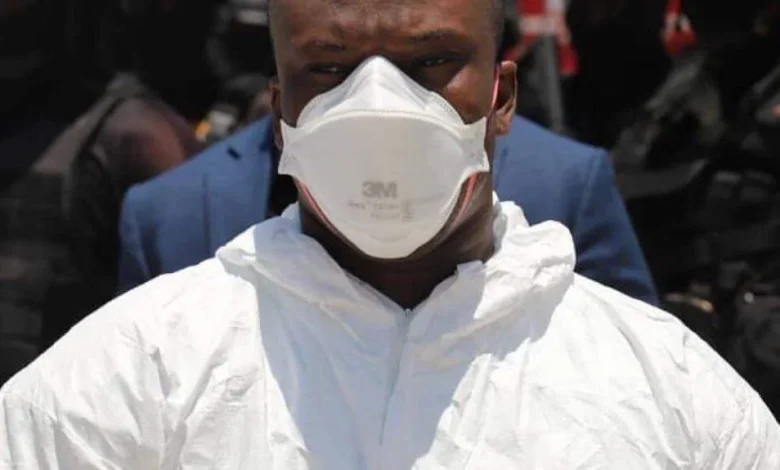
Germine Joly, better known as “Yonyon,” was transferred aboard a special Federal Bureau of Investigation flight on Tuesday, May 3 to the U.S. following a request from the U.S. on April 22. Joly is the leader of the gang 400 Mawozo, which was behind the 2021 kidnapping of 17 missionaries with Ohio-based Christian Aid Missionaries.
Miami
Washington
Germine Joly, the self-described “king” of Haiti’s notoriously violent 400 Mawozo gang, was sentenced on Wednesday to life in federal prison without parole for orchestrating the kidnapping of 17 missionaries — 16 of whom were U.S. citizens, including an eight-month-old baby.
The life sentence, handed down in a District of Colombia federal court, comes seven months after a jury convicted the gang leader known as “Yonyon” of helping to direct the abduction of the missionaries from Ohio-based Christian Aid Ministries. Most of the hostages, including a Canadian national, were held at gunpoint for 62 days. They won their freedom after a $350,000 ransom was paid, and it was made to look as if they had escaped, sources with knowledge of the matter previously shared with the Miami Herald.
In addition to life in prison, Judge John D. Bates ordered Joly, 34, to pay a fine of $1,700. The life sentence, Bates said, was “stiff but warranted.”
In court documents ahead of the sentencing, Joly insisted he was not the leader of a gang now being directed by his cousin and one-time No. 2, Joseph Wilson, better known as Lanmò Sanjou — which in English translates to “Death doesn’t know which day it’s coming.” The gang controls large sections of eastern Port-au-Prince, including neighborhoods near the U.S. embassy all the way to the border with the Dominican Republic, and is part of the powerful Viv Ansanm gang coalition.
Bates said there was “frankly overwhelming” evidence that Joly was directing the activities of 400 Mawozo, and the totality of evidence shows his role in the kidnappings. He rejected a request by the gang leader for a 25-year sentence but granted his desire to be imprisoned in Florida. His mother lives in the South Florida area.
Joly, who is from Croix-des-Bouquets, Haiti, and was wearing an orange jumpsuit, did not address the court. It was revealed Wednesday that he recently attacked two inmates with a shiv while in jail awaiting sentencing.
In a statement, U.S. Attorney Jeanine Pirro said the sentencing makes clear that Joly’s “scheme to win freedom for himself by using Christians as pawns backfired.”
Kidnapping thrust Haiti into global spotlight
The bold kidnapping catapulted both 400 Mawozo and Haiti’s spiraling lawlessness into the global spotlight, highlighting the growing power of kidnapping-gangs in a country besieged by criminal violence.
At the time of the abductions, Joly was an inmate in Haiti’s National Penitentiary. That didn’t stop him from running the gang’s operations, using unmonitored cell phones to direct gunmen in not only kidnappings but also a gun-smuggling operation that funneled weapons from the United States to Haiti, with the help of associates in Florida.
During the trial, witnesses also testified that he controlled 400 Mawozo’s finances, directing payments to gang members, including payment of their salaries derived from hostage ransoms.
In January 2024, near the end of a bench trial, Joly pleaded guilty to charges in a different case related to a gun-trafficking conspiracy that violated U.S. export laws, as well as laundering ransom payments of U.S. citizen hostages. He was sentenced in June to 35 years in federal prison for those offenses.
The FBI Miami Field Office investigated the case with assistance from Bureau of Alcohol, Tobacco, Firearms and Explosives. Both of Joly’s cases received extraordinary assistance from other U.S. law enforcement agencies. The kidnapping case was prosecuted by Assistant U.S. Attorneys Karen P. Seifert and Thomas N. Saunders.
The U.S. Probation Office had recommended a life sentence for the hostage-taking conviction, followed by 60 months of supervised release and a special assessment of $1,700. They also recommended that both sentences be served concurrently.
The government supported the recommendation. The “significant sentence” reflected the seriousness of Joly’s conduct, prosecutors said.
“This horrific crime was driven by defendant [Joly’s] own self-interest; he wanted to secure his release from prison in exchange for the hostages,” they said in court documents. “The requested sentence is sufficient, but not greater than necessary, to serve the interests of justice.”
Joly, however, argued through his lawyer that the court should impose a sentence of roughly 25 years and 8 months in prison, along with 60 months supervised release — concurrent to the sentence imposed in the firearms’ conspiracy case. He also asked to serve his sentence in the South Florida region.
“Any prison sentence longer than 308 months imprisonment will have no greater effect toward the goals of sentencing than a life sentence,” defense attorney Allen Orenberg said in court documents. He argued that any sentence longer than 25 years would be “discorporate” and unreasonable when considering the sentences his co-defendants received in the gun-smuggling case.
Joly’s defense team, reiterating his denial of being the leader of 400 Mawozo, argued that he should not be penalized twice, and he should be afforded a reduced sentence. In their arguments, they provided a glimpse of his life, arguing that he was raised by an aunt and uncle after his parents left for the U.S. They said “not having his parents with him surely impacted him.”
Joly “genuinely tried to help his countrymen, especially those that did not have much,” his lawyer said in court documents. “The Haitian government did not provide services and resources to the poor like we have in this country, and [Joly] tried to fill the gap.”
Targeting of U.S. citizens
The Mennonite missionaries were returning from visiting an orphanage east of Port-au-Prince at around 1 p.m. on Oct. 16, 2021 when they were forced from their vehicles at gun point. They were kept in various locations by armed gang members while their relatives negotiated ransom payments for their release. Among the hostages were five children, including the baby.
Shortly after, 400 Mawozo claimed responsibility for the kidnapping on social media and demanded a ransom of $17 million—$1 million per victim. On or about Nov. 11, 2021, the gang contacted a representative of the hostages and said, in lieu of ransom money, 400 Mawozo wanted defendant Joly freed from his Haitian incarceration.
One of the gang’s victims, Cheryl Noecker, addressed the court. “I forgive you,” she said to Joly and broke down in tears. “My heart goes out to your mother because I know she loves her son.”
Several other victims and their loved ones were also in attendance. Some of the victims attended via video conference.
The judge commended the victims for their courage, dignity and compassion.
This story was originally published December 3, 2025 at 3:51 PM.
Shirsho Dasgupta
Miami Herald
Shirsho Dasgupta combines traditional reporting with data analysis to produce high-impact stories and accountability journalism. He won a Sigma Delta Chi Award in 2025 and was named finalist for both Livingston and Scripps Howard awards in 2024. His stories have spurred investigations, influenced legislation and received numerous awards and citations from the National Press Foundation, Investigative Reporters and Editors, the Society for Advancing Business Editing and Writing and others.
Jacqueline Charles
Miami Herald
Jacqueline Charles has reported on Haiti and the English-speaking Caribbean for the Miami Herald for over a decade. A Pulitzer Prize finalist for her coverage of the 2010 Haiti earthquake, she was awarded a 2018 Maria Moors Cabot Prize — the most prestigious award for coverage of the Americas.