Listen to this article
Estimated 5 minutes
The audio version of this article is generated by text-to-speech, a technology based on artificial intelligence.
Almost a year and a half after pieces of the Mont-Blanc were discovered during dredging in Halifax harbour, plans are taking shape for what to do with some of the wreckage from the famed ship involved in the Halifax Explosion.
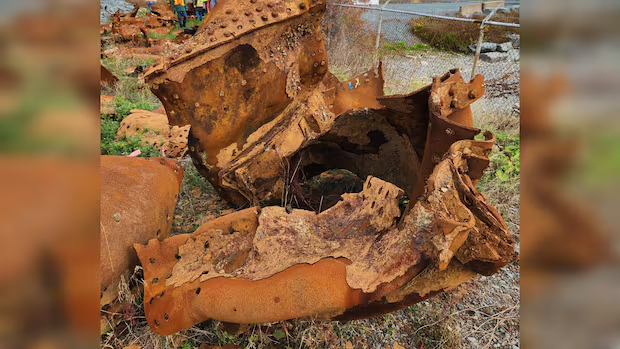
The dredging was part of an expansion at Irving’s shipyard. More than 100 pieces from the Mont-Blanc were among the 100,000 tonnes of material pulled out of the harbour. In some cases, the artifacts were car-size chunks.
The pieces came from the present-day location of what would have been home to Pier 6 on Dec. 6, 1917. This is the area where the Mont-Blanc, a French munitions ship, drifted to and exploded after it collided with the Imo, a Norwegian steamship carrying Belgian relief supplies.
“These pieces are so important because they are part of our culture and heritage, not the happiest part of our culture and heritage, but they are part of ours,” said Marilyn Davidson Elliott, a north-end Halifax resident whose father was blinded by the explosion when he was just 2½.
“And it is important that we preserve what we can. We can’t preserve everything, but we can preserve most of it, I believe.”
The Halifax Explosion is the worst disaster in Canadian history — and arguably the most important event in the city’s history. Two thousand people were killed and 9,000 injured, while two square kilometres of the city was levelled.
The aftermath of the Halifax Explosion is shown in this 1917 file photo. (The Canadian Press)
The fragments are considered historically significant because they are far larger than existing ones.
Davidson Elliott wrote a book, The Blind Mechanic, about her father. She gives talks on the explosion and is part of two community groups that work to preserve the memory of the disaster.
She requested a piece of the Mont-Blanc for use in her talks and was given an 82.5-centimetre piece of steel plating and two rivets. The plating weighs about 15 kilograms and its wave-like shape stems from the force of the explosion.
Marilyn Davidson Elliott is shown with a rivet from the Mont-Blanc. Her father was blinded in the Halifax Explosion when he was 2½. (Galen McRae/CBC)
“It’s incredible to think what kind of force took that, but we know what kind of force because it was the worst explosion prior to the atomic age,” said Davidson Elliott.
The Naval Museum of Halifax on Gottingen Street will be home to a car-size piece of the Mont-Blanc that will be placed on display outside the museum. The piece is estimated to weigh around 725 kilograms.
The location is fitting given that at the time of the explosion, the building was home to a hospital that treated some of the victims.
“It’s a really cool, tangible way that people can touch and see and be next to, to really get a sense of how awesome the force of the explosion was,” said museum director Jennifer Denty.
This is the piece that Davidson Elliott was given to use for her talks on the Halifax Explosion. It’s 82.5 centimetres long and weighs about 15 kilograms. (Galen McRae/CBC)
At the time of the explosion, Canada was fighting in the First World War, with Halifax serving as a strategic port. Denty said this detail sometimes gets lost in the explosion discussion.
“The ability to keep the war front moving, keep supplying the Allies, while also dealing with a major disaster on the home front, that’s a hugely important story to tell and we’re really hoping that monument can kind of look at that broader experience,” she said.
WATCH | What’s next for Mont Blanc artifacts:
Fate of Mont-Blanc artifacts much clearer
Huge chunks of the Mont-Blanc were discovered during harbour dredging a year and a half ago. Officials are now trying to find homes for the Halifax Explosion artifacts in places like museums. The CBC’s Richard Woodbury reports.
In a statement, the Department of Communities, Culture, Tourism and Heritage said the Nova Scotia Community College will also be collaborating with the Nova Scotia Museum to do 3D scans of the recovered fragments.
The department said it has been speaking with museums, community groups and others to see if they might be interested in using pieces for education, exhibits or other ways to tell the story of the Halifax Explosion. It said it’s still open to proposals from institutions and groups.
The Norwegian steamship Imo is beached on the Dartmouth shore after the 1917 Halifax Explosion. Its collision with the munitions ship Mont-Blanc sparked the fire that set off the explosion. (Nova Scotia Archives & Record Management/The Canadian Press)
The province said it’s exploring options for storing the pieces long term, which would require significant space and resources.
However, with so many pieces recovered, it’s “quite likely” many fragments will be returned back to the bottom of the harbour, the statement said.
If that happens, Davidson Elliott hopes it will be a solemn event.
She hopes other pieces get placed in museums and cemeteries.
But the one spot she’d especially like to see a Mont-Blanc piece is at the Halifax Explosion Memorial Bell Tower at Fort Needham Park.
The Halifax Explosion Memorial Bell Tower is located in Fort Needham Park in Halifax’s north end. (Richard Woodbury/CBC)
“I can’t imagine anything much more powerful than having a real piece of the Mont-Blanc there,” said Davidson Elliott.
Asked if this was something the city was considering, a municipal spokesperson did not answer the question.
The city had previously committed to taking two Mont-Blanc fragments, each measuring less than 15 centimetres in size.
MORE TOP STORIES