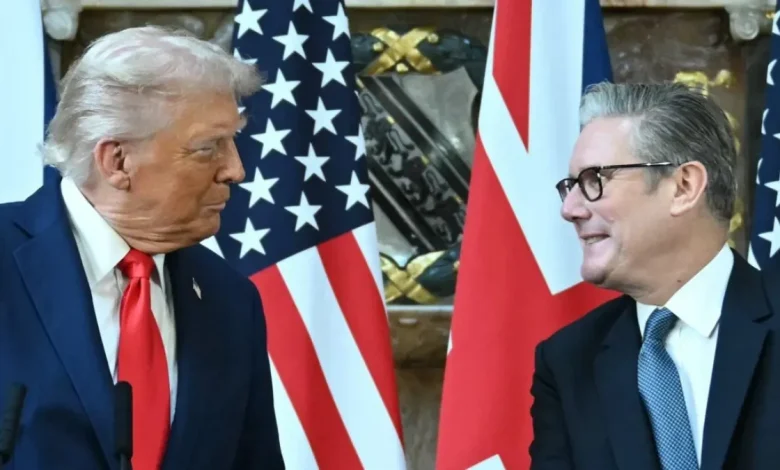
Dealing with Donald Trump was never going to be easy. The mercurial President makes life tricky for his friends as much as for his enemies, and he has certainly added to Sir Keir Starmer’s difficulties.
The Prime Minister has won plaudits for his handling of Trump. The two men, it is often said, make an unlikely pairing – yet they have formed a bond of some sort, and Starmer seems to have genuine influence on the White House.
That influence, though, is limited and always will be. More than normally, this President is singlehandedly responsible for the state of the world and no junior partner can fundamentally shift him.
One reason for this is the growing relative power of the US. As the American economy has boomed Europe’s has stagnated, including in the UK, while the EU has failed to stake a claim to global leadership with its divided response to crises such the Ukraine war – with Brexit probably contributing to this.
Another is the unique status of Trump himself, a man who does not share leadership within his own party let alone with foreigners. Getting on the good side of JD Vance, Marco Rubio or congressional leaders is almost pointless given how easily they can be overridden by the President.
The US has long been the world’s superpower, and the UK a (very) junior partner. But rarely has one man had such a personal impact on so many of the big global questions. The resolution of the Russia-Ukraine conflict; fragile peace in the Middle East; the rise of China and rewiring of the world’s trading networks – all these are very directly shaped by Trump himself.
The best that Starmer can do is make a difference at the margins. Witness this week’s Downing Street talks on the future of Ukraine: the UK is trying to show leadership in the “coalition of the willing” to provide security guarantees for Kyiv, but this work will be useless without a peace deal underpinned by America. Or the Israel-Palestine dispute: Britain will host a gathering next year of civil society leaders from both sides of the divide, a worthy enterprise but one that means nothing if Trump cannot stop war in Gaza from breaking out again.
The President’s unpredictability is one thing. Outright hostility would be more challenging. This week Trump has become more critical of Europe than ever before, publishing a National Security Strategy which warns of “civilisational erasure” and giving an interview to Politico in which he called the continent “decaying” and “weak”.
He has stopped short of criticising Starmer directly – although his barbs at Sir Sadiq Khan are getting nastier and nastier. Nonetheless the ramped-up rhetoric will make it ever harder for the Prime Minister to maintain his strategy of avoiding direct confrontation with Trump at all costs, especially as progressive voters continue to shun Labour in favour of more outspoken alternatives such as the Greens and Liberal Democrats.
UK economic policy too is made harder by Trump’s erratic behaviour. Even leaving aside his tariff wars, there are two serious dangers looming in the US: the possibility of an epic stock market crash, and the loss of faith in the Federal Reserve which could be sparked if Trump chooses a henchman to chair the American central bank early next year.
If the US sneezes, Britain will catch a cold. Higher borrowing costs on the other side of the pond would worsen the UK’s debt problems too, and a market collapse would send economic shockwaves our way. Starmer could not realistically survive in office in the event of a setback like that which forces further tax rises and/or worsens the cost of living.
There is one possible glimmer of light. 2026 will be a year where Trump is primarily concerned with domestic policy, given the mid-term elections in November which – if election results this year are anything to go by – could deliver a battering for the Republican Party. Starmer must hope that the President dials down his belligerence on the world stage as he pushes to win over voters at home instead, providing (so-called) Western allies with a little breathing room.
But imagine things go badly in the mid-terms, and Trump is humbled. Would that make him easier to deal with, or harder? If the Prime Minister thought triumphant Trump was a handful, try angry Trump. The fear in No 10 must be that things can only get worse.