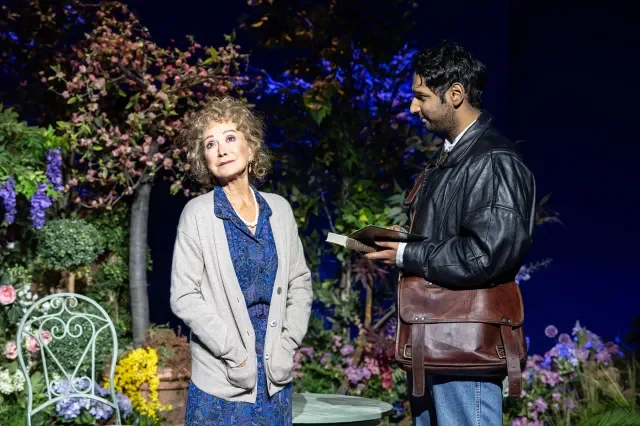
Felicity Kendal and Aaron Gill in Indian Ink, © Johan Persson
By sad chance, the press night of Indian Ink at the Hampstead Theatre fell on the day of its playwright Tom Stoppard’s funeral and was played to an audience containing many of his friends, full of grief at his death two weeks before. On stage, the actress Felicity Kendal was in effect giving a gift to a man she had loved – a performance that honoured and illuminated his work.
This revival of Indian Ink was always likely to be emotional. It is a play that has many things coursing through it, like the wash of watercolour on paper, but among them are ideas about a writer’s legacy and how history has a horrible habit of misinterpreting ideas by tying them too closely to biography.
Originally written for radio, it jumps between two time periods, following a young Edwardian poet, Flora Crewe, on her passage to India in the 1930s, where her free spirit scandalises both the Indians and the British colonisers, and tying her story to an English garden in the 1980s, where her younger sister Eleanor fights off the attentions of Flora’s wrong-headed biographer.
Misunderstandings about the nature of things link both periods, and so do three portraits – one nude by Modigliani that is long destroyed, a portrait of Flora by an Indian artist, and a mysterious second nude portrait that may or may not hint at a relationship between them.
It’s also a play full of lush descriptions of things, of the need to seize a moment. Flora, beautifully played by Ruby Ashbourne Serkis, who captures both her wide-eyed innocence and her abandon, is dying. She understands the value of every second in her headlong rush at life; Eleanor, recollecting her life in tranquillity, understands all that has gone in a way that the American biographer, Eldon Prine, constantly rushing around with his footnotes, simply cannot.
All of this is beautifully underlined in a production of utmost delicacy and understanding by Jonathan Kent. Leslie Travers’ lush designs, rising and falling to reveal different settings, manage the constant scene changes with dreamlike fluency, and Kent’s direction catches the same sense of life constantly shifting in front of one’s eyes, understanding coming and going with the same fleeting sense as a flash of colour in a tree.
Peter Mumford’s lighting and Christopher Shutt’s sound, with a score by Kuljit Bhamra, all evoke time, place and heat with clever economy, matching the ever-changing moods of the piece.
Ruby Ashbourne Serkis and Gavi Singh Chera in Indian Ink, © Johan Persson
As Nirad Das, the artist who paints Flora, Gavi Singh Chera is extraordinarily powerful and tender, furious with the British and with her incomprehension – “I am Indian,” he snaps when she keeps accusing him of being exactly that – but drawn towards her warmth and difference. As his son Anish, seeking answers to the mysteries of his father’s life, Aaron Gill manages to share his gentleness, while Donald Sage Mackay is sharply amusing as the bumbling biographer Pike.
But it’s Kendal’s night, her wry intonation and timing both comic – “a reservoir near Staines is never going to have the makings of a good cup of tea” – and emotional, perfectly modulated to the nuance and meaning of Stoppard’s lines. The moment when she sees the nude sketch of her sister and suddenly gasps, “How like Flora”, which is both humorous (because it contains a pun) and sad, making you understand how much this is a play about love and loss.
In the final scene, she stands by a writer’s grave and thinks about the past, about youthful hope and strange chance. It would be moving at any moment. So soon after Stoppard’s death, it feels both overwhelming and somehow right.