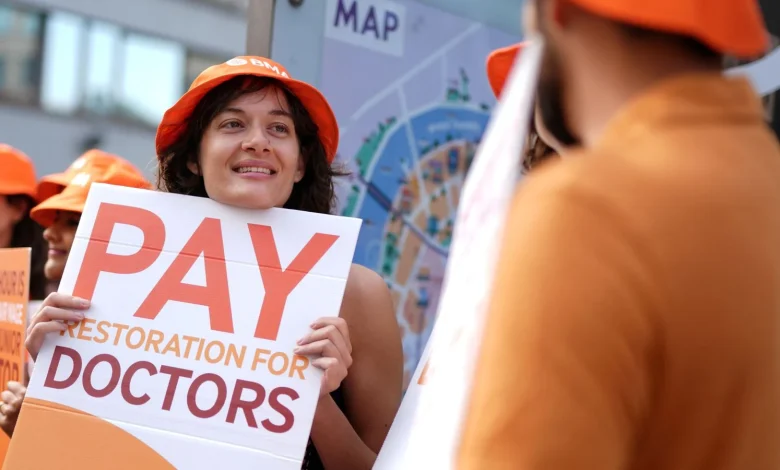
Resident doctors across England begin a five-day strike this morning over pay and jobs, marking the 14th walkout by them since March 2023.
It coincides with the record number of flu cases in England and NHS leaders warning of a “huge strain on hospitals” and strikes causing “further disruption and delays”.
Strike latest: Follow live updates
Resident doctors are striking in England from 7am today until 7am on Monday 22 December.
Sir Keir Starmer called the action “irresponsible” while Health Secretary Wes Streeting has rejected the British Medical Association’s (BMA) pay demands, accusing the union of a “shocking disregard for patient safety”.
But the BMA insists its strike is “entirely avoidable” and has demanded a “credible offer” to avert “real-terms pay cuts”.
Streeting: Government has gone ‘as far as we can’ with BMA negotiations
Why are resident doctors on strike?
The government says resident doctors have already received an average pay rise of 28.9% over the past three years (2023-24 to 2025-6).
But the BMA has been demanding an additional 26% pay uplift to restore what they say amounts to erosion in their earnings, once inflation is taken into account. Although there is some dispute about the extent of the real terms fall, because of the BMA’s use of the Retail Price Index (RPI) in its calculation.
Hopes that the strike could be averted were dashed on Monday when the BMA said 83% of resident doctors rejected a fresh proposal from the government.
While it did not include any extra pay, the offer included the fast expansion of specialist training posts; covering out-of-pocket expenses such as exam fees; and offering to extend the union’s strike mandate to enable any walkout to be rescheduled to January.
BMA boss on decision to go ahead with doctors’ strike
What if I need urgent medical care?
The Department of Health and Social Care says it is important people do not avoid seeking urgent care, and should use 999 if it is a serious or life-threatening emergency. For everything else, there is NHS 111 or the NHS App.
It adds that patients should turn up for planned appointments unless they have been told otherwise. Any appointments that need to be rescheduled will be given priority.
During strikes, there are exemptions or special arrangements, called derogations, which allow certain essential services to continue operating. It means critical services will be maintained to ensure patient safety and prevent serious harm.
How much do resident doctors earn?
There are many different types of resident doctor in England with different levels of pay. Full Fact, which has crunched the numbers, said they currently earn between £38,831 and £73,992 a year, but that does not take into account extra pay for unsociable hours.
Full Fact states that resident doctors typically get between a quarter and a third more than their basic salary from other sources.
This takes estimated average earnings (in the year ending August 2025) to between £45,846 and £81,061 (although the government claims the figures are more like £49,000 to £97,000).
Comparisons with other countries are difficult because of how doctors are categorised. Broadly, resident doctors in England earn about the same as those in Ireland and anything between 1% less and 26% more than in New Zealand.
But doctors in Australia earn somewhere between 23% and 48% more than their counterparts in England.
BMA rejects offer despite Streeting’s attack
Wes Streeting took a risky line of attack. He put an offer of more jobs to the BMA.
And while that offer was being considered he went on the offensive.
He warned the NHS would collapse if the resident doctors carried on with their strikes during a record flu season.
He repeated that line throughout last weekend when doctors were voting on whether to call off the strikes.
The BMA responded by accusing Streeting of “scaremongering”. In the end, 83.2% of those who took part in the poll rejected the government’s offer.
Senior NHS consultants gave interviews saying flu season was bad, but to be expected, and with the same contingency planning that happens every summer (off flu season) the NHS would cope.
The BMA will argue that Streeting can make the resident doctors his scapegoat for an NHS that will struggle again this winter.
They rejected that idea completely. And now they have rejected his offer.
What has the reaction been?
The prime minister has said the strike comes “on the back of a very substantial pay increase in the last year or so”.
“I think it’s irresponsible action by the BMA,” he told MPs.
BMA actions ‘irresponsible’, says Starmer
The health secretary called for doctors to ignore the strike and criticised what he called the “fantasy demand for another 26% pay rise,” adding that “it reveals the BMA’s shocking disregard for patient safety”.
Dr Jack Fletcher, chairman of the BMA’s resident doctors’ committee, said the strikes were “entirely avoidable”. He added that “we should start negotiating, and the government should stop game-playing”.
But organisations representing NHS trusts have been scathing about the walkouts. Daniel Elkeles, chief executive of NHS Providers, said: “Trust leaders and staff will be working now to minimise the impact of the strike, but sadly it will mean further disruption and delays.”
Meanwhile, Rory Deighton, acute and community care director at the NHS Confederation, said: “These strikes come at the worst possible time, with rapidly rising flu levels putting huge strain on hospitals.”
What about public support for strikes?
Public support for the strikes is low, according to a YouGov poll released last week.
The results showed 58% of those asked either somewhat or strongly opposed the industrial action, while 33% somewhat or strongly supported it.