This is an excerpt from The Buzzer, which is CBC Sports’ daily email newsletter. Stay up to speed on what’s happening in sports by subscribing here.
By its (very high) standards, Canada is mired in a terrible slump at the world junior hockey championship.
OK, it’s only two years, but the country that cares more about this event than anyone else (combined?) was eliminated in the quarterfinals twice in a row. Since the world juniors switched to its current format of a group stage followed by playoffs in 1996, this is the first time that Canada has failed to reach the semifinals in consecutive years.
Last year’s exit was especially frustrating. Despite enjoying home-ice advantage in Ottawa, Canada mustered only 10 goals in its four group games and was the most penalized team in the tournament. In the quarterfinals, a questionable kneeing call late in the third period led to the decisive power-play goal in a 4-3 loss to the Czech Republic, who knocked out the Canadians for the second straight year.
Now the pressure is really on. The last time Canada went three straight world juniors without winning at least a bronze medal was way back in 1981, when the late Dale Hawerchuk led the team in scoring as a 17-year-old.
No doubt sensing the urgency, Hockey Canada brought in a big gun behind the bench in Dale Hunter. Widely considered the top coach in junior hockey, the former gritty NHL forward has won three Memorial Cup titles and three Ontario Hockey League coach of the year awards with the London Knights since buying the team and taking over as coach in 2001. He also guided Canada to the world junior title in 2020 with a pretty mediocre roster.
Here are a few more things to know for the world juniors, which open on Boxing Day in Minneapolis and Saint Paul, Minn.
Canada is the favourite to win gold — but it’s still more likely they don’t.
A quick glance at the betting odds usually gives us a pretty good idea of who should win. The current prices on one popular site show Canada (+125) as a slight favourite over the back-to-back champion United States (+185). Sweden (+460) is quite a bit behind the Americans, and then there’s a big gap between them and Finland (+1300) and then another drop-off to the Czechs (+3000).
So, basically, Canada is the front-runner in what the gambling markets suggest is a two- or maybe three-horse race. But we should note that Canada’s odds imply their chance of winning the tournament is just 44 per cent. The host United States is at 35 per cent as it goes for its first-ever three-peat and the first by any country since Canada won five in a row from 2005-2009.
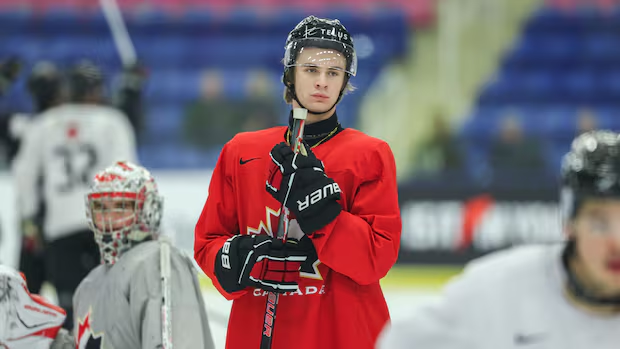
Gavin McKenna has something to prove.
The highly skilled winger from Whitehorse was still a week shy of his 17th birthday when he made the cut for the Canadian team last year, making him an exceptionally young player in a tournament where most guys are 19. Despite not being eligible for the NHL draft until 2026, the consensus at the time was that McKenna would go No. 1 overall in 2025 if he were allowed to enter.
Only a handful of guys have ever played for Canada at the world juniors before their draft season, and the hope was that McKenna would follow in the footsteps of Connor Bedard, who helped Canada to back-to-back titles and absolutely lit up the 2023 tournament in Halifax as a 17-year-old. But it didn’t work out. After scoring Canada’s first goal of the tournament, McKenna did not record a single point the rest of the way.
McKenna went on to have a great season with Medicine Hat of the WHL, racking up 41 goals and 129 points in 56 regular-season games before leading the Tigers to the Memorial Cup final. His six points in four games at the Canadian junior championship tournament included a goal in Medicine Hat’s 4-1 loss to Hunter’s London Knights in the title game.
WATCH | Gavin McKenna, the next great Canadian NHL star:
From the Yukon to Penn State: Who is Gavin McKenna?
The projected 1st-overall selection in next year’s NHL entry draft hails from the far north of Canada — Whitehorse, Yukon. He’ll also be playing in the NCAA at Penn State for his draft year, a decision that could change the path top prospects take to the NHL. But, who is Gavin McKenna?
After that, McKenna became one of the first players to make use of a rule change in the United States allowing NCAA hockey teams to sign players who have already suited up in the Canadian major junior leagues. McKenna joined Penn State, where his transition to playing against older, bigger, stronger players in a more structured environment has not been the smoothest. Through 16 games, the six-foot, 170-pound freshman has a relatively modest four goals and 18 points, and it seems less certain (though still pretty likely) that he’ll be the No. 1 pick in the draft.
During Canada’s training camp, McKenna said he relishes the chance to prove his doubters wrong. The team’s first exhibition game, against Sweden last night in Kitchener, Ont., was a good start: McKenna set up a pair of goals by his linemate Brady Martin with lovely passes to give Canada a 2-1 win.
Here’s more on McKenna’s Yukon upbringing from CBC Sports’ Karissa Donkin.
Canada looks solid in net.
Along with McKenna, the six holdovers from last year include goalies Carter George and Jack Ivankovic, marking the first time Canada has brought back two netminders together.
George was very good as the starter last year, recording two shutouts and giving up zero even-strength goals in his three group-stage games before the Czechs beat him twice on the power-play and twice at even strength in the quarters. He finished with a tournament-best .936 save percentage.
Ivankovic, the backup last year, stopped 24 of 26 shots and was perfect at even strength in his only appearance, a too-close-for-comfort 3-2 win over Latvia in the group stage.
Hunter has not named his No. 1 goalie, but George seems to have the inside track after starting last night’s exhibition opener and making 19 saves.
There’s some interesting new blood.
Former head coach Dave Cameron raised a lot of eyebrows last year by cutting talented forward Michael Misa, who ended up leading the OHL in scoring with 134 points (including 62 goals) in 65 games, and slick defenceman Zane Parekh, who topped all CHL defencemen with 33 goals and 107 points as Misa’s teammate in Saginaw. It came back to bite him as Canada averaged just 2.6 goals per game and the professorial-looking coach was pilloried for overthinking his roster construction.
In fairness to Cameron, he lost superstar defenceman Matthew Schaefer to a broken collarbone in Canada’s second game. Schaefer ended up being the top pick in the NHL draft, and the impressive New York Islanders rookie is currently making a strong case that he belongs on Canada’s Olympic team. So it’s safe to say he would have been a difference-maker in the world juniors.
But maybe Misa and Parekh would have been too. Misa went second overall in the draft to San Jose, while Parekh was the No. 9 pick in 2024 by Calgary, so clearly they have the talent.
Though both are now playing in the NHL, they’re set to make their world junior debuts after getting permission from their pro teams. Parekh was in camp from the start, while Misa joined on Wednesday after the Sharks were satisfied with his recovery from a lower-body injury that has kept him out since Nov. 1.
Other intriguing newcomers include 17-year-old defencemen Keaton Verhoeff and Carson Carels, who are set to be among the youngest blue-liners Canada has ever sent to the world juniors. Both are expected to go in the first handful of picks at the upcoming NHL draft. And Carels, a rugged farm boy from Cypress River, Man. (a “small town of about 50 people in the middle of nowhere,” as he describes it) has been climbing up the prospect rankings with his well-rounded game.
Canada’s schedule:
A shot at revenge on the Czechs comes right away as Canada opens its group slate against last year’s bronze medallists on Boxing Day at 8:30 p.m. ET. Next up is Latvia on Saturday, Dec. 27 at 4:30 p.m. ET, then Denmark on Dec. 29 at 8:30 p.m. ET and, to close out the group stage, 2025 silver medallist Finland on New Year’s Eve at 8:30 p.m. ET. The other group is made up of the United States, Sweden, Switzerland, Slovakia and Germany.
The top four in each group advance to the quarterfinals on Jan. 2. In that round, the first-place team in each group faces the fourth-place team in the other, while the No. 2s cross over to play No. 3s. The winners are then re-seeded for the semifinals on Jan. 4. The medal games are on Monday, Jan. 5.