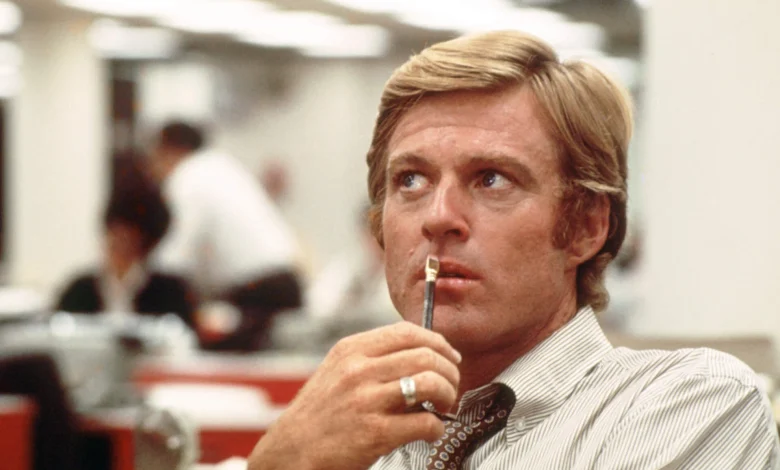
I spent nine years working in the print traffic department at the Sundance Film Festival, making sure the movies got from theaters in Park City to Salt Lake City and back again in time for screenings, which could get tricky on those snowy canyon roads. One of the great things about the gig — besides the altitude sickness, unprintable party anecdotes and celebrity sightings — was that I could tell everyone Robert Redford was my boss. Of course, a festival on that scale employs hundreds of people. We never interacted, and for all I know, Mr. Redford didn’t have the slightest idea what my department even did. But I still liked being able to say that I worked for “Bob,” because the name Robert Redford stood for something. When he died in September at the age of 89, it felt like the end of an era.
More than just my mom’s favorite movie star, Redford was a different kind of celebrity. Passionate about land conservation and the environment, he put his money where his mouth was. He also used his considerable clout to make the movie industry more welcoming to young and undiscovered talent. Who knows if the U.S. independent cinema revolution of the ‘90s would have happened if Redford hadn’t backed a struggling little film festival up there in the mountains, lending the name of his most iconic character to this ragtag gathering of artists and social issues documentarians while nurturing it into a cultural juggernaut.
One of the most absurdly handsome men ever to wander in front of a camera, Redford got his start in matinee idol roles and had a real flair for light comedy, but he was always after something meatier and more substantial. Desperate to prove he wasn’t just a pretty face, the star leveraged his popularity into creative control, and Redford pictures came to epitomize classy and often socially conscious entertainment for adults. The Brattle Theatre’s “A Tribute to Robert Redford” runs from Thursday, Dec. 18, through Tuesday, Dec. 23, spotlighting 11 of the actor-producer-director’s best-known movies from the 15-year period when he did his finest work.
From left, Robert Redford and Dustin Hoffman in “All the President’s Men.” (Courtesy the Brattle Theatre)
The retrospective kicks off with a 35mm screening of arguably his best film, 1976’s “All the President’s Men” (Dec. 18). Redford produced the picture, which was directed by Alan J. Pakula from a smart script by William Goldman. It’s a superb bit of shoe leather detective work, following two young Washington Post reporters — Redford’s stuffy Bob Woodward and Dustin Hoffman’s cocky Carl Bernstein — as they start sniffing around a break-in at the Watergate Hotel. The movie’s masterstroke is that it only covers the first seven months of the scandal. We all know how Watergate ended, what’s fascinating is how it began; how all the little clues and slips snowballed into a story that would eventually bring down a president.
During a visit to New York City in October, I went to a rep screening of “All the President’s Men” at the IFC Center, figuring I could honor two recently deceased American institutions: Robert Redford and the Washington Post. What I’d forgotten is what a bang-up audience picture it is, full of sly buddy comedy between the mismatched leads and a barn-burner of a supporting performance from Jason Robards as tough-talking editor Ben Bradlee. “All the President’s Men” is the kind of movie that really makes you appreciate what movie stars can do. Redford spends a not inconsiderable amount of the film on the telephone, silently reacting to an offscreen voice, which is a big ask for any actor and not the easiest thing to make compelling on camera. But he was always so great at that kind of acting. Redford projected such an easy intelligence that you loved to watch him thinking things through.
Early in his career as a producer, Redford teamed with director Michael Ritchie for two tougher-than-expected pictures that started pecking away at his fair-haired golden boy persona. Ritchie was a filmmaker fascinated by how competitive sports reveal the American character — his 1976 masterpiece “The Bad News Bears” is one of the greatest movies ever made about this country — and 1969’s “Downhill Racer” (Dec. 23) stars Redford as a champion skier displaying some surprisingly unsportsmanlike tendencies on his way to the Olympics. There’s a terrific Gene Hackman turn as the coach who’s had it up to here with his star athlete. It’s a prickly little film, with elliptical New Wave editing that makes the movie feel intriguingly unfinished. What should be a triumphant ending comes off as fascinatingly uneasy.
Robert Redford (left) and Gene Hackman in “Downhill Racer.” (Courtesy the Brattle Theatre)
They collaborated again in 1972 on “The Candidate” (Dec. 21), a bracingly sour satire starring Redford as a crusading lawyer lured into a can’t-win Senate campaign who gradually finds himself being corrupted and co-opted by the political machine. Movies pitting one man with shaggy sideburns against the system were a dime a dozen in those days, but this is something more sophisticated and sadder, a film about the gradual, inevitable erosions that come with compromise. We watch the Redford character’s idealism die a death by a thousand cuts, leading to one of the most devastating last lines from a movie decade that was full of them: “What do we do now?”
A good deal less despairing were Redford’s beloved collaborations with longtime friend Paul Newman, and on Saturday, Dec. 20, the Brattle is showing both 1969’s “Butch Cassidy and the Sundance Kid” and 1973’s “The Sting” as a double feature, so you can fill an entire day with the easygoing banter of two guys who were born to bat it back and forth with each other. I don’t think either of these is a great movie, but they are great fun to watch. Seeing Redford and Newman’s chemistry together, it’s hard not to miss that kind of comfortable, unthreatened masculinity in a modern culture that seems to be overcompensating wildly in every other direction. I also think a lot about how these two guys used their fame and fortune to try and leave the world a better place than it was when they found it. Looking at how much good was done by Newman’s Own and the Sundance Institute, I find it difficult to have much patience for modern movie stars pitching their branded tequilas and ancillary product lines.
Speaking of chemistry, “The Electric Horseman” (Dec. 22) was one of five movies Redford made with his favorite leading lady, Jane Fonda. It’s a breezy charmer in which the actor stars as a washed-up rodeo star who steals a $12 million horse from a breakfast cereal commercial shoot after he finds out it’s being abused. Fonda’s the stubborn reporter following him for the story, and there’s a wonderful turn from Willie Nelson, making his film debut as Redford’s sidekick. The movie unspools with the sturdy — if slightly starchy — signature of the star’s seven-time director Sydney Pollack, a filmmaker of more professionalism than verve. One of their previous collaborations was the 1972 outdoor adventure “Jeremiah Johnson” ( Dec 22). I’m sorely tempted to go to the Brattle screening just to observe the audience’s reaction when they realize that the ubiquitous social media Nodding Man meme is actually a shot of Redford in this picture.
From left, Paul Newman and Robert Redford in “The Sting.” (Courtesy the Brattle Theatre)
As the years went on, Redford became increasingly more protective of his screen image. He never really mixed it up with the New Hollywood guys, and was not unfairly labeled by many as the greatest star who never worked with a great director. But Redford did become a fine filmmaker in his own right. His excellent 1980 directorial debut “Ordinary People” (Dec. 23) is often unfairly slagged by young cinephiles because it beat “Raging Bull” at the Oscars that year. (As if Scorsese’s brutal, black-and-white psychodrama had any prayer of winning Best Picture.) Redford was extremely cautious about what kind of roles audiences wanted to see him in. He didn’t dare play a villain until the very end of his career, in Marvel’s 2014 “Captain America: The Winter Soldier,” which is itself basically a kiddie pool, Underoos version of he and Pollack’s 1975 espionage thriller “Three Days of the Condor” (Dec 18).
I used to joke that I wished I could walk around with Robert Redford’s glorious backlighting, the vanity of which became distracting in later years. Still, he understood that audiences (not critics) came to see him bathed in that golden glow. For the full Redford mythology experience, look no further than “The Natural” (Dec. 19), director Barry Levinson’s preposterous 1984 adaptation of Bernard Malamud’s novel, in which the actor starred as a supernaturally gifted, 38-year-old baseball prodigy. The film’s oft-parodied finale has become a cultural touchstone, with Redford smashing a home run into the stadium lights and running around the bases in slow motion. Even if you haven’t seen the movie, you’ve seen that scene. Which makes it even funnier that in Malamud’s original story, the slugger struck out.
Redford used to make himself scarce at Sundance. After the opening day press conference, he’d basically disappear so as not to distract media attention away from the filmmakers, sticking to private screenings up at the resort he owned in Provo. But you’d sometimes hear rumors of him catching movies in town, surreptitiously slipping in and out of screenings. These were talked about like Yeti sightings. One night in 2013, I was settling into a back row seat for the premiere of the documentary “The World According to Dick Cheney.” In the next row, a chair closest to the exit door was taped off. “That’s Bob’s seat,” a volunteer told me. I laughed it off. Everyone who worked there made those kinds of jokes about “Bob.”
Paul Newman (left) and Robert Redford in “Butch Cassidy and the Sundance Kid.” (Courtesy the Brattle Theatre)
But sure enough, just as the lights went down, two people escorted a familiar-looking, sandy-haired gentleman to that taped-off seat in front of me. Reflected in the glow of the movie screen was one of the most famous faces in film history. I couldn’t pay attention to the documentary at all; I was so captivated watching Redford watch it. He was such a demonstrative viewer, shaking his head in disgust at every vile thing Cheney said — and there were a lot — before nodding in approval at Sen. Robert Byrd’s speech condemning the invasion of Iraq. I started thinking of other movies I might like to watch Robert Redford watch. And then the documentarian started interviewing Bob Woodward.
It suddenly struck me that the real Bob Woodward was up there on the movie screen and the movie Bob Woodward was sitting right there in front of me in the theater. This made me extremely grateful I had declined my roommate’s offer to smoke a joint with him before I left for the screening, because the cosmic implications of that moment might have melted my brain. The second the film was over, before the lights came up, Redford had already been escorted out the back door. People sitting around us had no idea he’d even been there. I didn’t stay for the director’s Q&A. I had to go call my mom and tell her I’d just watched a movie with her favorite movie star.
“A Tribute to Robert Redford” runs at the Brattle Theatre from Thursday, Dec. 18, through Tuesday, Dec. 23.