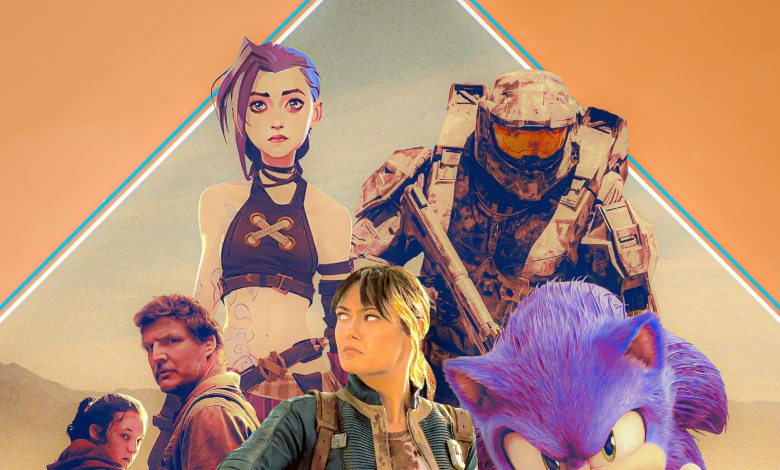
Now that video game movies and shows are (often) good, how can we classify the adaptation types? And where does ‘Fallout’ fit in?
It’s not a spoiler to tell you that Fallout Season 2 is an entirely different kind of Fallout adaptation. The show made this pivot clear in the final moments of Season 1. While Fallout‘s maiden voyage was a bold and successful attempt to weave the franchise’s many facets into an original story with surprising bite, its cliff-hanger ending pointed in the direction of one specific game: Fallout: New Vegas. Prime Video’s Fallout is set further in the postapocalyptic future than any of the video games to give showrunners Graham Wagner and Geneva Robertson-Dworet a healthy amount of creative freedom, so they weren’t exactly promising a straight adaptation of that 2010 game. But a semi-sequel? Maybe!
Whatever Fallout intends to do with this new take on the Mojave wasteland and the Vegas Strip, the show’s pivot to pulling directly from a specific game makes for a good opportunity to consider the many ways a video game can be adapted. In this new golden age of video game TV and cinema, kicked off by the success of the Sonic the Hedgehog trilogy and HBO’s The Last of Us, the rules are still being written.
The interactivity of video games used to be cited as the primary reason why making a good TV show or movie based on them is so difficult, but a new generation of gaming-savvy creators is seeing that as an advantage. (Another reason why Fallout is so interesting as a game-to-TV success story: The games are one of the most player-directed franchises out there.) So, with half the decade in the rearview, let’s assess the ways Hollywood has started to capitalize on the gaming IP gold rush.
A few constraints: I’m declaring 2020 the beginning of this era of video game adaptations, largely because of the success of Sonic the Hedgehog—which earned its place not just via box office returns but by launching a bona fide franchise. Sonic checks a lot of boxes that game adaptations had previously struggled to reach. Each of its sequels is more critically and commercially successful than the last, it has a weird spinoff series in which movie talent appears, and there’s a forthcoming “Sonic Universe event film,” the sort of thing every franchise aspires to now. It’s the solid foundation that subsequent game adaptation success stories would build on or complement, and as good a starting pistol as any for the reign of the video game adaptation.
1. Chapter and Verse
It’s easiest to imagine adapting games that already resemble films or television. Relatively linear plot- and character-driven games can make the jump to the noninteractive screen rather easily—or at least, as easily as other regularly adapted media like novels or comic books. Until recently, this has been the method tried least.
When it works: The Last of Us, easily. While some things are added, cut, or reordered, the reverence for the source material is clear and is still uncommon in the world of game adaptations … for now.
When it does not: Resident Evil: Welcome to Raccoon City (2021) attempts to make up for Paul W.S. Anderson’s long-running series of very loose adaptations by hewing more strictly to the shape of the first two games in the series. Unfortunately, it does so with a full franchise’s worth of hindsight and gets too bogged down in lore to really bring the thrills.
See also: Five Nights at Freddy’s, Detention, Like a Dragon: Yakuza
2. Lore Explainer
Lots of games that don’t need a story still have some semblance of one that provides a compelling rationale for whatever outlandish activity you may be doing in the game. Most fighting games live in this space, as do a number of mobile and online games, whose incredibly elaborate backstories are also entirely secondary to the gameplay. Adaptations in this mode bring all that good esoterica to the fore, crafting their plots to demonstrate just how elastic these characters and settings can be.
When it works: You get Arcane, a show so good at building out just one corner of Runeterra, the setting of the wildly popular online game League of Legends, that you might resent Riot Games and animation studio Fortiche for wrapping things up in a brisk two seasons. Whatever follows Arcane will likely be just as much of a blast to watch, but who can blame us for wanting to spend more time in Piltover?
When it does not: Paul W.S. Anderson’s Monster Hunter has quite a few things going for it. Milla Jovovich is as good as she was in the very best of her Resident Evil movies, wholly committed to kicking monster ass and not taking it too seriously. Tony Jaa and Ron Perlman show up and are reliably fun, as is the grand spectacle of the monsters and the ritual of hunting them. But as dedicated as the movie is to the specifics of the Capcom games it’s based on (arguably more so than Anderson’s take on Resident Evil), there just isn’t enough here to warrant fleshing them out.
See also: Castlevania: Nocturne, Dota: Dragon’s Blood, Mortal Kombat
3. Original Story
Historically, the most common approach to adapting a video game has been to spin an original story. This makes sense: In the earliest days of video games, there wasn’t much story to work with anyway, and many more modern video games are built around a player character who is either a complete cipher or shaped by the person playing. Now that games are more respectable fodder for TV and film, however, the original story approach is also a way to keep the continuity of the games intact—so that the adaptations can sit comfortably alongside them if they’re good or be completely disavowed if things go south.
When it works: As we noted from the start, this is key to Fallout Season 1’s success. With its trio of original protagonists—Lucy (Ella Purnell), Maximus (Aaron Moten), and Cooper/The Ghoul (Walton Goggins)—Fallout is able to walk the tightrope between giving newcomers an on-ramp into its world and offering longtime fans a new lens on a familiar setting. The surprises it has in store for both parties are a testament to the showrunners’ skill at knowing exactly what’s worth spending the series’ comparatively limited running time on.
When it does not: Netflix’s Resident Evil series is one of the oddest ducks in the very strange history of screen adaptations. It’s positioned as a wholly new take on the franchise, but—in one of the most ridiculous late twists I’ve ever seen—it firmly places itself in continuity with the video games. Unfortunately, the new ideas and characters Netflix’s Resident Evil brought to the table weren’t very good, and an excellent series of games still awaits a fitting Hollywood take. Maybe Zach Cregger will break the curse.
See also: Werewolves Within, Until Dawn, the Adi Shankar “Bootleg” universe, Cyberpunk: Edgerunners
3b. The Halo Situation
In one of the most extreme examples of freeing an adaptation from the tyranny of continuity, the Paramount+ take on Halo was preceded by a blog from the franchise stewards at Halo Studios (formerly 343 Industries) that designated the show as taking place in “the Silver Timeline,” wholly separate from the continuity of the games. Unlike J.J. Abrams’s Star Trek, there is no in-universe reason for this split—no multiverse, no mirror dimension, no Bob Newhart–style dream. In hindsight, this probably made it easier for fans to come to terms with the fact that the series wasn’t terribly successful at much of what it did, but it’s still extremely funny that the blog was written at all.
4. Fan Service
The most subjective category in this mostly subjective act of faux scholarship, the fan service adaptation attempts to jam-pack its running time with as many Easter eggs and shout-outs to the game as possible. At first blush, this category and the original story approach to adapting games may seem redundant, but the fan service adaptation stands apart in its single-minded commitment to delivering these referential moments. Plot and character are secondary to the hero shots, of which there are many. These can be great fun. Usually, they are a disaster. Occasionally, they’re both.
When it works: The Sonic the Hedgehog trilogy has been exceptionally deft at this, carefully doling out loving shots of game iconography in a conservative first installment, then hitting the gas on fan-service allusions and never letting up.
When it does not: The film adaptation of Borderlands is, on paper, a pretty comprehensive tour through the world of Gearbox Entertainment’s irreverent shooting games. All the hallmarks are there: Claptrap, a gleeful rejection of maturity, and a surprisingly involved mythology. Unfortunately, despite a likable cast that includes luminaries Cate Blanchett and Jamie Lee Curtis, Eli Roth’s cover version was all out of tune. The Borderlands games aren’t for everyone, but the Borderlands movie is for even fewer people.
See also: The Super Mario Bros. Movie, Uncharted, A Minecraft Movie, Fallout Season 2
Joshua Rivera
Joshua Rivera is a Philadelphia-based culture writer whose work has appeared in GQ, New York, Vanity Fair, Polygon, and others. You can follow him at @jmrivera02.