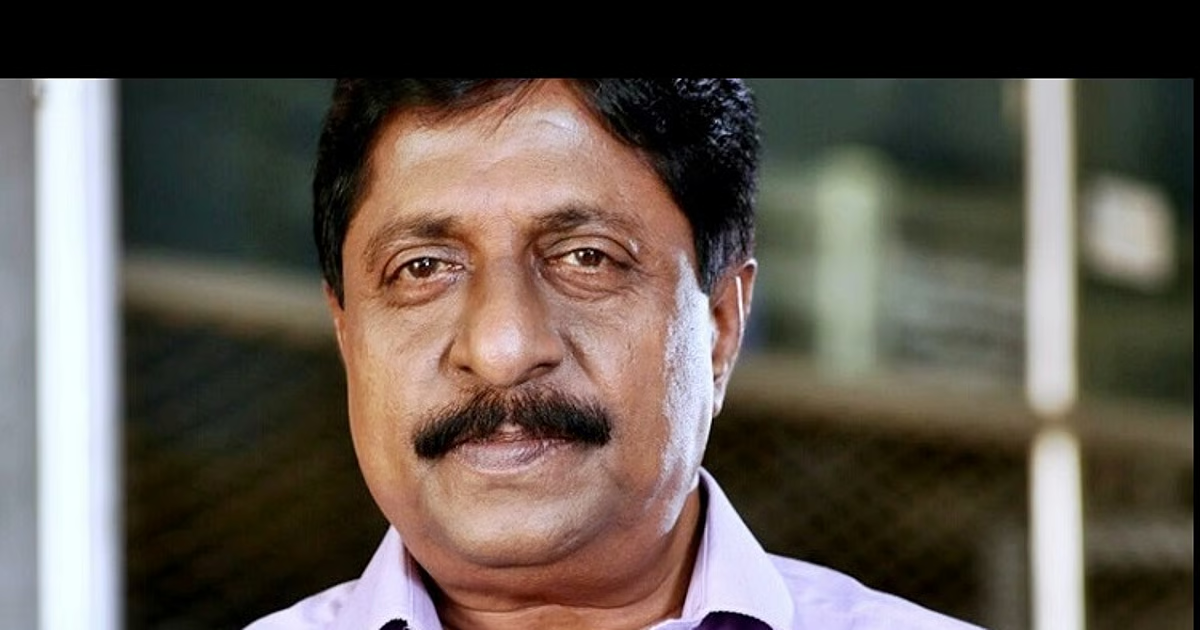
The Malayalam film industry has lost a giant. Actor, writer, and director Sreenivasan is no more. He was 69. Sreenivasan passed away at the Ernakulam taluk hospital on December 20 Saturday.
Sreenivasan was no hero material by conventional standards. But yet, there are few people in Malayalam cinema who are as capable and versatile as he was, or blessed with the rare ability to laugh at themselves. Born in Patyam near Thalassery in Kannur district, he went to Chennai to study cinema.
Apart from being an actor, Sreenivasan was also a screen writer, director, and producer. He’s perhaps Malayalam cinema’s “sakalakalavallabhan” or the “man of many talents”.
Sreenivasan made his debut in the 1970s and continued to make his presence felt in Malayalam cinema well into the new millennium. It’s impossible to list all the fantastic films that he’s starred in or written – this is simply a small sample. S
reenivasan was often referred to as a comedian but he had played a wide range of roles in his films, ranging from the hero’s side-kick to characters that could move the audience to tears. Often, he could make you laugh and cry in the same film, as in Vadakku Nokki Yanthram in which he played the role of a man with a severe inferiority complex about his looks.
When we first meet Dineshan who wants to paint his face white with powder and makes hesitant confessions to his acquaintances about his impending marriage to a beautiful woman, we get ready for a laugh riot. And a good part of the film is precisely that. His painstaking efforts to narrate jokes to impress his wife (“Appozh barber”), his antics to escape the watchful eye of his authoritarian mother, and the many tactics he employs to find a place in his lady’s heart all strike one as funny.
But the film grows decidedly darker as Dineshan’s obsession spirals out of control and he turns into a controlling, jealous tyrant towards his wife and family. Dineshan’s character is closely built on Sreenivasan’s own appearance and it could have so easily turned into slapstick humour, where the jokes about somebody’s physicality keep coming but the story doesn’t grow beyond it, a common enough technique that comedians use.
Instead, Sreenivasan, who also wrote and directed the film, was willing to expose his vulnerabilities to the audience and yet retain the character’s dignity while doing so.
In Ponmuttayidunna Thaaravu, Sreenivasan as Bhaskaran makes you root for him, the lower class man who is cheated and ditched by his girlfriend (Urvashi). Even as you feel sorry for Bhaskaran, you realise that he wasn’t really as guileless and innocent as you thought him to be. Roles like these are not child’s play, for a bit of “over-action” here and an eye-roll there could easily give the game away. Sreenivasan imparted a verisimilitude to these characters that made them flawed, believable and likable all at once.
Even when playing the hero’s sidekick, Sreenivasan was never predictable. He could be a pompous, two-timing friend as in Mukundetta Sumitra Villikunnu or a jealous, conflicted one as in Nadodikaatu (which had two equally hilarious sequels, Pattanapravesham and Akare Akare Akare). He could be the boss’s most loyal employee who elopes with the latter’s sister as in Midhunam.
Or he could bring on the waterworks with a film like Kadha Parayumbol (which he also co-produced), a story that moved all those who watched it, including Shah Rukh Khan and Rajinikanth. Sreenivasan appears as Balan, a barber, who shoots to fame when people come to know that he was the childhood friend of Ashok Raj (Mammooty), a big time film star who has come to shoot in their small town.
In a replication of the Krishna-Kuchela story, Balan is hesitant to approach his old friend who has now reached the sky. Unless your heart is made of stone, you must have wept buckets for the endearing, unlikely friendship between the two men, especially the naive Balan who touches your heart with his humility.
Sreenivasan consistently refused to fit himself into stereotypes. He did experimental films like Passenger and Kerala Cafe, moving with the times and doing films that are of different genres. Even if his role was limited to a few scenes, as in the comrade doctor in Sakhavu, Sreenivasan left an impact. And despite his general geniality, he also essayed roles with negative shades as in Killichundan Maambazham, where he played a lustful Muslim man with three wives, or Kaalapani, where he was a played Moosa, a spy for the merciless jail warden (Amrish Puri).
Sreenivasan’s understanding of human nature and observation of people’s everyday behaviour were evident in the scripts that he wrote. Sandesham, the sharply satirical, hugely funny, and adequately tragic Sathyan Anthikkad film, for which Sreenivasan was the writer, is perhaps the best example of this.
The film tears into the hypocrisy of the two main political parties in Kerala by focusing on two siblings, played by Sreenivasan and Jayaram who belong to opposite camps. The microcosm of the family, where their ideological battles play out, is etched with so much detail and richness that the film makes its point in an entirely relatable way to the audience.
Thalayana Manthram is another timeless comedy Sreenivasan wrote which saw Urvashi delivering one of her finest performances. Once again, Sreenivasan and Jayaram played brothers in a hilarious script about family politics and rivalry.
Chinthavishtiyaaya Shyamala, another directorial venture of his, is about a lazy man who uses every excuse in the book to get out of doing work, much to his wife’s grief and indignation. Shyamala (Sangita), takes it upon herself to look after the family when her husband decides to abandon them for a “spiritual quest’.
Vijayan, Sreenivasan’s character, is someone you’d run into in every town or village. He’s the quintessential leech who gets by since he’s developed an extremely thick hide. Taking a jibe at those who turn to religion to avoid dealing with real world issues, Chinthavishtiyaaya Shyamala also had a strong female protagonist. Even though Shyamala doesn’t give up on her husband, there is enough self-respect and dignity in how she handles her circumstances. The film is equal parts about her as it is about Vijayan.
Malayalam films are often made on a small budget and may not have the grandeur of films made in other industries. Most of Sreenivasan’s films barely had any populist elements in them. What makes these movies indelible in the memory of the audience is simply the strength of the storytelling, a talent that Sreenivasan had in abundance.
Over the years, Sreenivasan grew into a public figure whose views on various social and political issues were taken seriously by the people of Kerala, a state where fans treat cinema and politics with equal gravity. He got himself into controversy over certain remarks, but despite the criticism, he continued to be a much loved star.
Sreenivasan was no giant in appearance, but the stature that his art achieved is immeasurable. And Kerala will miss him deeply in the years to come.