‘It: Welcome to Derry’ Star Chris Chalk Unpacks Episode 5’s Mystery Box and Previews Madness Ahead

[This story contains spoilers from It: Welcome to Derry episode five, “29 Neibolt Street.”]
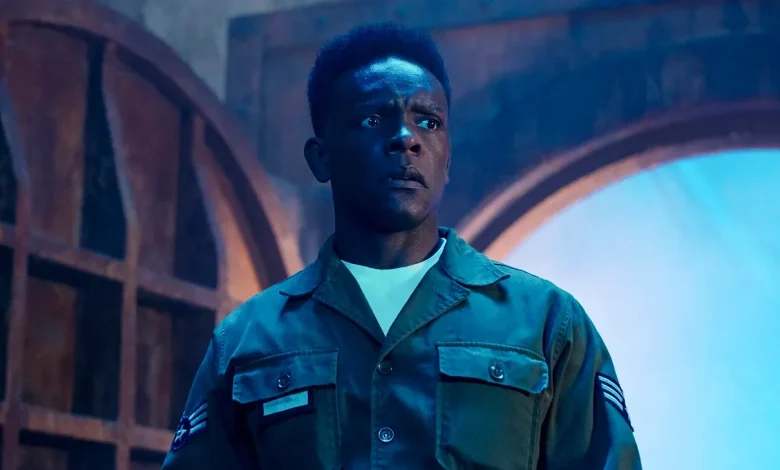
With each passing week on It: Welcome to Derry, Chris Chalk further proves he was the ideal choice to fill the big shoes of Stephen King-verse character Dick Hallorann.
Following in the footsteps of previous on-screen Dick Hallorann portrayals — including Scatman Crothers (1980’s The Shining), Melvin van Peebles (1997’s Shining miniseries) and Carl Lumbly (2019’s Doctor Sleep) — may seem like a tall order, but the North Carolina native learned long ago through working with the likes of Denzel Washington, Philip Seymour Hoffman and Viola Davis that one must command their own respect to succeed. Chalk certainly revisited these previous takes on the psychic who inherited his gift to “shine” from his grandmother, but he ultimately made a point to carve out his own niche.
The 1962-set prequel series — which takes place 27 years before the events of Andy Muschietti’s It Chapter One (2017) and 54 years before It Chapter Two (2019) — finds the future head chef at the Overlook Hotel in a unique position for the U.S. Armed Forces. As Airman Hallorann, he’s been applying his telepathic and clairvoyant gifts to help the Army find a “weapon” to end the Cold War. From the start, the audience is well aware that the weapon is “It,” the malevolent shapeshifting entity most recognizable as Pennywise the Dancing Clown (played by Bill Skarsgård).
Along the way, Hallorann befriends Major Leroy Hanlon (Jovan Adepo), who is the father of Will Hanlon (Blake Cameron James). (In King’s It novel, Will’s eventual son, Mike, recalls a tale in which Halloran saved his father’s life from an arson-set fire at a Derry club called The Black Spot.) During last night’s fifth episode, “29 Neibolt Street,” written by co-showrunner Brad Caleb Kane, the visage of Skarsgård’s Pennywise has finally been brought to the fore, and It turns the tables on Hallorann by opening up a mystery box of horrors that Dick has long suppressed inside his brain.
“Everything that happened before this moment is so tiny in comparison to that box now being open,” Chalk tells The Hollywood Reporter. “It’s saying, ‘Now we have danger. Not only do we have Pennywise, this living fucking nightmare, but now we have all of Dickie’s past nightmares and traumas and pains set free. What are you going to do now, Mr. Psychic?’”
With three episodes remaining in season one, Chalk teases what lies ahead now that Pennywise is out in the open. “Dick continues to disintegrate into the madness,” Chalk says. “We know where it’s going. We’ve seen It Chapter One and It Chapter Two. How can you beat Pennywise, guys? Is that even possible for this group of ragtag goofballs? We’ll see.”
Below, during a recent conversation with THR, Chalk also discusses his special bond with Adepo, before elaborating on the prevailing lesson he picked up from working with industry heavyweights.
***
Given the legacy of Dick Hallorann, how much rigmarole was there during the casting process?
Very little. There was a conversation where [EP-director] Andy [Muschietti] had already said, “I like him,” and then I think I miscommunicated that and thought, “Oh, they gave it to me.” But then someone said, “Come read for it.” I remember being slightly annoyed, but saying sure. I hadn’t been to a [casting] office in a very long time, and I remember knowing the guy that I was there to read with that day. He’s enormous, like weightlifter big, and I thought, “That doesn’t make sense. Why would they cast a guy that big?” He looked like a professional wrestler and was auditioning for the Leroy [Hanlon] part. I won’t say his name because he didn’t book it. But we read, and he smelled like a cigarette. I hated that. Then, a few days later, I found out I booked it. I think Andy is pretty good about knowing what he wants.
Chris Chalk’s Dick Hallorann in IT: Welcome to Derry.
Brooke Palmer/HBO
Are in-person auditions making a comeback?
No, not for me, but man, I miss it. It’s a superpower you develop, and now they’ve taken it away from you.
I know that essence, not impression, is the name of the game, so how much tape did you watch on previous iterations of Dickie Hallorann?
I gave all the Dickies a little bit of time, but not too much. Like you said, it’s the essence, and we’re all drawing from the same source material. I did want to honor Scatman [Crothers] because we all love him. I haven’t read a single person on Earth who’s like, “I fucking hate Scatman.” (Laughs.) But I looked at all of it, knowing it was part of the canon of Stephen King’s work, and then I just did my job without being too honorific of the other Dickies. I’ve acknowledged they exist, and all information is good information.
With Scatman, I noticed he’d tilt his head a lot and widen his eyes. He’d also keep his hands busy. Did any of that register with you?
If it did, it was unconscious, and we don’t know what we steal unconsciously. But I didn’t consciously think of it that way. He’s so much older than me in his iteration that none of those habits would necessarily apply. The speech and tone are similar, but de-aged a bit. So I did want to connect it a little, but it wasn’t to the point where I was doing a scene, thinking, “What would Scatman do?” No way, dude. I could do whatever I want.
Your Dickie does this business with his hands over his face, so that’s probably what got me thinking about it.
He had nothing to do with that — not even a little. That final hand position was actually a huge debate between me and all the creators. They did not like my original choice.
What was it?
It was a long time ago, but I remember going, “Hey guys, I don’t care. This is not the hill I’m going to die on. If y’all know how you want it to look visually, please tell me.” I received so few corrective notes or notes that led me to do this instead of that, but if you offer me one, I’ll take it. What kind of asshole would be like, “I’ll take zero notes this entire production”?
Jovan Adepo’s Leroy Hanlon and Chris Chalk’s Dick Hallorann in IT: Welcome to Derry.
Brooke Palmer/HBO
When you and Jovan Adepo first encountered each other on set, who was the first person to bring up Cory Maxson? (Chalk played the teenage Fences character on Broadway in 2010, while Adepo played him in the 2016 movie, alongside many of Chalk’s stage castmates, such as Denzel Washington and Viola Davis.)
Jovan called me the day I booked it. I remember leaving BCD Tofu House when we had just discovered it, and we were like, “Oh, shit, we can get Korean food all the time now.” As we were leaving, Jovan called me and said, “Hey, what’s up, dog?” I said, “What’s up? Why are you calling me? You never call me.” And he said, “What are you doing this winter/summer? I want you to do a short film for me.” (Laughs.) I was like, “What!? I can’t. I booked something, but I can’t tell you what.” Then he was like, “Man, I know what you booked.“ We didn’t know at the time we were going to be spending a year and a half together. [Writer’s Note: Production began in May 2023 and was suspended in July 2023 due to the SAG-AFTRA strike.]
But we’ve worked together a few times, and Cory Maxson has always been a conversation he likes to bring up. One time, this little kid from the show came up to us after a rehearsal for episode five. There was a lot of stuff we had never done before, so we had to practice. This kid walked up to Jovan, and he didn’t even see me, and he said, “Mr. Adepo …” Already I was like, “Get out of here.” (Laughs.) He was like, “Mr. Adepo, your work on Fences was transformative.” I was like, “You’ve got to be effing kidding me.”
Then I said, “Hey, hey.” And he said, “Yes, sir?” He didn’t even know who I was, and I was like, “Oh, I hate this kid.” (Laughs.) But he praised Jovan, and Jovan cast me a tiny little look of, “I told you my Cory was better.” So I spent the rest of production ignoring that little boy. (Laughs.) That’s not completely true, but it’s kind of true.
The first couple looks that Hallorann gives Hanlon (Adepo) — was he trying to read his mind and see if his clinical fearlessness is for real? Was he trying to warn him about what lies ahead? Or was he marking his territory?
Egoically, he’s marking his territory. He can’t help himself. He wants this new guy who’s highly ranked to realize, “I know you’re highly ranked, but I’m more powerful than you in this circumstance.” He’s also digging into his brain, doing his best to find things on the edges. It’s only when we get to the masked assault of Leroy that Dickie really digs into his brain and investigates what his thoughts are, and if he’s as fearless as it seems under duress. It turns out that he is, but it’s all just the way to get out of this military bullshit. It’s neither liking or disliking Leroy’s character at first. He then dislikes him until he falls in love with him.
James Remar’s General Shaw and Chris Chalk’s Dick Hallorann in IT: Welcome to Derry.
Brooke Palmer/HBO
There are several different versions of Hallorann depending on who’s opposite him. For a Black man in the early ‘60s who could easily be written off as crazy, is code-switching a matter of life and death?
Yeah, if someone had the ability to read minds during the civil rights movement, and even now, he’s going to code-switch every second. He’s going to look around and go, “What’s going to keep me the safest when talking to this authority figure or this hooligan or this individual?” Sometimes, he might read a mind and trigger them on purpose. But, yes, it’s a game of escape. It’s a game of, “How can I get back to my safe place?” It’s in a kitchen, cooking, surrounded by people that he’s attracted to and loves. That’s Dick’s whole want. To just get somewhere loud, sexy, and fun, which is the antithesis of Derry.
Hallorann is under pressure to find a very particular “weapon” that will end the Cold War and prevent what will lead to the Cuban Missile Crisis. How do you think the Army first discovered his ability?
I think Andy would still stick to this, but we talked about a card game. He was down South, playing a car game and winning too much. Then, through some sort of setup, they realized, “Oh, this guy’s kind of special. Lock him up, don’t care.” Eventually, they found a use for him. In my brain, he wasn’t used for a while, and he sat in a dark, damp room until they said, “We’ve got something for you, Hallorann, and then you can be set free.” He really has to succeed at this, or he’s going back to that little underground prison.
In episode three, Dick goes up in the air with Hanlon and experiences this psychological event in which a shadowy Pennywise confronts him. You didn’t get to see a lot of the visuals we see, so where did your mind go during those close-ups?
In the safest way humanly possible for Chris Chalk’s mental health, I allow Dick Hallorann to have these episodes. But it’s a part of the work I do beforehand: “What is this? What does it feel like? Is it cold? Is it hot? Is the brain frozen? Is it like an ice cream freeze at the roof of your mouth? How does he breathe in this reality when he’s under attack in the other reality?” I found the breath to be the most important thing because if he stops breathing over there, he stops breathing over here.
It’s also a game of dodging the things that aren’t necessary. If we think of the psychic world as this information superhighway, there’s infinite roads. So even with his psychic ability, he has to find the right road. As I defined all that nerdy, exciting stuff, I then just did my job. I’d look for it, find it, and then they’d go, “That’s a bit long. Can you speed it up?” Or they’d take some stuff and build on it.
We reshot some of [episode four’s] Taniel sequence because Andy wanted to change things around, visually. So I got lucky, honestly. I got to do this scene two-and-a-half or three times, and I really let it come into its own. That’s the scene that had the huge debate about the hands of it all. I got the most notes on that one.
Later in episode three, Dickie has dinner at the Hanlons and asks about their son, Will Hanlon. The purpose of the scene was for Leroy to pick up on Dick’s psychic abilities. But was it also meant to be a nod to the book’s Black Spot story in which Dick saves Will’s life during a fire?
I wish we had talked about that before, but not in my brain. I think Dick just gets sloppy. Dick found out about the boy when he was inside Leroy’s head previously. Jovan and I actually talked about whether Dick tries to search his head during dinner. But I do know that Dick is obsessed with this guy’s family after a while. He meets Leroy’s charming wife, Charlotte [Taylour Paige], and he sees what he fears he can never have, which is this family that seems somewhat put together. He’s also a drinker who’s stressed out, and I truly think this is a moment where he realizes, “Shit, I got caught, and I better come clean.”
When Hanlon asks him how he knew he had a son, I suppose it’s also meant to mirror the scene in The Shining when Dick slips up again. Wendy Torrance (Shelley Duvall) calls him out for somehow knowing that Danny Torrance’s nickname is Doc.
It’s very much that. He’ll then try to charm and disarm, but it’s difficult to charm a man like Leroy after he’s caught you. Inside Leroy’s head, Dick was like, “Holy shit, I’ve been through a lot of stuff, but this guy got shot in the face. He’s been through all this shit in the war in order to climb the ranks.” That scene was a little bit longer; they cut out my monologue. (Laughs.) But I think he’s really looking at it like an allyship: “Damn, this is a bad motherfucker, and it’d be cool to have a tough guy like him next to me since he now knows that I’ve got this secret power. Let me recruit him, and maybe we both can get out of this goofy ass town.”
Getting into episode five, Dickie and his grandmother were very close because of their shared ability to shine. And based on the bathroom vision that “It” conjures, it’s heavily implied his grandfather resented their unique relationship to the point of physical abuse.
Yeah.
Does the grandmother now appear in Dickie’s mind as his protector because she originally tried to protect him against the grandfather?
I believe she put stopgaps in his brain to protect him from himself. It’s also to keep him from opening anything he shouldn’t and going down any path that’s going to lead to psychological torture. She realizes that she went through some shit, and her power is not even close to as strong as his, so imagine how wrong his power can go if he does it poorly.
Yes, she is protecting him over and over again from himself, and then Pennywise eventually saw everything he needed to see [in episode three] in order to manipulate and maneuver Dick. So Dick’s biggest fears are two things. His grandfather is the physical fear, and then there’s this idea of, “Can I be loved if I can read everyone’s mind? Can I even love somebody if I can always find the shortcut to what they want?” That’s why he has this attachment to Leroy’s family and to kids, because they’re innocents.
It’s time for the evergreen question of, “What’s in the box?”
Everything. It’s everything he’s ever been afraid of since he was a kid. My mother would hate that I’m saying this, but I’m going to say it anyway. The way she handles stress is she sips it and squishes it down. You can even hear it in how she talks. She squeezes her throat when she gets very upset because she’s squished so much trauma down. But Dick, instead of squishing the trauma down, he’s locked it all up in this psychic box that he can protect. So the box contains literally every one of his nightmares, and they’re not happy with him. If you engage these fucking things, they’ll come for you.
Chris Chalk’s Dick Hallorann in IT: Welcome to Derry.
Brooke Palmer/HBO
When he finally makes his way out of the tunnel and out of his vision, he’s greeted by zombie Russo (Rudy Mancuso). Then the show cuts back to the box. What do you make of that exclamation point?
Coming out of this fog experience, this alternate reality that Dick disappeared into, he knows the box is opened because he sees this dead person. So it is terror for Dick, because everything that has happened before this moment is so tiny in comparison to that box now being open. It’s saying, “Now we have danger. Not only do we have Pennywise, this living fucking nightmare, but now we have all of Dickie’s past nightmares and traumas and pains set free. What are you going to do now, Mr. Psychic?”
It then puts a shit ton of pressure on Dick. And from the moment he meets Leroy, he’s never the same. Every episode has moments where he’s never going to be a thing again. I love that [co-showrunners] Jason [Fuchs] and Brad [Caleb Kane] and [EPs] Andy and Barbara [Muschietti] built this never-ending deflation of this man who is so full of himself.
Pennywise finally appears in clown form toward the end of episode five. Was Bill Skarsgård’s presence on set a lot like his character’s presence in the story? Was there a lot of behind-the-scenes build-up to him finally stepping onto set?
I don’t really do that to myself. For you, the audience, there’s a lot more anxiety and a lot more anticipation. You’re not professional actors who know that the schedule says he’s coming in for this month, at this time, to do these things. So, for us, it wasn’t like that. There was no mystery.
I mean this respectfully, because I love all the actors I work with, but I can’t be impressed with anybody. That would be goofy. We obviously shot a lot of it before Bill came to set, and all we wanted to do was make sure he knew that he was home. We wanted to make sure that he knew he was supported, not that he needed it, my God.
But you must have been impressed by the likes of Stephen McKinley Henderson, Denzel and Viola on Fences.
You give yourself a moment. I remember auditioning with Denzel for the eventual callback, and that one had a whole rigmarole. It took them months. They hated everybody who auditioned for Cory [in 2010’s Fences revival on Broadway]. Then they brought in the “best of the worst,” which was how I think they said it, and that’s not a great setup.
They kept moving the audition. I kept saying, “Look, I have a class that I’m teaching on Saturdays, so I won’t do the audition if it’s on Saturday.” It was not an ego thing. Just as Denzel has had to forge his course ahead for Denzel, I had to forge mine. I can’t be like, “Ooh, there’s a shiny thing.” My manager thought I was crazy when I said that I wouldn’t do the audition on Saturday, but then I said, “It’s your job to manage my career, not Denzel’s career.”
During the audition, Denzel wasn’t paying that much attention to me. So I kicked him, and he kicked me. Then I pushed him, and man, he’s strong. That dude pushed me so hard that we were barely doing the scene at a certain point. [Writer’s Note: Cory and Troy Maxson have a couple fight scenes in Fences.] But I think it’s important even for him to be in a room of people who are not fanboying over him. People like Denzel respect themselves enough to be like, “We’re all peers doing this.”
Also, I’ve known McKinley for decades. McKinley is the goal. Stephen McKinley Henderson — the way he thinks, talks and articulates — he’s the goal as far as how I’d like to develop as a human being. When I first met McKinley at 20, hell yeah, I was impressed. But then I grew up and realized that if I spent that energy finding reasons to be impressed with myself, that’s a much better use of time. I’ve worked with Phil [Seymour] Hoffman, I’ve worked with some pretty fucking badass people. But if I’m walking around being impressed, how can I be their peer? I don’t want anybody to be impressed with me either.
It’s our job to do the best of our ability on any given day. Then y’all can put your judgments and flavor on it. That’s the honor of what we do, and hopefully you like the road we built. But if I’m looking up to see what someone else is doing while I’m supposed to be putting a brick on the road, that’s goofy.
Lastly, what cryptic tease would you like to offer for the remainder of the season?
The onion continues to peel. Dick continues to disintegrate into the madness. I mean, we know where it’s going. We’ve seen It Chapter One and It Chapter Two. How can you beat Pennywise, guys? Is that even possible for this group of ragtag goofballs? I don’t know. We’ll see.
***
It: Welcome to Derry currently streams new episodes every Sunday on HBO and HBO Max.