Captured on Nintendo Switch (Docked)
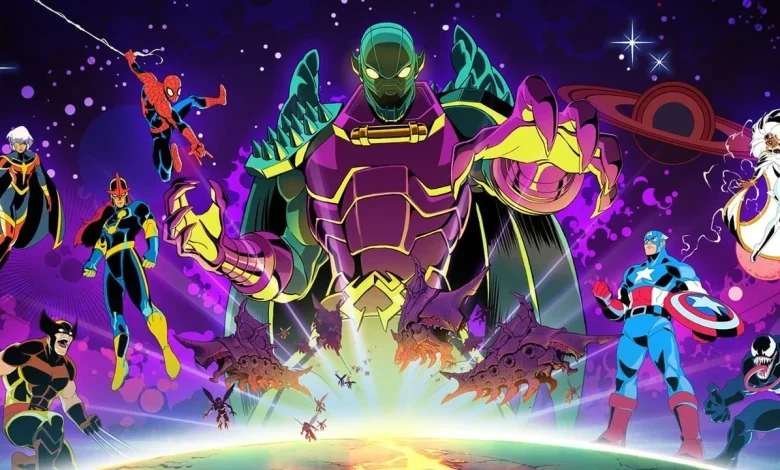
It’s been over three years since Teenage Mutant Ninja Turtles: Shredder’s Revenge was released, and Tribute Games has been really busy. Stuffed like a return-trip suitcase, Marvel Cosmic Invasion’s enormous cast of heroes and villains is here united in a rapturous beat-’em-up fanfare. Its pixel art positively simmers, with beautifully rendered backgrounds, giant set-pieces, and solid, impressively animated sprites. And, in addition to primary antagonist Annihilus, nemeses like Galactus, Hela, and Thanos make sufficiently heavy-duty appearances.
What’s particularly endearing is that the production feels wholly comic book. Its story mode, fleshed out with superbly rendered cutscenes and spot-on voice acting, really honours the source material. From Wolverine’s growl to Spider-Man’s quips, Venom’s brusque manner to Nova’s heroic fortitude, the exchanges really capture the Marvel feel. The slightly squat sprite styling works well, too, and the soundtrack is on-point throughout.
Captured on Nintendo Switch (Docked)
Outside of palette swap options, there are no Marvel movie elements here, and the roster is interestingly formed, teaming up the likes of Captain America and Iron Man with lesser-knowns like Beta Ray Bill and Phyla-Vell. In total, there are a whopping 15 playable characters, several of whom are unlocked during playthroughs.
Any modern scrolling beat ’em up worth its salt requires a creative and dynamic combat system, and Cosmic Invasion rises to the challenge with a dual-character tag-team setup. In Story Mode, you choose a fresh duo each time you begin a stage, selecting your destination of choice via a bullet-pointed map that runs along branching paths. Certain stages need to be beaten before you can progress, and finishing a stage will level up your team with increased power and health.
Story Mode also comes with a set of optional Challenges. These include tasks like defeating a set number of enemies with a specific move or finishing a boss with a specific character. The challenge list shows which heroes properly align with a stage’s cutscenes and narrative. Characters that are narratively required for each level have glowing boxes around them on the select screen, too, although that could be signposted better.
Captured on Nintendo Switch (Handheld/Undocked)
Arcade Mode operates in true linear fashion: your initial character choices remain fixed for the entire game, there’s no levelling up, and you’re restricted to a limited number of stages across optional routes. For many, this will be the most enjoyable way to play.
The cast’s fighting properties are amazingly varied, with differing speeds and weights, and enough unique attack forms to make each one feel interesting. Some can fly with a double-jump tap, patrolling the air, while others, like Rocket Raccoon, dominate from range with heavy artillery. Each wields a basic tap combo, a double-tap rush attack, and a dodge or block that, when timed right, enacts a parry. Every character can charge a unique breakout move, and the ‘X’ button lets loose their special attack. The ‘R’ button is reserved for big, flashy supers, requiring a “Focus” energy that recharges while battling.
Second Opinion
I’m at the end of my first Cosmic Invasion playthrough, and I am simply having a marvellous time with it on Switch 2. Each character’s moveset feels unique, the level challenges are encouraging me to check out the full roster, and the returning cartoon voice actors tickle every bone in my nerdy little body.
Switch 2 performance is just as smooth as on older hardware (which is pretty damn smooth), and the sprite work looks gorgeous both handheld and docked. There’s also local GameShare if you want to bring a nearby pal along for some separate-screen action, and though I wish that extended to online, there’s no denying that couch co-op is where it’s at.
Jim Norman
Staff Writer, Nintendo Life
Tag-teaming works entirely around the left trigger. Tapping switches characters, who can swing in and break you out of holds. You can also combine attacks, whereby pressing the trigger mid-combo will have your partner appear alongside you, dealing out extra blows. Interestingly, you can combine the tag function with different buttons, creating different partner effects like aerial dives or rushing slashes. All tag battling eats into your Focus energy, a point to consider if you’re trying to build a team super: a devastating dual attack engaged with ‘ZL’ and ‘R’ that requires maximum Focus for both characters.
Cosmic Invasion is flashy and superbly slick, and mining all the little details is quite the adventure. There’s not much included in the rather threadbare tutorial, so it’s down to you to experiment, discovering which grabs can be turned into throws with D-pad combinations, and which characters have functions that respond to simultaneous button presses. The fastest hack here is to hit pause and read through your character’s movelist.
In a world post-Absolum, Cosmic Invasion doesn’t quite land in the same way Shredder’s Revenge did. While it does get furiously heated, its pace does feel a tad slow overall. What’s surprising, though, are the numerous oversights in the visual feedback department. The map points on Story Mode, for example, don’t change colour when you clear a stage or complete its challenges, and post-toilet break it can take a moment to recognise which you just did.
Captured on Nintendo Switch (Docked)
Tribute Games clearly aren’t fans of prominent combo counters either, which is a shame as Cosmic Invasion seems to be crying out for one. Here, the combo counter is small, tame, and seated inconspicuously beside your health bar. As such, your building of blows isn’t as rewarding, and, being a comic-book-themed game, classic onomatopoeia or “Dazzling!”, “Amazing!”, or “Super!” would have been the perfect way to celebrate combo milestones.
The feedback element that really needs bolstering, though, surrounds the tag mechanic. With so many different usage combinations, some additional visual, aural, or haptic cues to delineate each state would have been helpful amidst the game’s flurrying pyrotechnics. For example, a short pad vibration upon engagement, and perhaps character colour flashes could give some idea of how much Focus energy is being consumed. And, as the tag function can be combined with different buttons for different dual attack types, some kind of visual feedback to articulate each state wouldn’t have gone amiss.
Captured on Nintendo Switch (Handheld/Undocked)
It’s not the end of the world, but your tag mechanics tend to get drowned out in the fighting stew, lacking a sense of tactility. For your mammoth dual super attack, too, any kind of wind-up effect or chime would have been welcome, just to let you know you’re primed to go. Additionally, recovering the secret green cubes hidden on each stage is so perfunctory it’s like a fart in the wind. There’s no indication it even has value, no message screaming “Cube Recovered!” or the like. In fact, it’s quite possible to pick one up accidentally without realising it.
These aren’t criminal offences, and they certainly don’t diminish the effort involved. But anyone who understands arcade games knows that good feedback aspects can really elevate the experience. As such, while impressively deep with its dodging, parrying, and potential for wild mix-ups and tag-team juggling, Cosmic Invasion’s combat doesn’t feel quite as satisfying as something like Streets of Rage 4, the recent Absolum, or even Shredder’s Revenge, which was a touch more honed in the battling department.
The more overt problem with Cosmic Invasion, though, is its difficulty balancing. Credit-feeding arcade games robs them of their value, largely because of their routine nature, and a lack of challenge has a similar effect. For some reason, Cosmic Invasion’s default Medium difficulty setting is a total cakewalk. Bosses, whose attack patterns are often thoughtfully designed, go down to first-attempt spamming in all but the last few stages. Health items are scattered all over, and being able to tag characters, regularly deploy super attacks, and regenerate not only Focus but your health too, actually makes the campaign a tad mundane. It’s much like the Marvel movies themselves in this respect: when there are no stakes, you start to switch off.
Captured on Nintendo Switch (Docked)
Now, there is a Hard Mode, but it isn’t available from the outset. Instead, you need to earn cubes to be spent on a hexagonal grid, unlocking additional character palettes and other in-game adjustments. For your information, you want to go right to the top middle of the hexagon and unlock that Hard Mode option, because frankly, it’s transformative.
Playing Arcade Mode on Hard Difficulty suddenly makes Cosmic Invasion both reasonably challenging and, with it, far more interesting, requiring thought and skill over mindless button mashing. All aspects of your moveset take on genuine importance, with different enemies and situations demanding experimentation — and the dodge and parry become crucial. While, in my opinion, the default difficulty should have been set somewhere between Medium and Hard Mode — and that means Tribute Games didn’t quite get either quite right — Hard Mode is still the place to go lest things get boring.
Captured on Nintendo Switch (Handheld/Undocked)
Now, if you’re primarily here for the multiplayer aspect, all this challenge criticism goes out the window. With friends, it’s just a blast, even if the four-player is a little too chaotic, all things told. In terms of delivering campy Marvel magic, however, in which iconic superheroes smash iconic supervillains, Cosmic Invasion comes through with flying colours.