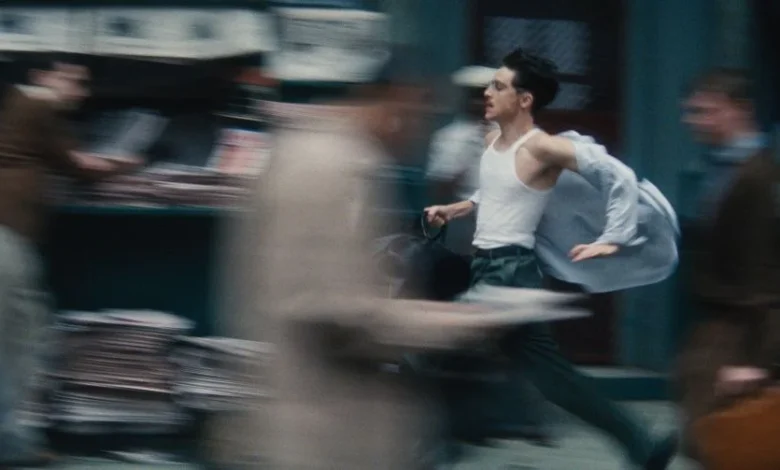
From the very beginning of “Marty Supreme,” Josh Safdie wants to confuse you a little. It’s a film set in the ‘50s, filmed with a movie language that’s incredibly reminiscent of the jittery character studies of the ‘70s, all set to a backdrop of ‘80s needle drops by Public Image Ltd., Peter Gabriel, and Tears for Fears. The displacement is intentional, a way to subconsciously disorient the viewer, putting them in the shoes of a character who’s never quite where he thinks he belongs, someone flung out of time.
Safdie employed similar techniques with his brother on “Uncut Gems,” another propulsive drama about a man who looks uncomfortable in his own skin, a shark who’s convinced he will drown if he stops swimming. Safdie’s daring choices merge with the best performance of Timothee Chalamet’s career for a story of a man who thinks he’s the best in the world at something, and that thinking is as important as actually being it.
Chalamet plays Marty Mauser, a ping pong champion who barely makes ends meet working at a NYC shoe store. That’s where he sleeps with an old friend and neighbor named Rachel (Odessa A’zion), who’s married to a Stanley-esque brute named Ira (Emory Cohen) but is clearly in love with the captivating Marty. After what is basically a prologue, Marty takes off for a ping pong championship, where he tries his best to live as large as possible, including upgrading his room to the Ritz and trying to pin the blame on the organizers of the event.
That’s where he spots former box office queen Kay Stone (Gwyneth Paltrow) walking through the lobby, and he’s instantly drawn to her star power, even if it’s somewhat faded. Marty talks his way into Kay’s life (and bed) through sheer bravado, even trying to coordinate business deals with Kay’s husband, Milton (Kevin O’Leary of “Shark Tank” fame), while he sleeps with his wife. When he loses the championship and becomes a joke in Japan as the “Defeated American,” he returns to New York in debt, having to rebuild his ego and reputation, at whatever cost. And then he discovers Rachel is pregnant.
Safdie circles Marty with unexpected, familiar faces designed to provoke a response. It’s not entirely stunt casting, but Safdie knows what O’Leary is famous for, making his business-driven decisions another aspect of the film that’s just left of center. Famous New Yorkers dot the scenery from stars like Sandra Bernhard & Fran Drescher to filmmaker Abel Ferrara and local legend John Catsimatidis. Tyler Okonma (aka Tyler, The Creator) is excellent in a few scenes as Marty’s partner-in-hustling; Penn Jillette is almost unrecognizable, late in the film. It’s a consistently inspired piece of work from the casting director that leans into the unpredictability of the narrative in that you have no idea who’s coming around the next corner.
Of course, the film belongs to Chalamet, who fully captures the kind of guy who thinks confidence is currency. He doesn’t just refuse to take no for an answer; he never stops to think before he speaks, often shutting doors that others are trying to open for him through his big mouth. He gives a performance reminiscent of ’70s Al Pacino, playing the guy who’s the most fascinating and annoying person in the room at the same time. Leaning into the temporal displacement mentioned above, it’s almost as if Marty is an ‘80s shark stuck in the ‘50s. What if Jordan Belfort were born a generation too early? It was ping pong for Marty 70 years ago; it would probably be Bitcoin today.
It’s an idea that flourishes in the storytelling, too, in that Safdie and co-writer Ronald Bronstein are almost telling an origin story not just of American business but of the way toxic bravado became part of the American reputation around the world. At first, Marty refuses to do the travel circuit of ping-pong sideshows and acts that perform at halftime of shows like the Harlem Globetrotters, but he eventually relents. Sometimes you have to play ping pong with a seal to get ahead. He may just be a ping pong prodigy, but he’s also a vision of the aggressive American businessman, a fast-talker who’s not content to just dominate his corner of the world—he needs the whole planet. And will do whatever it takes to vanquish his international enemies.
Two excellent supporting performances balance Chalamet: A’zion could have disappeared into a loyal girlfriend role, but she imbues Rachel with her own kind of confidence, the kind that comes from knowing someone like Marty for so long that she doesn’t just see through his act, she knows how to enable him to the best version of himself. Paltrow avoids the cliché of the fading star, subtly finding the truth of a woman who needs to be loved, whether it’s by a crowd on opening night or the ping-pong player who love bombs her. She has a beautiful moment that washes over her face when she hears theater goers respond to her entrance, just one of several smart choices throughout “Marty Supreme,” a movie that feels big but succeeds through hundreds of small decisions.
Finally, “Marty Supreme” doesn’t work without two key collaborators: Darius Khondji and Daniel Lopatin. The legendary cinematographer behind films like “Seven,” “The Immigrant” and so much more gives “Marty” a jittery, sweaty visual language as if the camera itself is struggling to keep up with the protagonist (an aesthetic enhanced by Safdie & Bronstein’s ace editing work too) while Lopatin’s pulsing score, along with the crazy needle drops, becomes a character itself. I nearly levitated when the Peter Gabriel track kicked in.
A reductive shorthand for “Marty Supreme” will be “Uncut Gems with ping pong,” and the two films do share a filmmaking language intended to shake viewers. Still, this movie is no mere echo of Safdie’s former collaboration with his brother. It is unlike anything released this year, a riveting study of a man who fully believes it when he says, “I have a purpose. You don’t. And if you think that’s some kind of blessing, it’s not.”
“Marty Supreme” is a story of a guy burdened by how great he thinks he’s supposed to be. How very American.