‘Marty Supreme’ Review: Timothée Chalamet Sure Plays a Mean Ping-Pong in a Role of Singularly Enervating Intensity

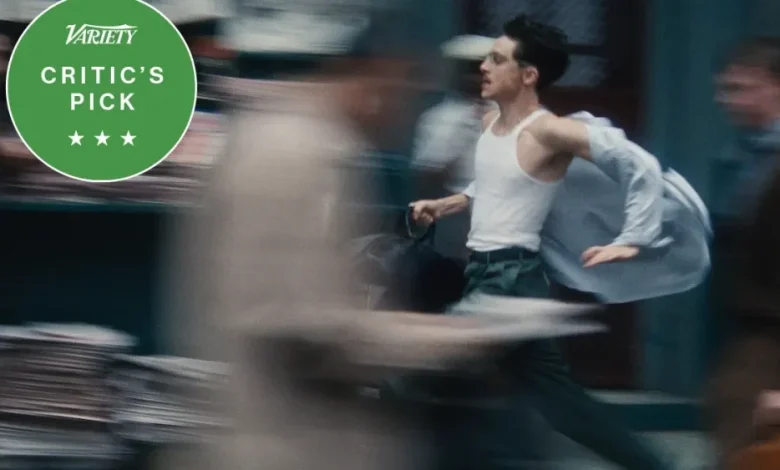
Built like a two-by-four with acne scars, freckles and a pencil mustache, Marty Mauser is simultaneously blessed and cursed with absurd quantities of unearned self-confidence. The movies have rarely given us such an entitled underdog, and it’s both mesmerizing and maddening to watch this arrogant table-tennis prodigy ricochet from high to low for nearly two and a half hours. In the defining performance of his still-burgeoning career, Timothée Chalamet — aka “Marty Supreme” — makes you want to believe in this instantly iconic character too … even if sometimes you also want to strangle him.
The year is 1952, and hardly anybody (apart from Marty) takes “ping-pong” seriously. Few would even call it a sport. But Marty is convinced that table tennis is his life’s calling, hustling for a chance to prove it over the course of 149 incredibly stressful, undeniably exhilarating minutes. Within that rip-roaring running time, director Josh Safdie volleys audiences from the grotty tenements of New York’s Lower East Side — the Jewish neighborhood Marty calls home — to a swanky room at the Ritz hotel in London, to a climactic match in Tokyo.
Loosely inspired by midcentury table-tennis sensation Marty Reisman, a slender showman known as “the Needle,” Chalamet’s character is the most charismatic person in any room. Eyes blazing beneath a bushy unibrow, his cover-boy allure only slightly muted by geek-chic specs and made-up blemishes, Marty seems to have four arms and an extra brain. How else to explain the speed of his return, whether in table tennis or everyday conversation? Marty’s got the moves, but is beaten all the same. Instead of graciously accepting defeat, he demands a rematch with the Japanese champion Koto Endo (Koto Kawaguchi), whose cool discipline and focus seem the polar opposite of Marty’s atomic-meltdown energy.
For 15 years, Josh Safdie and his older brother, Benny, were the demented cooks behind such almost-real-time anxiety-attack thrillers as “Good Time” and “Uncut Gems.” Now, in his first solo directing effort since 2008’s “The Pleasure of Being Robbed,” Josh answers which half of the duo is the better filmmaker. Earlier this year, Benny (a gifted actor) released “The Smashing Machine,” an Oscar-baiting wrestling biopic that tapped out almost immediately, while Josh put his brain together with screenplay collaborator Ronald Bronstein and came away with one of the year’s few masterpieces.
While putatively packaged as a sports movie, “Marty Supreme” uses the compulsive drive of its Jewish American wunderkind to mirror the country’s post-war emergence as a global superpower — in which national pride, capitalism and good, old-fashioned moxie are unfettered by the slightest self-doubt. Where others might suffer an inferiority complex or the impostor syndrome, Marty has blind faith in his ability to return whatever life serves him. The guy can spin his way out of practically any predicament.
After strategically world-premiering at the New York Film Festival, “Marty Supreme” makes its way into awards season, having already drawn fawning comparisons to J.D. Salinger’s 1951 novel “Catcher in the Rye” — though Marty actually has more in common with Ferris Bueller than with Holden Caulfield. Safdie and his decade-older co-writer are children of the 1980s, which explains not only the film’s coked-out intensity (presumably inspired by films such as “Something Wild” and “After Hours”) but also the semi-ironic selection of period-incompatible power anthems so effectively complemented by Daniel Lopatin’s erratic-pulse score.
Cranked up to 11, the synthesized chimes of Tears for Fears’ “Change” blast straight out of the gate, lending the kind of galvanic kick normally reserved for the nail-biting finale of a sports movie. Marty is a round-the-clock hustler. Working at the family shoe shop, he pretends not to have a client’s desired size in order to upsell her on a more expensive pair, deceiving first the customer and then his boss/uncle (Larry Ratso Sloman) as he sneaks sometime-girlfriend Rachel (Odessa A’zion) into the backroom for a risky quickie.
Cue another ’80s classic, “Forever Young,” as Safdie cuts to a “Look Who’s Talking”-style close-up of Marty’s sperm flooding her cervix. It’s a cheeky sequence that forecasts the complications ahead, since Rachel happens to be married to Marty’s neighbor (a Stanley Kowalksi-esque Emory Cohen), even as it reminds that Marty’s entire life has been a contest, starting with the lucky gamete that won the lottery of his own existence. His dad is no longer in the picture, while his mother (Fran Drescher) is something of a con artist too — like all the film’s characters — constantly spinning lies to get her son’s attention.
The central conceit of “Marty Supreme” is that despite the title character’s preternatural racket skills, hardly anyone respects his near mastery of table tennis. If the equivalent story were set in 2025, Marty might be a video game wizard or a sudoku samurai. Nobody cares, except for the motley collection of gargoyles at the underground table tennis club where he practices — one of the many intimate, dark-shadowed spaces enhanced by “Se7en” DP Darius Khondji’s eye-of-the-tornado aesthetic.
Without the moral support of his family, Marty has it tough trying to raise the funds to attend the British Open in Wembley, London. His mom wants him to stick to a real job. His uncle withholds his pay, hoping Marty will stay on as manager. And Rachel (later, once she starts to show) hopes he’ll settle down and take responsibility for their unborn bundle of joy. Instead, Marty grabs a pistol from the shoe-shop desk and demands what he’s owed at gunpoint.
That’s the thing about Marty Mauser: He never takes no for an answer. And because he believes he’s the best, Marty feels justified in achieving his goals by any means necessary — the rules do not apply. That goes for table tennis (which occupies an inordinate amount of the movie) as well as other pursuits (which yield more indelible drama), like seducing faded movie star Kay Stone (Gwyneth Paltrow). Marty has seen none of her movies, but the challenge of wooing her electrifies him.
Standing on his hotel bed in a trenchcoat and boxers — an image that defines this impetuous kid, playing grown-up in a world he only half-understands — Marty places a call to Kay’s room, fast-talking her into attending his match the next day. We can hear her businessman husband (“Shark Tank” panelist Kevin O’Leary, perfectly cast as the smug face of American industry) in the background. Seeing them later at the Ritz’s restaurant, Marty offers to pick up the check for the man he’s cuckolded.
He’s shameless that way, though some find him charming. That contradiction is Chalamet’s to sell: Whether giving outrageous quotations to journalists (“I’m like Hitler’s worst nightmare”) or defending the “honor” of his assorted mistresses (never mind their marital status), this kid is pure id, a cocky celebrity many want to be — or be with — but even more want to punch.
In lieu of glamorous faces and over-recycled character actors (the sort of predictable types we once associated with “central casting”), Safdie populates the film with refreshingly authentic-looking individuals — memorable mugs, like those of his lanky co-worker Lloyd (Ralph Colucci) and paunchy accomplice Dion (Luke Manley), who’d be right at home in the kind of outsider comics drawn by R. Crumb or Harvey Pekar. Paltrow’s a star, but that tracks because she’s playing one. Plus, it takes an actor of her ability to access the compromise and disappointment Kay feels: When Marty thinks he’s scored with her, he’s only half-aware of the game she’s playing with her callous spouse.
Back in New York, following Marty’s unimaginable defeat in London, Abel Ferrara appears as a scuzzy street-level gangster who entrusts Marty and his taxi-driving best friend Wally (Tyler Okonma) with his near feral dog. A master improviser, Marty sees it as yet another get-rich-quick scheme, though this one comes with potentially lethal repercussions. Over the course of his career, Safdie has given us no shortage of endearingly flawed antiheroes. In “Uncut Gems,” Adam Sandler’s character had no idea how close he was cutting it. For those who experienced that film’s shock ending, “Marty Supreme” assumes an extra dose of danger.
After losing to Koto in London, Marty must get to Tokyo to recapture the title — to protect his ego, if nothing else. Doing so will take every whisker of ingenuity he has, along with the help of both women in his life. In A’zion’s hurricane-force Rachel, Marty meets his match: a woman who thinks every bit as quickly on her feet as he does, fooling even him at times. Through it all, Marty remains a fundamentally callow character. More than his pride, Marty’s self-centered immaturity is the source of his hubris, and seeing him humbled (with a wooden paddle, no less) proves an especially satisfying form of schadenfreude.
Are we rooting for him to win, or hoping this whirlwind of triumphs and humiliation might cure Marty of his notion that no one else matters? Whereas victory elevated his Japanese rival to national-hero status, it’s all those setbacks that ultimately make Marty a better man.