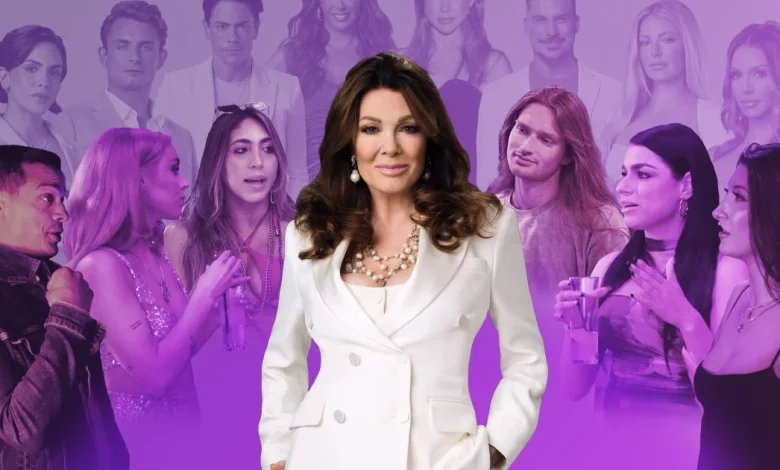
Could it be? Are we about to experience the best days of our lives (again)?
On a rainy Wednesday afternoon earlier this month, West Hollywood’s SUR (an acronym for Sexy Unique Restaurant, in case you still haven’t committed it to memory) is three hours away from opening its doors to fulfill another night as a fried goat cheese ball factory and selfie backdrop for Bravo superfans. But some members of its staff, dressed in the restaurant’s black and mauve uniforms, are already ping-ponging through the space during a shift for their other high-profile side gig.
This new group of unknowns is the next generation of Bravo’s “Vanderpump Rules.” They’re in the middle of a press day inside the tourist hot spot, which, at the start of the show’s run, had been the epicenter of where drama spun out from — and they’re on the brink of either injecting new life into a strained reality franchise or being another example of a reboot gone wrong.
“I bartend tonight from 6:30 p.m. until 11,” Venus Binkley says, with an exaggerated eye roll, as he settles in for an interview. “I don’t want to work. I hate working. I want to do anything other than work. If you’re here, you’re here to be a star.”
A spinoff of “Real Housewives of Beverly Hills,” “Vanderpump Rules” launched in 2013, giving a peek into the messy and absurd shenanigans of SUR’s youngish waitstaff who all dreamed of life beyond the lounge’s ornately-decorated walls. Like the wives before it, the show made household names of its cast — Ariana Madix, Katie Maloney, Scheana Shay, LaLa Kent, James Kennedy, Raquel Leviss and the two Toms (Schwartz and Sandoval); Stassi Schroeder, Kristen Doute and Jax Taylor, too — at least, in Bravo-watching homes.
The former fried goat cheese ball slingers during a “Vanderpump Rules” reunion special, from left: James Kennedy, Kristen Doute, Tom Schwartz, Katie Maloney, show host Andy Cohen, Lisa Vanderpump, Jax Taylor, Scheana Marie, Tom Sandoval and Ariana Madix.
(Bravo / NBCU Photo Bank / NBCUniversal)
Now it’s the latest show from the network to undergo a reset, completely overhauling its cast after an awkward 11th season filled with tension that came in the aftermath of an explosive cheating scandal involving Madix, Sandoval and Leviss. Dubbed “Scandoval,” it quickly (and unexpectedly) became mainstream news, propelling the cast even further away from their beginnings as stardom-chasing servers and the fun, petty drama that made them so compulsively compelling to watch. But by the end of Season 11, the cast dynamics were too broken to make for a pleasurable viewing experience.
“We hit a stride with ‘Vanderpump Rules’ — it was nominated for three Emmys,” says the show’s namesake, Lisa Vanderpump, formerly of “The Real Housewives of Beverly Hills” and co-owner of SUR. “The show was rocking. But where would we go with it? It was fractured. So many people didn’t want to film with each other, their stories got quite heavy. Loss of business, marriages or infidelity. It wasn’t the same feeling anymore.”
“They were in their 20s,” she adds. “They were cavalier and they were naughty and they were learning. They got to an age where it was time for them to know better.”
In the end, the former cast ranged in age from nearly 30 to mid-40s. But the new cast? They’re in their 20s, cavalier, naughty and learning. Many are eager to find fame. Many were viewers of the original series.
Binkley is a server of three years at SUR whose long mane is its own supporting character and whose confidence is front and center (“I don’t think that there’s anyone like me. I’ve been waiting my whole life for the world to see me and see how I shine”), and is among the new crop vying for the spotlight. Others include Demy Selem, the longest tenured employee among the group who joined SUR eight years ago as a server and is now the assistant manager; Marcus Johnson, a server who moonlights as a DJ; Kim Suarez, a server and Marcus’ girlfriend who questions whether some of his friendships are truly platonic; and Natalie Maguire, the lead bartender at SUR who is at the center of some drama from the start.
The revamped cast of “Vanderpump Rules” includes SUR-vers Chris Hahn, left, Natalie Maguire, Audrey Lingle, Marcus Johnson, Demy Selem and Kim Suarez.
(Casey Durkin / Bravo)
“I’ve lived in L.A. since 2015, and I’ve always been modeling and working in restaurants like Cheesecake Factory,” says Johnson, who pursued a job at SUR at the urging of a family friend. “Never in my thoughts of working here did I think I would be on a reality show. All I can do is be myself. I could try to put on a show and try to paint a picture that I want people to perceive me as, but that’s not going to work.”
Maguire says she’s trained her whole life to sing and act: “I’m in L.A. to pursue that,” she says. “This is a survival job, but we’re all here to find success, whatever that means.”
Later in the week, over lunch at a nearby restaurant — the view of SUR’s infamous alleyway less than 100 feet away — the show’s executive producer Alex Baskin spoke to The Times about why the show is continuing, the search for a new group of unknowns to carry the torch and returning to SUR as a backdrop to the chaos. This interview has been condensed and edited for clarity.
When did it become clear to you that “Vanderpump Rules,” in its previous iteration, was no longer going to work?
We were on parallel tracks with thinking through what another season of “Vanderpump” would look like, while also exploring what we had to work with at SUR. And it wasn’t one to the exclusion of another, because clearly if the original “Vanderpump” [cast] came back, it probably would be for a final season. We considered different iterations of the show. One that some of us favored, including me, was potentially to do a shorter season where you didn’t necessarily get the entire cast together unless it were warranted, and you almost did the equivalent of epilogue cards for each of the cast members. That felt like that might be a nice send-off. Ultimately, it didn’t feel like it was needed. We landed on doing a special instead. At the same time we were exploring what we were going to do with the OGs, we came upon an exciting new group at SUR. So we thought, what if we pass the torch? The interest in the show and the show’s numbers demanded that we consider another season and see what that would look like. But no one involved wanted to do a season that wouldn’t be satisfying, and I think you have to know when to leave the party.
To that point, was there thought of just ending it altogether? Why did it make sense to do a reset?
The casting that we did made us all feel a lot better about it. As much as that IP has value, I think that only gets people to give it a chance. We can win skeptics over who are thinking, “What are you doing to the show that I love so much?” We thought that we had the goods for a show. The returns on that group made us think that we should invest in this and that we could grow a new crop. We didn’t endeavor to make the same show.
What was it like delivering the news to the cast? Who fought to try to keep it going?
I had tried to telegraph to the group that coming back was not a given, and I think the fact that a long time that elapsed also made that clear. The disappointment was most acutely felt in a few people, including Tom Sandoval. I think Tom thought that there was another season in the show. It was a different situation for those that were moving over to “The Valley.” Ariana had obviously moved on — and Ariana graciously heard out all of the conversations. It was a little bit different for everyone. But by and large, everyone thought the run was over.
SUR co-owner Lisa Vanderpump with new cast members Audrey Lingle and Venus Binkley.
(Casey Durkin / Bravo)
Previous attempts to introduce new cast members on “Vanderpump Rules” weren’t always well-received. What lessons did you learn from that?
It’s different when you are rounding out an existing group, versus everyone jumping into the deep end together. We were tapping into a group that is going through a life phase together that has a lot in common from that standpoint and is willing to let us in fully and completely — and that includes people who happen to have done some television before, people who are complete newbies, but really the nucleus of it is SUR. It’s going back to our basic principles.
When we were introduced to the original “Vanderpump Rules” cast, they were the L.A. archetype — young adults working at a restaurant to pay the bills while having ambitions to be famous actors, singers or models. Most of these new cast members pursued jobs at SUR, seeing that as a way to break into the industry. How does that shift the essence of the show?
For years and years, there were people working there, and they never got their moment in the sun, but it still stands to reason that you would have more visibility there than you would at another restaurant nearby. We’re also dealing with an age cohort that consider fame, in and of itself, a goal, whereas it used to be that fame was the result of something else that you did. Now it’s a commodity in its own right, and I think that we have to accept that. What I’ve found is that there are different types of influencers and creators, and there are some that are probably not as made for this kind of television because they more readily take to having control and curating their image. That’s not this group, and that’s why this show works.
Server Marcus Johnson, lead bartender Natalie Maguire and assistant manager Demy Selem in a scene from “Vanderpump Rules.”
(Casey Durkin / Bravo)
How did you decide on the cast?
We spent a little bit of time there, and Lisa, along with co-owners Nathalie [Pouille Zapata] and Guillermo [Zapata] had some thoughts. We allowed anybody who worked there to have a conversation with us and potentially come in for an interview. The fun part of the casting process, especially when casting is a closed circuit and it’s a pre-existing group of people, is you start to unpack all the relationships, and the show emerges. That’s what happened when we were pitching the original “Vanderpump Rules.” There’s a now notorious diagram that we included in the pitch that just had lines going between the cast members just to define the relationships. And because the relationships were so complicated and messy, you really could only see it visually. We did the same thing here and that helps sort out who it should be because it isn’t just about all the requisite qualities of an individual. They also have to be connected.
Natalie, for example, is very reactive, and in the best sense for us, has a big mouth and has a great attitude for television; she’s a tough cookie. Clearly, Marcus doesn’t suffer from self-doubt. Venus is a very distinct and memorable personality. There’s a bunch of them that elicit strong reactions, but genuinely just by being who they are, nobody was putting it on.
You also have two people who have done reality before — Chris Hahn and Jason Cohen, who’ve appeared in Netflix’s “Dated and Related” and “The Perfect Match.” Why?
The restaurant was figuring out their staff at the same time we were thinking about the cast. Anyone they met with, they sent our way, and if we came across anyone that we thought might work for us, we had them meet with them. You had to commit to working at the restaurant. We outright own the fact that we have a couple cast members that have been on television before; we don’t make any bones about that, but the bottom line is, they work at SUR and they hold those jobs.
Lisa Vanderpump and Jason Cohen, who has appeared on reality TV before.
(Casey Durkin / Bravo)
But how do you balance that? The intrigue with reality TV was its novelty and watching people reveal their authentic selves. How do you find the authenticity that made the original “Vanderpump Rules” cast so compelling to watch?
Over enough time on these shows, anyone who thinks they can control and curate the experience is broken down enough by not being able to do it. It can be a struggle. We try in the pre-screening and in all of our conversations to make sure that people know what they’re signing up for, and that we know what we’re getting — that it’s someone who isn’t coming into this solely because they think this is a great platform and they’re using it as a marketing tool. If you’re doing a show these days about anyone in their 20s, they’re going to have a presence on social media; whether or not it’s something they do professionally, it’s something they do personally, and they do it with skill. That’s different than it was in the prior generation. I don’t think that’s disqualifying, but I think it comes down to what someone’s mentality is coming into this, and whether or not they intend to be open.
In the scripted world, a reboot typically has viewers quick to make comparisons about which new person is like which previous person. Were you thinking in terms of archetypes when casting?
It was really important to us not to think in those archetypes, and we never referred to them in casting. Before there was Jax Stassi, there was not Jax and Stassi. No one knew them, people had to fall in love with that show in the first place. Now they have to do it again. The shortest distance for us to make them do it is to entertain them, and not to make them forget the original. We honor the original. We made other decisions along the way — we thought that maybe we would have some of the original group make some appearances. And ultimately, we didn’t go in that direction, because we don’t need a “Saved by the Bell: The New Class.” Although, Schwartz does come in for a second because he happened to be at TomTom.
We’ve seen attempts to reboot other Bravo franchises, namely “The Real Housewives of New York City,” that didn’t really land. How much did that create debate about carrying out this vision?
We always knew doing this was a tall order. We are well aware of how beloved the original was, and we knew that when we announced we were doing this, we had to also announce all of it at the same time. There’s the challenge of that, because to a core group who have been so faithful and so loyal to us, we are, in some ways, disappointing them. But I would say that’s until they fall in love with the new group.
I think there are differences between rebooting this and some of the other series. “The Real Housewives of New York” presented a different set of challenges than I think this did. We’re going back to anchoring this in the restaurant and people who work there.
How will you gauge whether this reboot is successful? Linear ratings don’t tell the whole story, streaming numbers can have different internal goals.
My current pet peeve is everyone on social media posting linear ratings and comparing them to the season before. Spoiler alert, they’re going to be awful. We’ll get a sense of the Peacock numbers. The big thing will be: Where does it land over time? Where does it go across the season? If it grows, that’s a great sign. That, to me, has to be the metric of it.
What has animated us has been we want to defy the naysayers. No one is going to think, “Oh, thank God. I’m so excited to meet this faceless group.” But over time, we want to win them over. We were very heartened by the reaction at BravoCon with the first two acts [of the premiere that screened for attendees]. And relevance is really important — are people online talking about it?




![2025 Jiangxi Open: Tagger [235th] vs. Zhu Prediction, Odds and Match Preview](https://cdn1.emegypt.net/wp-content/uploads/2025/10/2025-Jiangxi-Open-Tagger-235th-vs-Zhu-Prediction-Odds-and-390x220.webp)